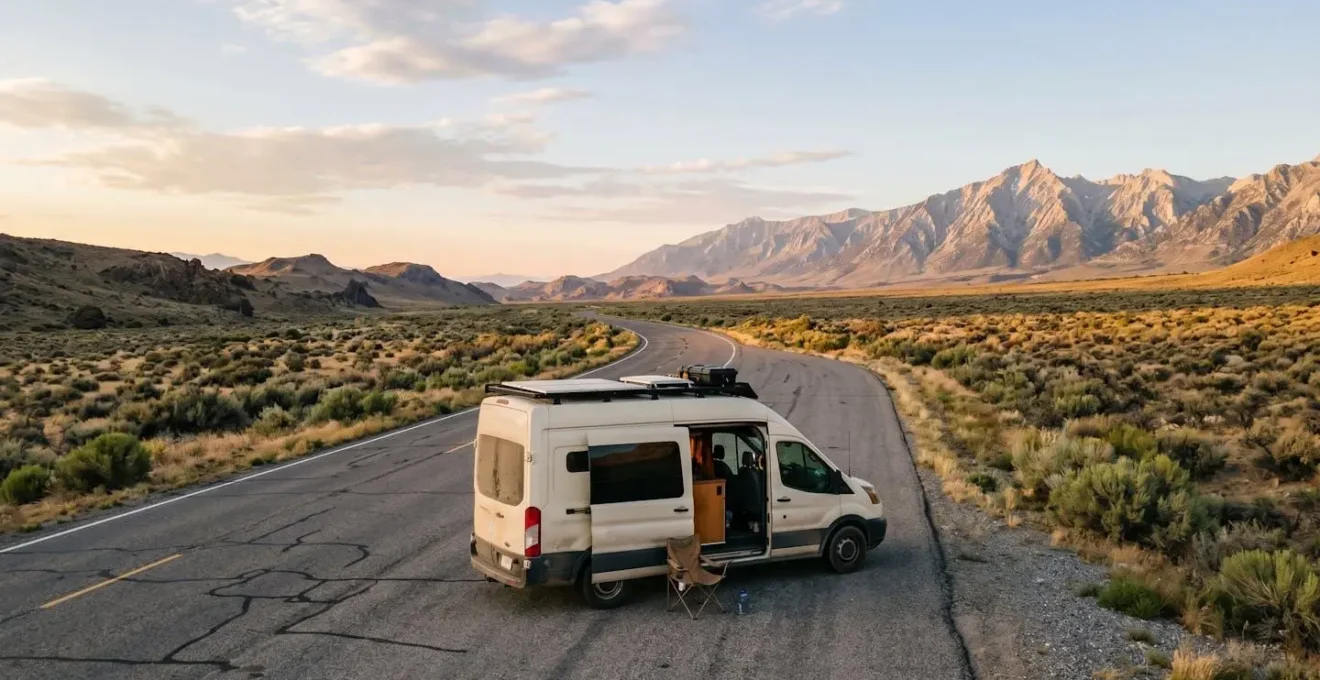
Success in nomadic culture is not about what you own or where you are, but about mastering the art of building a home within yourself.
- It replaces the currency of possessions with the social currency of shared experiences and mutual trust.
- It requires navigating the paradox of deep connection in transient communities and an identity crisis when bureaucratic norms collide with a life in motion.
Recommendation: To embrace this philosophy, one must shift their focus from accumulating stability to cultivating resilience and a portable sense of self.
What constitutes success in a world that measures it by the size of our homes, the stability of our careers, and the permanence of our roots? For a growing movement of modern nomads, these metrics are not just irrelevant; they are obstacles to a deeper, more fluid form of achievement. To the outsider, this life appears as a collage of scenic Instagram posts and carefree liberty. But this view mistakes the symptom—mobility—for the cause. The nomadic impulse is not about escaping a place, but about a radical recalibration of life’s operating system.
Many discussions about this lifestyle get caught on the surface-level benefits of “freedom” or the minimalist aesthetic. They offer tips on packing light or finding Wi-Fi in remote places. But they rarely delve into the profound philosophical shift required to thrive. The true challenge and reward of a nomadic existence lie in deconstructing the very idea of “home” as a geographical location and re-engineering it as an internal state of being. It’s about learning to build a sense of belonging that is portable, cultivating relationships that value depth over duration, and forging an identity that is not dependent on a postal code.
This is where the real work begins. If success is no longer a ladder to be climbed within a stable structure, what is it? It becomes a measure of one’s adaptability, resilience, and capacity for connection in a state of constant flux. It is a success defined not by accumulation, but by the richness of one’s experiences and the strength of one’s inner anchor in a world of shifting tides. This is the currency of the new nomad.
This article will explore the architecture of this alternative definition of success. We will examine the economic and psychological shifts that prioritise experiences, the methods for building community amidst transience, the collision with bureaucratic identity, and the profound act of reconnecting with culture through the simple act of choosing the slower path.
Summary: The Nomadic Recalibration of Success
- Why Nomadic Communities Prioritise Experiences Over Possessions by 80%
- How to Build Meaningful Connections in Transient Nomadic Communities Without Loneliness
- Traditional Nomads vs Modern Digital Nomads: Which Movement Shares Deeper Cultural Roots?
- The Identity Crisis Vanlifers Face When Home Address Becomes a Vehicle Registration
- When Nomadism Ends: Reintegrating Into Settled Society After Years Travelling
- When Vanlife Becomes Unsustainable: The 3 Burnout Warning Signs to Recognise
- Why Single-Track Roads Reveal Traditional Farming Communities Better Than A-Roads
- How Rural Routes Reconnect You With Authentic Regional Culture
Why Nomadic Communities Prioritise Experiences Over Possessions by 80%
In settled societies, possessions often act as a shorthand for success—the car, the house, the designer watch. They are physical markers of status and stability. Nomadic cultures, by necessity and by choice, operate on a fundamentally different economic principle. When your entire world must be portable, material accumulation becomes a burden, not a goal. This inversion of values gives rise to a new form of wealth: experiential capital. This isn’t merely a preference; it is a structural necessity that shapes the entire social fabric.
This shift is a concentrated version of a broader trend. The wider societal shift is undeniable, with data from the Mastercard Economic Institute showing that the share of the experience economy in Europe grew to 22% of total spending in 2023, up from 19% in 2019. In nomadic communities, this isn’t just a portion of spending; it’s the dominant currency. A story of a shared meal during a storm, the knowledge of a hidden trail, or the skill of fixing a common mechanical fault holds more value—more social currency—than any luxury item. These experiences are not consumed and forgotten; they are integrated into one’s identity and become the stories that build bonds. As research from Barclays notes, a majority of people would rather talk about something they experienced than something they bought, because experiences become part of who we are.
This photograph captures the essence of this new economy. The value is not in the mug, but in the shared warmth of the fire, the untold stories held in the weathered hands, and the unspoken trust of the gathering. In a life of motion, stability is found not in static objects but in the dynamic, repeatable act of human connection. Possessions are anchors that tie you down; shared experiences are the sails that propel the community forward.
How to Build Meaningful Connections in Transient Nomadic Communities Without Loneliness
The greatest paradox of the nomadic lifestyle is the simultaneous pursuit of freedom and the deep human need for belonging. When relationships are, by definition, transient, how does one avoid a pervasive sense of loneliness? The romanticised image of the solitary wanderer belies a stark reality. Indeed, research into vehicle-dwelling populations warns that the lifestyle can increase an individual’s risk of poor mental health outcomes, victimization, and stigmatization. The answer, discovered and refined by modern nomads, lies in creating a resilient, multi-layered community structure that is as mobile as its members.
Meaningful connections are not left to chance; they are intentionally engineered. As a study on vanlife subcultures reveals, community is woven through a hybrid of digital and physical spaces. It’s not one or the other, but a fluid ecosystem. There are the digital campfires—social media groups, forums, and apps where information is shared, and plans are made. Then there are the physical convergences: arranged meetings at specific events or the organic formation of “tribes” in well-known locations like public lands. These gatherings are crucial for transforming online avatars into tangible friendships, creating a sense of togetherness that combats the inherent isolation of the road.
Case Study: The Hybrid Community Model
Research from Grinnell College on vanlife subcultures highlights this dual approach. While social media creates a “collective identity” and facilitates initial contact, the study emphasizes that many participants have a minimal online presence. For them, the in-person experiences—shared meals, collaborative repairs, impromptu gatherings—are what truly forge the bonds of community. This proves that authentic connection doesn’t require a large following, but rather the willingness to show up, both online to plan and offline to participate.
Building these connections requires a new social skillset. It involves a high degree of proactivity, a willingness to be vulnerable quickly, and an acceptance of “see you down the road” as a valid and hopeful farewell. It is the art of creating a “transient home” with people, not places.
Your Field Guide: Fostering Transient Community
- Points of contact: Identify your digital campfires. Join forums (like iOverlander), social media groups (for your specific vehicle or region), and WhatsApp channels relevant to your route.
- Collecte: Actively attend meetups. Whether it’s a large, organized vanlife festival or a small, informal gathering you see on an app, make a point to be there. Presence is the first step.
- Cohérence: Offer value first. Instead of asking what you can get, think about what you can give. Can you cook a meal? Offer a specific skill? Share a location you discovered? This is the fastest way to build trust.
- Mémorabilité/émotion: Master the art of the quick, deep connection. Ask better questions than “Where are you from?” Try “What’s the most surprising thing you’ve learned on the road?” or “What’s been your biggest challenge?”
- Plan d’intégration: Establish follow-up channels. End conversations with “Let’s connect on [Platform]” or “Hope to see you in [Next Major Hub].” This turns a chance meeting into a potential future connection.
Traditional Nomads vs Modern Digital Nomads: Which Movement Shares Deeper Cultural Roots?
It is tempting to draw a direct line from the Bedouin of the desert or the Mongols of the steppe to the modern-day vanlifer with a laptop. Both are defined by mobility. However, from an anthropological perspective, this comparison is flawed. The “deeper cultural roots” are not shared because their fundamental motivations are polar opposites. Traditional nomadism is born of environmental necessity; modern digital nomadism is a product of post-industrial choice.
Traditional nomadic cultures, such as pastoralist societies, move in patterns dictated by resource availability—seasonal pastures for their herds, water sources, and trade routes. Their movement is a collective survival strategy, deeply interwoven with kinship structures, oral traditions, and subsistence economies that have been refined over generations. Their identity is inseparable from the landscape they traverse and the animals they depend on. The culture is a direct, pragmatic response to the demands of their environment.
Modern nomads, in contrast, are engaged in what can be seen as a form of voluntary austerity and countercultural expression. As academic research points out, their movement is not typically for subsistence but for self-actualization, simplicity, and a closer connection to nature. This choice is made possible by the privileges of Western societies: technology that allows for remote work, a global infrastructure that supports travel, and a safety net that makes such a lifestyle conceivable. It is fundamentally a movement of individualism, even when practiced in community.
The Counterculture Connection
A study published by Taylor & Francis on motorhome travel traces the lineage of modern vanlife not to ancient pastoralists, but to more recent Western counterculture movements like the hippies of the 1960s. These movements shared an emphasis on rejecting mainstream consumerism, seeking authenticity, and valuing mobility as a form of freedom. The key difference today, the study notes, is the intensive use of social media to create a collective identity. This digital layer distinguishes modern nomads from both their traditional counterparts and their 20th-century predecessors, creating a culture that is simultaneously about disconnecting from physical society while being hyper-connected online.
Ultimately, while both groups are “nomadic,” they answer to different forces. Traditional nomads have a culture shaped by the question, “What must we do to survive here?” Modern nomads have a culture shaped by the question, “How do I want to live my life?” The first is a testament to human resilience in the face of necessity; the second is an expression of human aspiration in an age of abundance.
The Identity Crisis Vanlifers Face When Home Address Becomes a Vehicle Registration
In a settled world, our identity is tethered to a fixed address. It is a simple line of text that unlocks access to society’s essential services: a bank account, a driver’s license, health insurance, voting rights, and employment. For the modern nomad, the deliberate act of severing ties with a permanent address creates a profound and often underestimated existential problem. You become a bureaucratic ghost, a fully existing person who is invisible to the systems that govern society. This isn’t just an inconvenience; it’s a full-blown identity crisis.
The state demands a physical location as proof of existence. It cannot comprehend an identity that is fluid and in motion. As documented in countless vanlife guides, a physical address is required for a driver’s license, vehicle registration, health insurance, and bills. This forces nomads into a world of legal grey areas: using a relative’s address, paying for mail-forwarding services in states like South Dakota or Texas, and constantly explaining a lifestyle that doesn’t fit into a bureaucratic checkbox. The home is no longer a castle; it’s a vehicle registration number, and your legal self is a post office box in a state you may never have visited.
This disconnect between one’s lived reality and one’s official identity creates a persistent, low-level anxiety. It raises fundamental questions: Who are you when the state cannot place you? What does “belonging” mean when you are legally untethered from any specific community? The freedom from a fixed location comes at the cost of a constant, draining battle for bureaucratic legitimacy. This struggle is a hidden tax on the nomadic dream, a reminder that even in choosing to live outside the system, you are still bound by its rules.
When Nomadism Ends: Reintegrating Into Settled Society After Years Travelling
Every journey, even one that feels infinite, eventually reaches a new phase. For the long-term nomad, the decision to “settle down”—whether by choice or by circumstance—is not a simple return. It is an act of cultural re-entry, an often-disorienting process of reintegrating into a society whose rules, rhythms, and values you have unlearned. This “existential re-entry” can be more challenging than the initial departure, as you are no longer the person who left, and the world you’re returning to seems both familiar and alien.
After years of radical autonomy, self-reliance, and a life dictated by whim and weather, the structures of settled life can feel suffocating. A 9-to-5 schedule, a two-week vacation limit, a 30-year mortgage—these are the architecture of a stability that now feels like a cage. Researchers have noted how digital nomadism embodies the characteristics of late modernity: high mobility, individualism, and continuous instability. Returning to a “stable” life feels like a step backward, a betrayal of the very freedom that defined you.
Digital nomadism embodies several key characteristics of late modernity, including high mobility, individualism, and continuous instability.
– Researchers citing Bauman, Beck, Giddens, and Urry, Tailor-made nationalism: digital nomads and the crafting of national identity
This struggle is not just about missing the freedom of the road. Longitudinal research reveals the paradox at the heart of nomadism: the lifestyle demands immense self-discipline and personal responsibility to manage the blurred lines between work and leisure. Upon re-entry, this highly-honed muscle of self-management can clash with the external structures of traditional employment, leading to feelings of frustration and a sense of being misunderstood. The ex-nomad must now learn to navigate a world of external deadlines, office politics, and societal expectations that their previous life had rendered obsolete. It is the challenge of fitting a round peg of radical experience into the square hole of societal convention.
When Vanlife Becomes Unsustainable: The 3 Burnout Warning Signs to Recognise
The curated feeds of vanlife often project an image of perpetual bliss: endless sunsets, perfect campsites, and a profound sense of freedom. But behind the lens, the reality can be grueling. The very lifestyle chosen to escape the “rat race” can become its own form of unsustainable grind. Nomadic burnout is real, but its warning signs are often misunderstood. It’s rarely about working too many hours; in fact, surveys suggest that a majority of digital nomads work reasonable hours. The burnout stems from a more insidious source: the relentless emotional and mental toll of the lifestyle itself.
The first warning sign is decision fatigue. In a conventional life, many choices are automated by routine. In nomadic life, every day brings a cascade of new, high-stakes decisions: Where will I sleep tonight? Is it safe? Where can I find water? Wi-Fi? A place to work? This constant cognitive load, week after week, can erode one’s mental reserves, turning the adventure into a chore.
The second sign is a growing sense of performative authenticity. The pressure to live an “amazing” life, to constantly have a story worth telling, can be exhausting. When the sunrise from your van door feels less like a moment of personal peace and more like a piece of content you need to capture, burnout is near. The lifestyle becomes a performance for an external audience (real or imagined), and the genuine joy is lost. This aligns with research highlighting the gap between idealized online portrayals and real-life struggles.
This representation may not always perfectly align with the lived experiences of Vanlifers, which can include struggles with isolation, mental health, and a nomadic lifestyle.
– Dodgson (cited in Vanlife Subcultures research)
The third, and most critical, sign is social exhaustion. As discussed, building community on the road requires constant, proactive effort. Friendships are often intense but short-lived. The emotional cycle of meeting, connecting deeply, and then saying goodbye is draining. When the effort of making new friends starts to feel greater than the reward, and isolation begins to feel preferable to the emotional rollercoaster, the lifestyle has become unsustainable. This isn’t a failure of the individual, but a natural consequence of a life built on a foundation of transience.
Key takeaways
- Nomadic success is an internal metric, shifting from material wealth to the “social currency” of shared experiences and resilience.
- Meaningful connection in transient life is not accidental; it is actively built through a hybrid of digital planning and physical presence.
- The nomadic lifestyle forces a confrontation with core identity, challenging bureaucratic norms and requiring a strong, portable sense of self.
Why Single-Track Roads Reveal Traditional Farming Communities Better Than A-Roads
Infrastructure is not neutral; it dictates our relationship with the landscape and its inhabitants. In the pursuit of authentic cultural connection, the choice of road is as important as the destination. A-roads—the major arteries of a country—are designed for one purpose: efficiency. They are engineered to bypass obstacles, smooth out gradients, and move people and goods from Point A to Point B as quickly as possible. In doing so, they create a homogenized, sterilized travel experience. The towns you pass are announced by identical blue signs, the food you eat comes from standardized service stations, and the landscape is a green blur seen at 70 miles per hour.
Single-track roads, by contrast, are not designed; they are born of the land. They follow the contours of the hills, wind around ancient property lines, and defer to the natural and man-made features that predate them. They are the circulatory system of a local community, built not for outsiders to pass through, but for insiders to live and work. To travel on a single-track road is to subordinate your own schedule to the rhythm of the place. You are forced to slow down, to pull over for a tractor, to wait for a farmer moving sheep from one pasture to another.
This forced deceleration is a gift. It transforms you from a passive consumer of scenery into an active observer. You notice the subtle changes in architecture from one valley to the next. You see the specific breeds of livestock that define the local agriculture. You have unplanned interactions, a nod from a farmer, a wave from a resident. The A-road shows you a map; the single-track road tells you a story. It reveals the living, breathing texture of a traditional community precisely because it was never meant to be a tourist route. It’s an artery of authentic life, not a conduit for transient traffic.
How Rural Routes Reconnect You With Authentic Regional Culture
The quest for “authenticity” is a driving force in modern travel, a reaction against the global standardization of culture. For the modern nomad, this quest is not about finding a pristine, untouched paradise. It is about reconnecting with the real, lived-in texture of a place. This is where rural routes become the primary tool of the cultural anthropologist on wheels. Taking the back roads is an intentional act of rejecting the curated, pre-packaged experience in favor of the serendipitous and the genuine. This is not a niche pursuit; a significant number of nomads are actively exploring their own backyards.
In fact, post-pandemic data shows that 42% of American nomads plan to stay within the United States, choosing to explore domestic landscapes over international ones. This trend underscores the immense cultural diversity waiting to be discovered within one’s own country. The rural route is the key to unlocking it. It is on these roads that you find the small town with a unique local festival, the family-run diner with a secret recipe, or the historical marker that tells a forgotten story. These are the elements that constitute the authentic “terroir” of a region—the unique blend of history, geography, and human endeavor that cannot be replicated.
Traveling these routes is an exercise in deep listening. It requires patience and curiosity. It’s about stopping to read the plaque on a town square statue, asking for directions at a local post office, and choosing the farm stand over the supermarket. Each of these small acts is a thread that weaves you, however temporarily, into the fabric of the local culture. It’s a shift from being a spectator to being a participant. The journey ceases to be a line between two points and becomes a rich, immersive experience in itself. This is how the road reconnects you not just with a place, but with the very idea of regional identity.
Your own journey of redefinition doesn’t require a passport or a van, only the courage to question what ‘home’ and ‘success’ truly mean to you. The most important explorations are often the ones we conduct within ourselves.