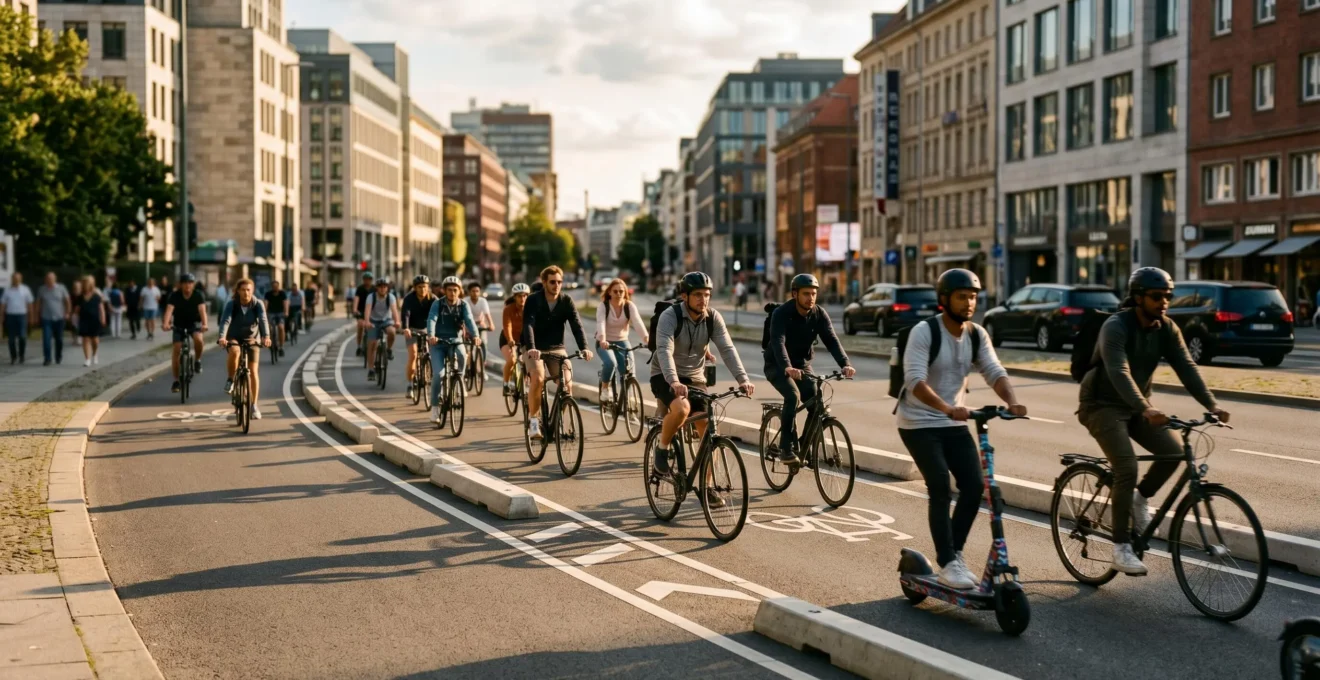
Successful micro-mobility deployment is not a guessing game; it’s an infrastructure discipline that hinges on quantifiable safety metrics and financially sustainable operating models to deliver on policy goals.
- Physically separated lanes are non-negotiable, proven to reduce accidents by drastically lowering the cognitive load on all road users.
- Treating micro-mobility as a for-profit business often leads to bankruptcy; a public utility model focused on capital investment is essential for long-term success.
Recommendation: Base your network design and expansion strategy on measurable demand thresholds and data-driven parking design, not political pressure or generic rollouts.
As an urban planner, you are under constant pressure to reduce car dependency, ease congestion, and meet ambitious climate targets. Micro-mobility is frequently presented as a turnkey solution. The narrative is alluring: deploy a fleet of e-scooters and e-bikes, and watch as citizens joyfully abandon their cars for short trips. However, the reality on the ground is often one of pavement clutter, rising accident rates, and financially unviable schemes that collapse within a few years.
The common approach of simply permitting operators and hoping for the best is a recipe for failure. The conversation often gets stuck on generic benefits or visible problems like sidewalk obstruction. But what if the key to unlocking a 25% reduction in car trips isn’t about the vehicles themselves, but about the underlying infrastructure and financial frameworks that support them? The true challenge lies in moving beyond the hype and treating micro-mobility as a rigorous infrastructure discipline, similar to how you would plan a water or power grid.
This implementation-driven approach requires a focus on quantifiable safety through infrastructure design, financially sustainable operating models that avoid common pitfalls, and data-driven methods for managing assets and expansion. This guide provides a blueprint for deploying a system that works, covering everything from the engineering of safe lanes and intelligent parking to the economic models that ensure long-term viability.
This article provides a structured framework for planning and implementing a successful urban micro-mobility program. The following sections will detail the critical components, from infrastructure design and operational comparisons to financial sustainability and data-driven expansion strategies.
Summary: A Planner’s Blueprint for Implementing Micro-Mobility
- Why Dedicated Micro-Mobility Lanes Reduce Accidents by 40% Compared to Shared Pavements
- How to Design Dockless Parking Zones That Prevent Pavement Clutter in 5 Steps
- Docked Bike-Share vs Dockless E-Scooters: Which Delivers Better Utilisation Rates?
- The Subsidy Mistake That Bankrupts Municipal Bike-Share Schemes Within 3 Years
- When to Expand Micro-Mobility Infrastructure: The 3 Demand Thresholds That Justify Investment
- Why Microcars Under 2.5 m Length Access Restricted Parking Zones in London
- Bus vs Tram for Urban Commuting: Which Offers Better Reliability in Traffic?
- How Urban Micro-Mobility Vehicles Cut Parking Time by 70% in City Centres
Why Dedicated Micro-Mobility Lanes Reduce Accidents by 40% Compared to Shared Pavements
The single most impactful intervention for ensuring the safety and success of a micro-mobility network is the implementation of dedicated, protected lanes. Simply painting a line on a road or asking riders to share pavements with pedestrians creates conflict and ambiguity. The core benefit of physical separation is the reduction of cognitive load for all road users. When drivers, cyclists, and pedestrians operate in clearly demarcated and protected spaces, they no longer need to constantly predict the movements of others, leading to a calmer, safer environment.
This principle is not theoretical; it is backed by clear data. For instance, research from New York City demonstrates that a 40% reduction in injuries for all road users is achieved where protected bike infrastructure is installed. The physical barrier—be it a concrete curb, planters, or bollards—sends an unambiguous signal that eliminates guesswork and prevents vehicle encroachment. This is the mechanism that drives down accident rates so effectively.
As the image above illustrates, the combination of physical barriers and colour-coded surfacing creates an intuitive and secure environment. As a planner, your priority should be securing the budget and political will for this level of infrastructure. As mobility expert Wesley Marshall, PhD, PE, noted in a study for the University of Colorado Denver, the conclusion is clear. In his research published in the Journal of Transport & Health, he states:
Bicycling infrastructure — specifically, separated and protected bike lanes — leads to fewer fatalities and better road-safety outcomes for all road users.
– Wesley Marshall, PhD, PE, University of Colorado Denver study
This is not an optional add-on; it is the foundational element upon which a successful, high-adoption micro-mobility system is built. Without it, you are planning for user conflict and inevitable public backlash.
How to Design Dockless Parking Zones That Prevent Pavement Clutter in 5 Steps
Pavement clutter from improperly parked dockless vehicles is a primary source of public opposition to micro-mobility. However, this is not a user behaviour problem; it is a system design problem. A successful parking strategy moves beyond punitive measures and instead engineers compliance through intelligent infrastructure and incentives. Your goal is to make correct parking the easiest and most logical option for the user. Best practices from cities that have successfully tackled this issue show that a data-informed, phased approach is critical.
By planning zones based on actual demand data and designing them for high compliance, you can significantly improve safety and operational efficiency. The following process provides a blueprint for creating an effective dockless parking infrastructure that serves users, residents, and businesses alike, transforming parking from a liability into a well-managed component of your urban landscape.
Your Action Plan: A 5-Step Blueprint for Compliant Dockless Parking
- Stakeholder Engagement: Conduct workshops with local businesses, resident associations, and disability advocates to ensure social acceptance and identify optimal placement locations that balance accessibility with obstruction minimization.
- Data-Driven Siting: Leverage pedestrian flow data and demand heatmaps from operators to strategically locate parking zones where they scientifically minimize obstruction while maximizing user convenience, not just city convenience.
- Behavioural Nudges: Incorporate dynamic pricing (rewards for parking in designated zones, small penalties for non-compliance) and in-app gamification to guide user behaviour toward compliant parking without being overly punitive.
- Technology-Enabled Verification: Mandate that operators implement AI-powered parking validation using smartphone cameras. This requires users to submit a photo to verify proper parking before their rental session can end, ensuring compliance through technology.
- Flexible Zone Management: Design flexible parking zones that can be digitally activated or deactivated based on time of day or special events (like street markets or parades) to dynamically manage public space utilization and adapt to the city’s rhythm.
Implementing these steps transforms parking management from a reactive enforcement issue into a proactive, data-driven system. It builds public trust by demonstrating a commitment to orderly public spaces while supporting a valuable mobility service.
Docked Bike-Share vs Dockless E-Scooters: Which Delivers Better Utilisation Rates?
When planning a micro-mobility system, a fundamental choice is between a docked model (e.g., traditional bike-share with fixed stations) and a dockless one (e.g., free-floating e-scooters). The decision impacts everything from capital investment to operational complexity and user experience. While both have their place, understanding their different performance characteristics is crucial for aligning the system with your city’s goals. One of the most important metrics for evaluating performance is the utilisation rate, typically measured in trips per vehicle per day.
Docked systems offer predictability and order, as bikes are always returned to a station. This simplifies rebalancing and eliminates street clutter. However, this rigidity can limit convenience, as users must start and end their trips at fixed locations. Dockless systems offer unparalleled flexibility, allowing “park-anywhere” convenience that is ideal for spontaneous, point-to-point trips. This often leads to different usage patterns and intensities.
Data provides a clearer picture. In a comparison of shared systems, a key performance indicator is the daily trip count. For example, North American data from 2020 shows that e-scooters achieved an average of 1.6 trips per vehicle per service day. While figures vary by city and season, e-scooters often show higher utilisation rates in dense urban cores due to their convenience for short-distance travel. As one study noted, “E-scooter trips are more concentrated around mobility hubs,” indicating their strong role in first/last-mile connections with public transport.
Ultimately, the choice is not about which is “better” in a vacuum, but which is better for a specific purpose. Docked bike-shares may be superior for commuter routes and recreational loops where predictability is valued. Dockless e-scooters often excel in dense, mixed-use areas for spontaneous trips, replacing walking or short car journeys. Many cities are now finding success with hybrid models, deploying both to serve different use cases and user demographics.
The Subsidy Mistake That Bankrupts Municipal Bike-Share Schemes Within 3 Years
One of the most catastrophic and repeated errors in municipal micro-mobility planning is structuring the system with the expectation of operational profitability. Viewing bike-share or scooter-share as a “business” that should pay for itself through user fees is a fundamental misunderstanding of public transportation economics. This flawed model inevitably leads to under-investment in maintenance, service gaps in less profitable neighbourhoods, and, ultimately, financial collapse.
The core issue is a confusion between capital investment and operational subsidy. Public transport is a public good. We do not expect roads, bridges, or bus services to turn a profit on their own. We fund their capital and maintenance costs through the public purse because they provide a net benefit to society. The same logic must be applied to micro-mobility. Relying on a private operator to cover all costs from ride revenue alone creates a system that is financially brittle and destined to fail.
The pursuit of a self-sustaining for-profit model without a robust public investment framework is the single biggest threat to a scheme’s longevity. This isn’t speculation; it’s a lesson learned from high-profile failures.
Case Study: The Bankruptcy of Public Bike System Co. (BIXI)
In 2014, Public Bike System Co. (PBSC), the supplier for major bike-share systems like New York’s Citi Bike and Chicago’s Divvy, filed for bankruptcy with nearly $50 million in debt. The collapse was rooted in an unsustainable business model that attempted to run a transportation utility as a profitable private enterprise. The case highlighted how over-reliance on operational revenue and insufficient public capital investment frameworks lead directly to financial collapse, jeopardizing essential urban mobility infrastructure.
As author Elly Blue commented on the failure, the core philosophy was flawed. Her insight captures the essence of the problem that planners must avoid.
We can’t run our transportation systems like a business, it doesn’t really work that way because then we run the risk of not serving the people that need to be served.
– Elly Blue, Author of Bikenomics
When to Expand Micro-Mobility Infrastructure: The 3 Demand Thresholds That Justify Investment
Once a pilot program is established, the inevitable question becomes: when and where should we expand? Expansion should not be an arbitrary or politically driven decision. It must be a strategic response to clear, data-driven signals that justify further capital investment. The potential is vast; more than half of all vehicle trips within the U.S. are less than or equal to 5 miles, a distance perfectly suited for micro-mobility. To tap into this potential effectively, you need a framework based on measurable demand thresholds.
Instead of guessing, you should establish a set of key performance indicators (KPIs) that trigger an expansion analysis. This data-driven approach ensures that investments are made where they will have the greatest impact on modal shift and user adoption, maximizing the return on public funds. The following three thresholds provide a robust framework for making these critical decisions.
Threshold 1: Utilisation Saturation
This is the most direct indicator of unmet demand. Track the average number of trips per vehicle per day within your existing service area. When this metric consistently exceeds a predefined benchmark (e.g., 3.5 to 4 trips per day), it signals that your current fleet is at capacity and unable to serve all potential rides. This is a clear sign that adding more vehicles or expanding the service area is warranted to meet existing demand.
Threshold 2: Consistent “Edge” Activity
Use operator-provided heatmaps to analyse trip start and end points. A strong signal for expansion is a high concentration of trips ending right at the boundary of your current service area. This “edge effect” indicates that users are riding as far as the system allows and then continuing their journey on foot. It demonstrates organic, unmet demand just beyond your current borders. Focus expansion efforts on these high-activity boundary zones first.
Threshold 3: Demonstrable Modal Shift
The ultimate goal of micro-mobility is to replace car trips. Use in-app user surveys and transportation modelling to measure what mode of transport a micro-mobility trip replaced. When you can demonstrate that a significant percentage of trips (e.g., over 30%) are replacing private car or ride-hail journeys, you have a powerful case for investment. This proves the system is delivering on its core policy promise, justifying the use of public funds for expansion to further amplify this positive impact.
Why Microcars Under 2.5 m Length Access Restricted Parking Zones in London
A sophisticated urban mobility strategy involves more than just two-wheeled vehicles; it also creates pathways for a new class of hyper-compact, efficient electric vehicles, often called microcars. Cities like London have pioneered policies that grant special privileges to these vehicles, such as access to restricted parking zones. The logic is simple and powerful: incentivise the use of vehicles that occupy drastically less public space. A standard car parking space is a blunt, inefficient use of valuable urban land.
By creating regulations that favour vehicles under a certain length (e.g., 2.5 metres), a city directly encourages a shift to a more space-efficient fleet. This is not about banning cars but about rewarding smarter choices. A policy that allows a microcar to park in a motorcycle bay or a specially designated compact zone fundamentally alters the economic and convenience equation for vehicle ownership in a dense city centre. It makes the smaller vehicle the more logical choice.
The potential land-use benefits of this shift are staggering. While not specific to London, the underlying principle is validated by advanced mobility modelling. For example, a scientific analysis of on-demand mobility revealed an inverse exponential relationship between parking reduction and traffic increases. The study found that an 86% parking infrastructure reduction is technically possible if a city transitions to a highly efficient, on-demand fleet. This research provides policy-makers with quantified trade-offs, demonstrating that incentivizing smaller vehicles is a direct lever for reclaiming vast portions of urban land currently dedicated to storing oversized private vehicles.
For an urban planner, this represents a powerful policy tool. By tying parking privileges to vehicle size, you create a market-based incentive for downsizing, which in turn reduces the physical footprint of the entire urban transport system and frees up public space for people, not just for cars.
Bus vs Tram for Urban Commuting: Which Offers Better Reliability in Traffic?
In the classic urban transit debate, trams (or light rail) are generally considered more reliable than buses in heavy traffic. Their primary advantage is their dedicated right-of-way. Because they run on tracks separated from general vehicle lanes, trams are not subject to the same congestion, bottlenecks, or unpredictable delays that plague buses operating in mixed traffic. This physical separation guarantees a more consistent and predictable journey time, which is a key factor in commuter satisfaction.
However, this framing of “Bus vs. Tram” is becoming outdated. The real breakthrough in improving bus reliability today comes not from an expensive city-wide conversion to light rail, but from a smarter integration with micro-mobility. The “first and last-mile” problem is the Achilles’ heel of many bus systems; potential riders are deterred if the walk to the bus stop is too long. This is where micro-mobility becomes a powerful ally.
By providing a convenient way to get to and from bus stops, micro-mobility solves this first/last-mile challenge. This, in turn, allows you to redesign bus routes for greater efficiency. As one analysis on public transport integration points out, “Micromobility directly boosts bus reliability by solving the ‘last-mile’ problem, allowing for the creation of Bus Rapid Transit (BRT) lite corridors with fewer stops and higher commercial speeds.”
With micro-mobility serving local access, buses no longer need to make as many stops. They can be consolidated into higher-frequency, limited-stop “BRT-lite” services that dramatically improve speed and reliability without the massive capital cost of full light rail. Transportation studies reveal that a significant portion of urban trips are short, with around 60% of urban car trips being less than 10 kilometres. By capturing these short access trips, micro-mobility makes the entire public transport network, especially the bus system, more efficient, reliable, and attractive to new riders.
Key Takeaways
- The most critical factor for micro-mobility safety and adoption is the implementation of physically separated, dedicated lanes.
- Successful dockless parking is a system design challenge solved with data-driven zone placement and technology-verified compliance, not just fines.
- Treating micro-mobility as a public utility with capital investment, rather than a for-profit business, is essential for long-term financial sustainability.
How Urban Micro-Mobility Vehicles Cut Parking Time by 70% in City Centres
The direct benefits of replacing a car trip with a micro-mobility trip are clear: lower emissions, reduced congestion, and better public health. However, a significant but often overlooked benefit is the dramatic reduction in time wasted searching for parking. The hunt for a parking space is a major source of driver frustration and a surprising contributor to traffic congestion. Studies show that drivers can spend between 100 to 150 hours per year just looking for a place to park their car, circling blocks and adding to local traffic.
Micro-mobility vehicles fundamentally solve this problem. Whether it’s a dockless scooter left in a designated corral or a shared e-bike parked at a station, the parking process is orders of magnitude faster and simpler. The time saved is not trivial; it can be the deciding factor for a user choosing a scooter over a car for a short city-centre trip. A process that takes 10-15 minutes in a car is reduced to less than a minute on a scooter.
This efficiency gain is a direct result of the vehicle’s small footprint. As the image shows, parking a micro-vehicle is an effortless, human-scale activity. This stands in stark contrast to the stress and uncertainty of finding a 12-square-metre space for a private car. The cumulative effect of this time saving across thousands of daily trips represents a massive productivity gain for a city’s residents and workers.
Furthermore, this efficiency translates into a more optimised use of urban land. As the previously mentioned Singapore study demonstrated, a large-scale shift to on-demand and compact mobility can liberate enormous portions of land currently wasted on parking. This creates opportunities for more green space, wider pavements, and dedicated public amenities—a virtuous cycle where better mobility leads to a better city.
To translate these benefits from theory into reality, your next step is to develop a formal implementation plan based on the data-driven principles of infrastructure design, financial sustainability, and demand-responsive network management. Begin by auditing your existing right-of-way to identify corridors for protected lanes and use data to map out an initial network of parking zones.