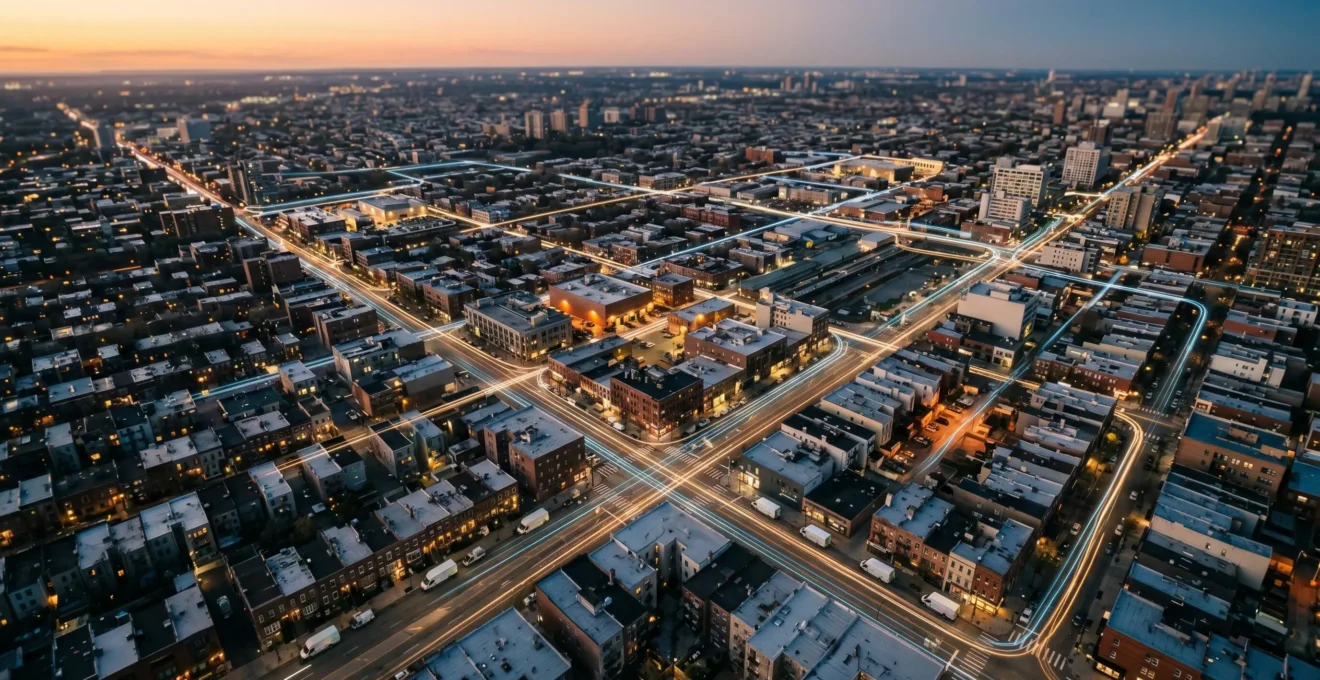
The persistent inflation of last-mile delivery costs is not a routing problem; it’s an infrastructure problem.
- True cost reduction comes from strategically increasing delivery density through micro-fulfilment centres and smart vehicle selection.
- Optimising routes with algorithms is only effective after the physical network has been engineered to minimise travel time between drops.
Recommendation: Shift focus from tactical route adjustments to a structural audit of your inventory placement and asset mix to unlock savings of 35% or more.
For logistics managers, the final mile of delivery is a constant battle against spiralling expenses. It’s the most complex and expensive part of the supply chain, often accounting for over half of total shipping costs. The conventional wisdom urges investment in route optimisation software or better driver tracking. While these tactical tools have their place, they often produce only marginal gains because they don’t address the fundamental issue: an inefficient network structure.
Simply finding a faster path through congested city streets is a losing game if your delivery van starts its journey 30 miles from the first drop-off point. The real opportunity for a significant, 35% cost reduction lies not in tweaking daily routes, but in re-engineering the very fabric of your delivery network. This involves making strategic decisions about where you hold inventory, how you group deliveries, and what vehicles you deploy for specific environments.
This guide abandons the platitudes of simple optimisation. Instead, it provides a strategic framework for cutting last-mile costs by focusing on the structural levers that create high-density delivery zones. We will explore how decentralised fulfilment, algorithmic clustering, and intelligent asset selection work in concert to dramatically lower your cost-per-drop. By the end, you will understand how to build a resilient and cost-effective last-mile operation from the ground up.
This article details the strategic pillars required to fundamentally restructure your last-mile operations for maximum cost efficiency. The following summary outlines the key areas we will cover, from macro-level infrastructure changes to micro-level optimisations.
Summary: A Strategic Framework for Last-Mile Cost Reduction
- Why Micro-Fulfilment Centres in City Zones Reduce Last-Mile Costs by 40%
- How to Optimise Delivery Density Using Route Clustering Algorithms in 4 Steps
- Cargo Bikes vs Electric Vans for Dense Urban Last-Mile: Which Is Faster Under 3 Miles?
- The Time-Window Mistake That Doubles Failed Delivery Attempts and Costs
- When to Use Collection Points vs Home Delivery: The 15-Drop Density Threshold
- Why A-Road Networks Often Beat Motorways for Multi-Drop Urban Deliveries
- Why Backhaul Planning Prevents 40% of Empty HGV Running and Boosts Profit Margins
- How Heavy Haulage Logistics Cuts Operating Costs by 18% Through Route Planning
Why Micro-Fulfilment Centres in City Zones Reduce Last-Mile Costs by 40%
The single most impactful structural lever for reducing last-mile costs is decreasing the distance between your inventory and your customer. Traditional logistics models, which rely on large, out-of-town warehouses, are fundamentally inefficient for urban e-commerce. The long stem mileage—the journey from the warehouse to the first delivery point—burns fuel, driver hours, and vehicle capacity before a single package is delivered. Micro-fulfilment centres (MFCs) are the antidote to this problem.
By positioning smaller, highly automated inventory hubs directly within dense urban or suburban zones, companies can slash stem mileage to near zero. This strategic placement means delivery routes start inside the target delivery area, enabling drivers to spend their time dropping off packages, not driving to them. The result is a dramatic increase in drops per hour and a corresponding fall in cost-per-delivery. Beyond direct cost savings, this model offers significant secondary benefits. Research confirms that MFCs significantly ease urban congestion; one study shows that micro-fulfilment centres can reduce delivery traffic by 13% in major cities, decreasing both emissions and delivery delays.
Case Study: Walgreens’ Strategic MFC Network Expansion
Major retailer Walgreens is aggressively pursuing an MFC strategy to enhance its urban delivery capabilities. Currently operating 11 MFCs that service 4,500 of its stores, the company plans to expand this network to support 6,000 stores within the next year. This move demonstrates a clear understanding that creating a highly localised fulfilment network is key to cutting last-mile costs. By decentralising inventory and positioning it closer to urban customers, Walgreens not only improves service reliability but also reduces its carbon footprint and operational expenses simultaneously.
Implementing MFCs is a capital-intensive decision, but it is a foundational investment in delivery density. It transforms the economics of the last mile from a high-cost necessity into a competitive advantage, enabling faster, cheaper, and greener deliveries.
How to Optimise Delivery Density Using Route Clustering Algorithms in 4 Steps
Once you have localised inventory with MFCs, the next step in engineering density is to intelligently group orders into compact delivery zones. Simply assigning orders to the nearest driver is inefficient. The goal is to create clusters of stops that are geographically tight and have a balanced workload, minimising travel time between drops. This is where route clustering algorithms become a critical operational tool, moving beyond simple A-to-B routing to strategic territory planning.
These algorithms analyse all pending delivery addresses and partition them into distinct, manageable zones. This pre-planning ensures each vehicle has a dense and logical route before it even leaves the fulfilment centre. The right algorithm can make a significant difference. A 2024 logistics case study that compared K-Means and DBSCAN algorithms found that K-Means was superior for most urban delivery scenarios. It consistently produced clear clusters with balanced demand, enabling vehicles to maximise package drop-offs while minimising travel distance. This optimisation directly impacts the bottom line by improving vehicle capacity utilisation.
As the visualisation suggests, clustering creates a logical and efficient division of labour. Instead of chaotic, overlapping routes, each colour-coded zone represents a self-contained route for a single vehicle. This approach has four key steps:
- Data Aggregation: Collect and geocode all delivery addresses for a specific time period (e.g., a day or a shift).
- Parameter Definition: Define the constraints, such as the number of available vehicles (which determines the number of clusters), vehicle capacity, and maximum route time.
- Algorithmic Execution: Run a clustering algorithm like K-Means to partition the geocoded points into optimised, non-overlapping territories.
- Route Sequencing: Within each cluster, use a route optimisation tool (like a Travelling Salesperson Problem solver) to determine the most efficient sequence of stops.
This systematic process of clustering is a cornerstone of delivery density engineering. It ensures that every route is profitable by design, preventing drivers from crisscrossing the city and wasting valuable time and fuel.
Cargo Bikes vs Electric Vans for Dense Urban Last-Mile: Which Is Faster Under 3 Miles?
For hyper-dense urban clusters under three miles, the choice of vehicle is a critical cost lever. While electric vans appear to be a modern and green solution, their operational reality in congested city centres is often hampered by traffic, parking restrictions, and limited access to pedestrianised zones. For short-distance, multi-drop routes, the electric cargo bike is often not just a cheaper alternative, but a significantly faster one.
The agility of a cargo bike is its greatest asset. It can navigate through traffic, use bike lanes, and get directly to the customer’s door, virtually eliminating the time wasted searching for parking—a task that can consume up to 50 minutes per day for a van driver. This translates into superior efficiency. While a van is stuck in a gridlock, a cargo bike rider is completing deliveries. This operational advantage is reflected in the total cost of ownership (TCO), where bikes prove to be a far more economical choice for the right environment.
A comprehensive analysis comparing the two options reveals a stark difference in both efficiency and cost. The following data highlights why cargo bikes are a superior tool for high-density urban logistics.
| Operational Factor | Electric Cargo Bike | Electric Van |
|---|---|---|
| Delivery Efficiency (parcels/hour) | 10.1 packages | 4.9 packages |
| Operating Cost Multiple | Baseline (1x) | 10x higher |
| Carbon Emissions Reduction | 90% vs diesel vans, 33% vs electric vans | Baseline comparison |
| Parking Time Impact | Direct door access, minimal delay | ~50 minutes/day searching for parking |
| Traffic Navigation | Can cut through closed streets and traffic | Hampered by congestion |
| Low-Emission Zone Access | Unrestricted access | Often restricted or charged |
As the comparative analysis clearly shows, electric cargo bikes are more than twice as efficient, delivering over 10 packages per hour compared to less than 5 for an electric van. When factoring in purchase price, insurance, maintenance, and energy, their operating cost is a staggering 10 times lower. For logistics managers focused on cost reduction, selecting the right asset for the right operational theatre is non-negotiable. In the dense urban core, the cargo bike is the undisputed champion of cost-effective delivery.
The Time-Window Mistake That Doubles Failed Delivery Attempts and Costs
Even with a perfectly structured network, optimised clusters, and the right vehicles, profitability can be destroyed by a single, common point of failure: the customer is not home. A failed delivery attempt is a catastrophic cost event. It’s not just the expense of the initial trip; it’s the added cost of storing the package, processing the failure, contacting the customer, and attempting redelivery. Each failure erodes, and often eliminates, the profit margin on an order.
Industry data reveals the staggering financial impact: a single failed delivery costs retailers an average of $17.20. For a typical retailer, this can add up to nearly $200,000 in losses annually. With first-attempt failure rates hovering between 10-15% in major markets, this is a fire that must be extinguished. The common mistake is offering wide, ambiguous delivery windows like “between 9 AM and 5 PM.” This approach shows a fundamental disrespect for the customer’s time and dramatically increases the likelihood of failure.
The solution is time-window precision. Modern logistics platforms allow for dynamic, narrow delivery windows (e.g., 60 minutes) that are communicated clearly to the customer. This is often supplemented with real-time driver tracking and proactive notifications (“Your driver is 3 stops away”). This level of precision and communication achieves two critical goals:
- It maximises the first-attempt success rate by empowering the customer to be present for the delivery.
- It enhances the customer experience, turning the delivery from a source of frustration into a positive brand interaction.
Investing in technology that enables precise, communicative time windows is not a cost; it’s an insurance policy against the far greater expense of failed deliveries. It ensures that all the efficiency gains from your network structure are not squandered at the final, most critical moment: the handover to the customer.
When to Use Collection Points vs Home Delivery: The 15-Drop Density Threshold
While optimising home delivery is crucial, a truly cost-effective strategy acknowledges that it isn’t always the best option. For certain areas, particularly those with lower delivery density or a high concentration of apartment buildings with access issues, forcing a home delivery model can be unprofitable. The alternative is a robust network of Pick-Up and Drop-Off (PUDO) points, such as automated parcel lockers or partnerships with local convenience stores.
The strategic question is not *if* to use PUDO, but *when*. The decision should be data-driven, based on a concept we can call the density threshold. A common industry benchmark suggests that if a route segment cannot guarantee an average of at least 15 drops per hour, the profitability of home delivery becomes questionable. Below this threshold, the cost of driver time and fuel for each individual stop begins to outweigh the delivery fee. In these scenarios, consolidating multiple deliveries to a single PUDO point becomes far more economical. One driver can drop 30 packages at a single locker in minutes, a task that could take hours via individual home deliveries.
Case Study: New York City’s Parcel Locker Pilot Program
To combat the estimated 90,000 packages lost or stolen annually and reduce traffic from 2.5 million daily deliveries, New York City expanded its public parcel locker pilot in late 2024. By installing secure lockers on public sidewalks, the city provides a consolidated collection point that addresses multiple problems at once. This initiative demonstrates the compelling business case for PUDO adoption in dense urban environments, proving it can simultaneously reduce failed delivery attempts, prevent package theft, and decrease urban congestion, making the entire logistics ecosystem more efficient.
PUDO networks also offer significant environmental benefits. By consolidating drops, they drastically reduce vehicle miles travelled. Recent environmental impact studies show that parcel lockers can cut CO2 emissions by up to two-thirds in urban areas compared to traditional home delivery. Offering customers a choice between home delivery and a convenient collection point allows logistics managers to strategically guide volume towards the most cost-effective channel.
Why A-Road Networks Often Beat Motorways for Multi-Drop Urban Deliveries
In the context of multi-drop urban deliveries, the fastest route is rarely the straightest line on a map. While motorways offer high speeds, they are a poor choice for routes with numerous stops. They are designed for long-haul, point-to-point transit, not for the intricate dance of urban distribution. Relying on motorways for the final mile introduces significant inefficiencies that inflate costs. Every time a driver exits a motorway to make a delivery, they must navigate complex interchanges and then find their way back, adding significant time and mileage for each stop.
A-road networks (or major arterial roads), by contrast, are the lifeblood of efficient multi-drop routes. They provide direct access to commercial and residential streets, allowing a driver to flow from one stop to the next without major detours. This is especially true when a route has been properly clustered. The optimal path will weave through a dense area using these arterial roads as a backbone, minimising the distance between each drop. The cost of the last mile is so significant—with some analysis suggesting it accounts for 41-53% of total shipping costs—that optimising at this granular level is non-negotiable.
Warehouse location is the most consequential structural variable in last-mile performance. Positioning inventory closer to demand reduces cost per stop more than any routing or technology improvement.
– Link Logistics Research, Last-Mile Optimization: Strategies to Cut Costs and Speed Up Delivery
This expert insight reinforces the core principle: structural decisions come first. The reason A-roads are more efficient is because they are the right tool to service a dense delivery zone created by an upstream decision, like placing an MFC nearby. A routing algorithm that prioritises A-roads for multi-drop routes will consistently produce lower costs and higher drops-per-hour than one that defaults to the “fastest” motorway path. This requires configuring routing software to penalise motorway usage and favour surface streets for final-mile segments.
Why Backhaul Planning Prevents 40% of Empty HGV Running and Boosts Profit Margins
A delivery vehicle’s journey doesn’t end after the last package is dropped off. The return trip to the depot, known as the “deadhead” leg, represents a significant and often overlooked cost. When a vehicle runs empty, it generates zero revenue while still incurring expenses for fuel, driver wages, and wear and tear. This “empty running” is a massive drain on profitability. Backhaul planning is the strategy of turning this empty return journey into a revenue-generating opportunity.
Instead of returning empty, a backhaul strategy ensures the vehicle picks up goods on its return path. This can involve several scenarios: collecting customer returns (reverse logistics), picking up inventory from a local supplier, or even transporting goods for another non-competing business as part of a collaborative arrangement. By filling the vehicle for the return trip, you effectively double its asset utilisation and can prevent up to 40% of empty running, directly boosting profit margins.
Implementing a successful backhaul strategy requires a systematic approach. It’s not about ad-hoc pickups; it’s about integrating reverse and collaborative logistics into your daily route planning. The following framework provides a clear path to implementation.
Your Action Plan: Implementing Collaborative Backhaul Operations
- Map Return Journeys: Analyse all outbound delivery routes to identify consistent return paths with available vehicle capacity. Calculate the potential backhaul volume and opportunities for each route segment.
- Establish Local Partnerships: Identify non-competing businesses located along your primary return routes (e.g., retailers, suppliers, recyclers) and negotiate collaborative pickup agreements that create mutual financial value.
- Integrate Reverse Logistics: Configure your delivery management system to automatically schedule customer returns for pickup during existing return journeys, completely eliminating the cost of dedicated return trips.
- Track Backhaul Performance: Continuously monitor key metrics such as empty mile reduction, new revenue streams generated from collaborative pickups, and inventory insights from returned product data to optimise the strategy.
By treating the return journey with the same strategic importance as the outbound delivery, you transform a cost centre into a profit centre. This holistic view of the entire delivery cycle is essential for maximising the efficiency of your logistics network.
Key Takeaways
- Reducing last-mile costs by 35% requires a strategic shift from tactical routing to engineering delivery density.
- Structural decisions like implementing micro-fulfilment centres (MFCs) and PUDO networks are the most powerful cost-reduction levers.
- Asset selection is critical: for dense urban routes, cargo bikes offer a 10x lower total cost of ownership than electric vans.
How Heavy Haulage Logistics Cuts Operating Costs by 18% Through Route Planning
Ultimately, all the structural decisions—inventory placement, vehicle choice, backhaul strategy—must be orchestrated by intelligent, dynamic route planning. This is where technology acts as the final multiplier for all the efficiencies you have built into your network. Relying on static, pre-planned routes or manual dispatch is a relic of the past and a primary reason why many logistics operations fail to control costs.
Last mile delivery accounts for 41% of total supply chain costs, yet most enterprises are still running it on static routing, manual dispatch, and fragmented visibility across carrier systems.
– Locus Supply Chain Intelligence, Last Mile Delivery Optimization: Enterprise Strategies That Scale
This statement from Locus highlights the critical disconnect in the industry. The most expensive part of the supply chain is often managed with the least sophisticated tools. Modern, AI-driven route planning moves beyond this limitation. These systems can process thousands of variables in real-time—including traffic, weather, vehicle capacity, time-window commitments, and even the likelihood of a successful delivery at a specific address—to create the most cost-effective route for an entire fleet.
The impact of adopting such a system is not marginal; it is transformative. Enterprise logistics data from Locus, gathered across over 30 countries, shows that AI-driven optimisation can achieve a 15-20% reduction in delivery times while simultaneously increasing the number of stops a driver can make per hour by 30%. This is the final piece of the puzzle: leveraging advanced software to capitalise on a well-structured physical network. The AI is the conductor, but it can only produce a masterpiece if the orchestra—your MFCs, vehicles, and delivery zones—is set up for success.
To achieve a substantial 35% reduction in last-mile costs, you must shift your focus from chasing incremental gains with route software to making foundational changes in your delivery infrastructure. Begin by auditing your network for density, evaluating the placement of your inventory, and matching your vehicle assets to the specific environments you serve. This strategic approach is the only sustainable path to mastering the last-mile challenge.