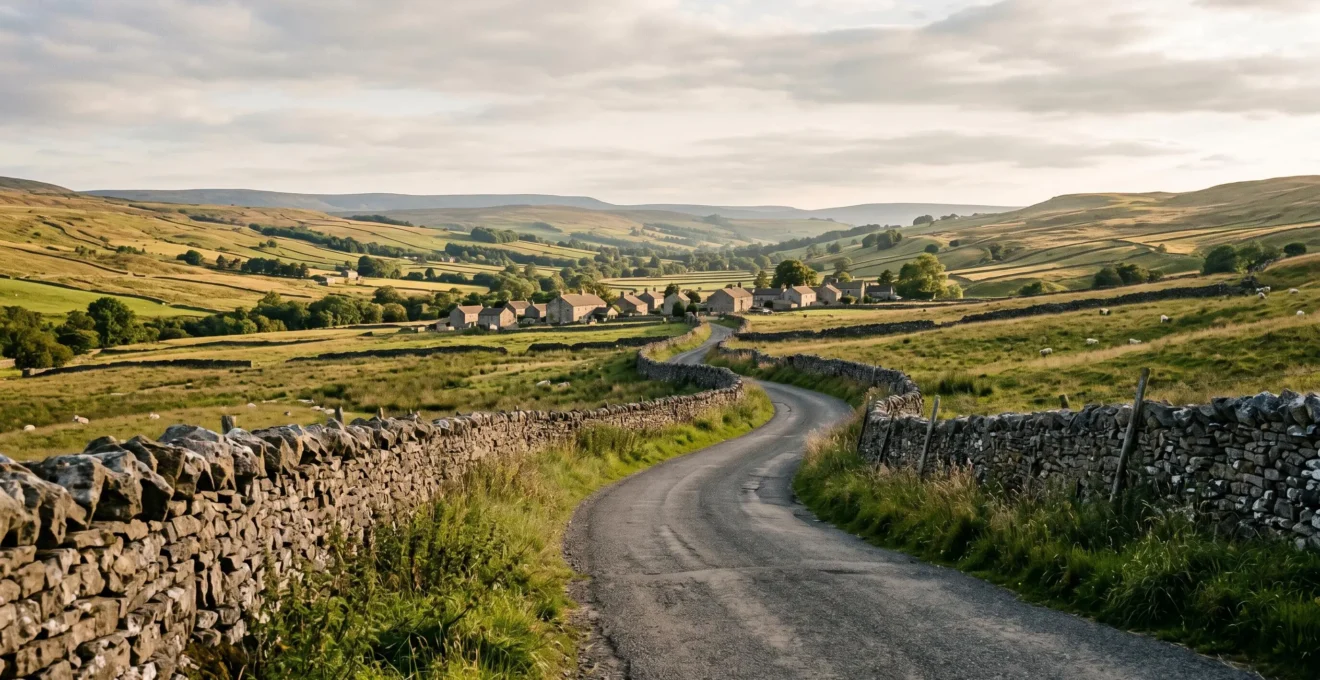
The most authentic cultural experiences aren’t found by following tourist signs, but by learning to read the countryside as a living system.
- Single-track roads force a slower, more observant pace, revealing the agricultural rhythms that major roads bypass.
- A region’s geology and historic economy—its “economic DNA”—are visibly imprinted on its architecture, villages, and food.
Recommendation: Shift your mindset from a passive tourist to an active “rural anthropologist.” Instead of just looking for scenic views, start decoding the signals of the landscape to uncover genuine local life.
There’s a universal yearning among thoughtful travellers: to break free from the curated, homogenous experience of modern tourism and connect with something real. We dream of road trips that lead to sun-drenched village squares, hearty meals in pubs humming with local chatter, and a genuine sense of a place’s unique soul. Yet, we often find ourselves funnelled down the same A-roads, stopping at the same over-polished attractions, and leaving with a feeling that we’ve only skimmed the surface. The common advice—”get off the beaten path”—is a start, but it’s not a strategy.
The conventional approach treats the countryside as a gallery of scenic viewpoints to be passively consumed. But what if the true key to cultural immersion isn’t about where you go, but *how* you see? The real magic happens when you stop being a tourist and start becoming a cultural anthropologist of the backroads. It’s about learning to read the “cultural topography” of a region, to understand how the stone in the walls, the goods at the market, and the layout of a village are all part of a single, interconnected story.
This guide is built on that principle. It’s designed to give you the tools and the mindset to decode the landscape, not just drive through it. We will explore why the narrowest lanes offer the richest experiences, how to use food as a map to a region’s economic DNA, and how to spot the subtle signals that separate a living community hub from a tourist facade. By the end, you won’t just see a pretty village; you’ll understand why it exists.
To help you navigate this journey from passive observer to active explorer, this article is structured to build your skills progressively. The following sections will guide you through the core principles and practical methods for uncovering the authentic culture hidden just beyond the motorway.
Summary: A Traveller’s Guide to Uncovering the Soul of the Countryside
- Why Single-Track Roads Reveal Traditional Farming Communities Better Than A-Roads
- How to Plan a Rural Food Trail Using Farmers’ Markets Along Backroads in 7 Steps
- Cotswolds Lanes vs Yorkshire Dales Routes: Which for Traditional Village Culture?
- The Tourist Mistake That Bypasses 80% of the Best Village Pubs and Tea Rooms
- When to Drive Rural Routes: Avoiding Harvest Season Disruptions in 3 Regions
- Why Market Towns Offer Better Local Food Quality Than Motorway Service Stations by 80%
- Why Coastal Routes Deliver 3× More Memorable Scenery Than Inland Motorways
- How to Find Authentic Local Gastronomy Stops That Tourists Miss
Why Single-Track Roads Reveal Traditional Farming Communities Better Than A-Roads
Motorways are designed for efficiency, their purpose to negate the landscape. Single-track roads, by contrast, are expressions of it. They are arteries of a different kind of system, one dictated not by speed, but by topography, land ownership, and the daily rhythms of agriculture. To choose these roads is to choose immersion over transit. Their narrowness is not a flaw; it is their defining feature, forcing a slower pace and a heightened state of awareness. You are no longer insulated in a metal box hurtling through scenery; you are an active participant in the environment, negotiating with oncoming tractors and exchanging a nod with other drivers at passing places.
This forced mindfulness is the first step in learning to read the landscape. These routes often trace the oldest patterns of settlement, connecting farms, hamlets, and ancient rights-of-way that A-roads have long since bypassed. The scale of this network is vast; for instance, there are over 2,500 miles (approximately 4,000 km) of single-track routes threading through Scotland’s Highlands alone. They are the circulatory system of traditional rural life, and driving them is like gaining access to the community’s backstage. You witness the real work: the mending of dry-stone walls, the movement of livestock, the quiet industry that sustains the region.
The etiquette of the passing place is itself a micro-lesson in rural social contracts—a dance of cooperation and foresight that is absent from the anonymous aggression of multi-lane highways. These roads don’t just lead to traditional farming communities; their very use is an act of participating in that community’s long-established way of life. They are a physical and psychological gateway to seeing the countryside not as a series of destinations, but as a single, living organism.
How to Plan a Rural Food Trail Using Farmers’ Markets Along Backroads in 7 Steps
A farmers’ market is more than a place to buy produce; it is a living index of a region’s agricultural soul. For the rural anthropologist, it is a primary research site. But to truly leverage it, you need a method that goes beyond casual browsing. It requires transforming a simple shopping trip into a strategic act of discovery. Planning a food trail along backroads is about connecting the dots between the producer, the product, and the place, creating a journey that is both delicious and deeply insightful. This isn’t just about finding lunch; it’s about tracing the economic DNA of the region from farm to fork.
The most successful food trails are built around “Seasonal Triangulation”—the art of timing your route to coincide with the peak of a hyper-local, short-season product. This could be wild garlic in spring, specific apple varieties in autumn, or fresh-landed mackerel on the coast. The product becomes the destination, and the journey is a treasure hunt. To do this effectively, you must become a “Producer-to-Plate Detective,” using the market as your starting point to find the source. Talk to the vendors. Ask about their farms, their dairies, their smokehouses. Often, these places are just a short, un-signposted detour away, offering a level of authenticity no guidebook can provide.
Your 7-Step Blueprint for a Backroads Food Trail
- Pick up a regional food trail brochure or map from a local tourism office as a foundational guide to participating businesses.
- Identify seasonal markets, ensuring they are authentic—featuring only goods grown, raised, or crafted by the vendors themselves.
- Master “Seasonal Triangulation” by timing your route to coincide with the short-season peak of hyper-local products.
- Check market operating hours meticulously, as rural schedules are often seasonal and variable (e.g., May-October only).
- Use the “Producer-to-Plate Detective” method: talk to vendors to discover the actual farm or producer locations for un-signposted detours.
- Build your “Mobile Larder” by equipping your vehicle with essentials like local salt, a good knife, a cutting board, and proper cooling equipment.
- Research local farm stands and u-pick options along your route, always checking hours and availability with each farm before visiting.
This methodical approach transforms a simple drive into a curated gastronomic expedition. Each stop builds on the last, creating a rich, multi-layered understanding of the local food ecosystem. Your vehicle becomes a mobile larder filled with the authentic tastes of the region, and your map becomes a story of its people and their connection to the land.
Cotswolds Lanes vs Yorkshire Dales Routes: Which for Traditional Village Culture?
Not all traditional village cultures are the same. The choice between, for example, the Cotswolds and the Yorkshire Dales is not about which is “prettier,” but about what kind of cultural story you want to experience. This is where “reading the cultural topography” becomes essential. The very geology of a place dictates its architecture, its historical economy, and the character of its communities. The soft, honey-coloured limestone of the Cotswolds and the hard, grey gritstone of the Dales tell two vastly different stories of English rural life.
As one experienced traveller on a forum noted, the contrast is stark. This observation perfectly sets the stage for a deeper analysis of their cultural DNA. As they put it, making a direct comparison between the two regions: “The Cotswolds are gently rolling hills, green and manicured, chocolate box pretty villages with thatched roofs and cottage gardens. The Yorkshire Dales are wilder, grey stone cottages standing square against the elements.” This poetic summary hints at a deeper truth rooted in the land itself.
The Cotswolds’ aesthetic is a direct result of wealth derived from wool, thriving on the gentle pastures the limestone geology created. This prosperity built the grand “wool churches” and prosperous merchant villages filled with manicured gardens and antique shops. It is a culture of preserved, picturesque affluence. The Yorkshire Dales, in contrast, were shaped by the tougher economies of mining and textiles, industries born from its hard gritstone terrain. Its villages are more robust, its social life often revolving around a working market square rather than a passive village green. The beauty here is wilder, more elemental. To understand these differences is to choose your experience with intention, as this comparison helps illustrate.
| Cultural Element | Cotswolds | Yorkshire Dales |
|---|---|---|
| Building Material & Color | Honey-colored soft limestone, creating ‘chocolate box’ aesthetic | Grey gritstone, standing square against elements |
| Historical Economy | Wool wealth from soft limestone pastures, leading to prosperous merchant villages | Mining and textile industries from hard gritstone terrain, creating more robust working towns |
| Village Aesthetic | Gently rolling hills, manicured, thatched roofs, cottage gardens | Wilder landscape, grey stone cottages, fewer flowery gardens, stone walls dotting green valleys ascending to moorland |
| Social Hub Character | Village green as passive, aesthetic center | Working market square as active commercial and social hub |
| Tourism Infrastructure | More quality restaurants, cafés, craft shops, antique stores, galleries supported by affluent population | Similar amenities but less plentiful; more authentic working community feel |
| Crowd Density | More crowded at honey-pot attractions during busy weekends | Significantly fewer tourists, more open vistas |
Choosing between them is not a matter of better or worse. It’s about deciding whether you seek the manicured, prosperous culture born of soft limestone and wool, or the rugged, resilient character forged by gritstone and industry. This analytical lens can be applied to any two regions, allowing you to move beyond surface-level beauty and connect with the deeper cultural narrative of a place.
The Tourist Mistake That Bypasses 80% of the Best Village Pubs and Tea Rooms
The quintessential country pub or charming village tea room is a cornerstone of the rural dream. Yet, the average tourist, guided by prominent signage and main-road locations, often ends up in establishments that are little more than themed restaurants catering to transient visitors. The critical mistake is failing to recognize that a true local hub operates on a different set of signals. Bypassing the authentic spots isn’t about bad luck; it’s about not knowing how to read the “social infrastructure signals” that a living community emits.
Authenticity is rarely advertised. It’s revealed through subtle clues. The first and most powerful tool is the ‘Car Park Test’: observe the vehicles at peak lunchtime. A collection of work vans, farm trucks, and older, well-used cars is a far better indicator of quality, value, and local atmosphere than a fleet of rental cars and campervans. Another key is to apply the ‘One-Street-Back’ Principle. In any village, identify the main tourist thoroughfare, then purposefully explore the first parallel street behind it. This is often where locals retreat to enjoy their own community spaces, away from the crowds. Learning to spot these signals is a skill that reliably guides you to the heart of a village.
The interior of these places tells a story of community and continuity, a stark contrast to the generic decor of a tourist-focused chain.
To find these gems, you must learn to think like a local, not a tourist. Here are the key indicators to look for:
- The ‘Car Park Test’: At 1 PM, look for work vans and local cars, not rental vehicles. This is a strong signal of authentic food and atmosphere.
- Decoding the A-Board: Handwritten signs for ‘Quiz Night’ or ‘Darts Team Welcome’ indicate a living community hub. Professionally printed signs for ‘All Day English Breakfast’ often target tourists.
- The ‘One-Street-Back’ Principle: Intentionally explore the street parallel to the main tourist road to find the pubs locals use.
- Listen for the ‘Local’: True village pubs are social centers where residents gather. The clientele is a mix of regulars, often with dogs at their feet, not just a stream of transient visitors.
When to Drive Rural Routes: Avoiding Harvest Season Disruptions in 3 Regions
A rural road trip is a journey through a working landscape, not a theme park. This means the calendar is dictated by agriculture, not tourism. Harvest season, lambing time, and other major agricultural events can lead to slow-moving machinery, temporary road closures, and significant “disruptions” for the unprepared traveller. With popular areas like Yorkshire attracting a huge number of heritage-focused visitors, the potential for conflict between the rhythms of tourism and agriculture is high. However, for the rural anthropologist, these moments are not disruptions; they are opportunities for immersion.
The key is a mindset shift: reframe “disruption” as “immersion.” A delay behind a combine harvester isn’t a traffic jam; it’s a front-row seat to the region’s economic lifeblood in action. It’s a chance to witness the scale and process of the work that shapes the very landscape you’ve come to admire. The goal isn’t to avoid the agricultural calendar but to understand it and plan accordingly. This means researching not just what’s in season at the market, but what’s happening in the fields.
Beyond the main harvest, the rural calendar is rich with other culturally significant events that offer a deeper glimpse into community life. Local ploughing matches, livestock auctions, and village fetes are the real fabric of the countryside. Information on these is rarely found on major tourist websites. Instead, you must consult the “Analogue Search Engine”: local council websites, parish newsletters, and community noticeboards in village shops. Targeting the ‘Shoulder Season’—the weeks just before or after major agricultural activities—often provides the perfect balance of good weather, clear roads, and an authentic, lived-in atmosphere, without the peak-season crowds.
- Reframe ‘Disruption’ as ‘Immersion’: Safely and respectfully use delays behind farm machinery as unique photo opportunities and moments to witness the region’s economy in action.
- Research the Full Rural Calendar: Look beyond harvest to include culturally rich events like local ploughing matches, livestock auctions, and village fetes in your plans.
- Use the ‘Analogue Search Engine’: Find event schedules on local council websites, in parish newsletters, and on community noticeboards—not mainstream tourist sites.
- Target the ‘Shoulder Season’ Sweet Spot: Plan for the weeks just before or after major agricultural activities for the best balance of weather, access, and authentic atmosphere.
- Celebrate the Season: In some regions, farmers have been celebrating the harvest for decades. Time your visit to participate in these unique seasonal experiences.
Why Market Towns Offer Better Local Food Quality Than Motorway Service Stations by 80%
The choice of where to stop for a meal on a road trip is a defining moment. The motorway service station represents one philosophy: convenience, speed, and sterile uniformity. The market town represents another: locality, patience, and authentic quality. While the percentage in the title is illustrative, the principle is absolute: market towns are not just geographically separate from motorways; they exist in a different food universe. They are the historic nexuses of local commerce, and their food offerings are a direct reflection of the surrounding agricultural landscape.
The difference lies in the supply chain—the food’s economic DNA. A service station meal is the end point of a long, anonymous industrial process: from a central factory to a logistics hub, onto a lorry, and into a microwave. The supply chain for food in a market town is dramatically shorter and more transparent. It often involves a direct relationship between the local farm, the town’s butcher or baker, and the consumer. This proximity is a guarantee of freshness and seasonality that a centralised system can never replicate.
Case Study: The Farm Trail Economic and Quality Model
Projects like The Farm Trail highlight the systemic benefits of local food networks. The core principle is that buying local keeps money circulating within the community, making the local economy more resilient. This short supply chain—from local farm to market town vendor to consumer—not only ensures freshness but also preserves traditional farming practices and heirloom varieties of fruits and vegetables, which are often more nutritious than mass-produced counterparts. Furthermore, supporting local agriculture helps preserve the very farmland and rural landscapes that attract visitors, generating additional revenue through agritourism and farmers’ markets. This creates a virtuous cycle where tourism supports agriculture, and agriculture enhances the tourist experience.
Choosing a market town over a service station is a conscious act of investing in this virtuous cycle. It is a vote for quality over convenience, for local economies over multinational corporations, and for a food system that is tied to a specific place and its people. Every purchase, whether it’s a pie from a family baker or cheese from a local dairy, reinforces the cultural and economic fabric of the countryside.
Why Coastal Routes Deliver 3× More Memorable Scenery Than Inland Motorways
A road is not just a line on a map; it’s a curated path through a landscape. While an inland motorway is engineered to be as monotonous as possible, a coastal route is defined by perpetual drama and dynamism. The reason for its outsized memorability can be explained by a concept from ecology: the “edge effect.” In nature, the boundary zone between two different ecosystems—like a forest and a meadow, or in this case, land and sea—is the most diverse and vibrant area. Coastal routes are the ultimate expression of the edge effect, offering a constantly shifting interplay of two powerful, contrasting elements.
This “edge” provides a sensory richness that inland routes lack. On one side, you have the stability of the land: its geology, flora, and human settlements. On the other, the ever-changing sea: its tides, weather, colours, and sounds. The road becomes the thread that weaves these two worlds together. This constant tension and dialogue between solid and fluid, permanent and ephemeral, is what sears the experience into our memory. This is particularly relevant in an era where domestic travel is booming; recent data from across Europe shows that in 2024, there were 761 million domestic trips booked, far outstripping international ones, meaning more people are exploring the edges of their own countries.
The memorability is also rooted in narrative. An inland motorway has no story; its purpose is to erase the chapters between start and finish. A coastal route, however, has an inherent narrative arc. It reveals a sequence of fishing villages, high cliffs, sheltered coves, and windswept headlands. Each turn brings a new scene, a new relationship between land and sea. You are not simply travelling from A to B; you are following the dramatic contour of a continent, experiencing a story written by geology and water over millennia.
Key Takeaways
- Roads are not just for transit; they are tools for immersion. The type of road you choose dictates the experience you will have.
- Authenticity is not advertised. It is uncovered by learning to decode the subtle social and economic signals of the landscape.
- Food is the most direct path to understanding a region’s “economic DNA”—its history, its agriculture, and its people.
How to Find Authentic Local Gastronomy Stops That Tourists Miss
The ultimate goal for any travelling food lover is to find that one perfect, unpretentious stop—the roadside shack with the best smoked fish, the farm shop with the perfect cheese, the tiny bakery with a legendary local pie. These places are almost never on Google Maps’ top ten lists. They are discovered by moving beyond digital tools and activating the most powerful discovery tool available: the “Analogue Search Engine.” This means tapping into the embedded knowledge of the local community through non-digital sources.
This method requires you to scan village notice boards, post office windows, and church newsletters for announcements of supper clubs, charity bake sales, or Women’s Institute (WI) lunches. These are the beating heart of real local gastronomy. It also means following local infrastructure—spotting where the butcher’s or baker’s van makes its deliveries, or simply asking the postman or a local shopkeeper for their recommendation. Another powerful heuristic is to seek out ‘Single-Product-Vendors’. A stall, shop, or van that specializes in only one thing is a powerful signal of mastery and high quality. They do one thing because they do it exceptionally well.
The pinnacle of this approach is to connect food with lodging. The rise of rural homestays, which, according to some market analyses, represent 37.1% of the rural tourism accommodation market, offers an unparalleled opportunity for gastronomic immersion.
Case Study: The Homestay Gastronomy Experience
Staying with a local family through a rural homestay offers unprecedented access to daily routines and regional lifestyles. The experience becomes a lived-in one, not just a glimpse. Interacting with hosts over generous, home-cooked meals nurtures bonds and provides insights rarely found in a hotel. The simple, rustic accommodation, often with a minimal ecological footprint, becomes a lesson in sustainable rural living. Learning regional dialects, assisting on the farm, and enjoying local delicacies alongside the family create memories that last far longer than the trip itself, all while directly supporting the marginal rural economy.
By combining these analogue search methods with a willingness to explore, you can consistently uncover the authentic food experiences that most tourists miss. It is the final and most rewarding skill of the rural anthropologist.
Your next road trip is an opportunity for profound discovery. Don’t just drive through the landscape—learn to read it. Start planning your route with this new, anthropological perspective and uncover the rich, authentic stories the countryside is waiting to tell.