Successfully living remotely isn’t about escaping to a ‘simpler life’; it’s about proactively engineering a resilient, modern one.
- Your biggest challenges are not scenery or solitude, but failures in infrastructure: digital, logistical, and social.
- Modern satellite internet is the primary enabler, but your choice of location (island vs. valley) and its hidden costs (heating) are what determine long-term success.
- True integration comes from understanding unwritten rules, like the ‘passing place dance’ on single-track roads.
Recommendation: Before committing, conduct a three-season “stress test” of your chosen location during its worst weather to audit both the infrastructure’s resilience and your own.
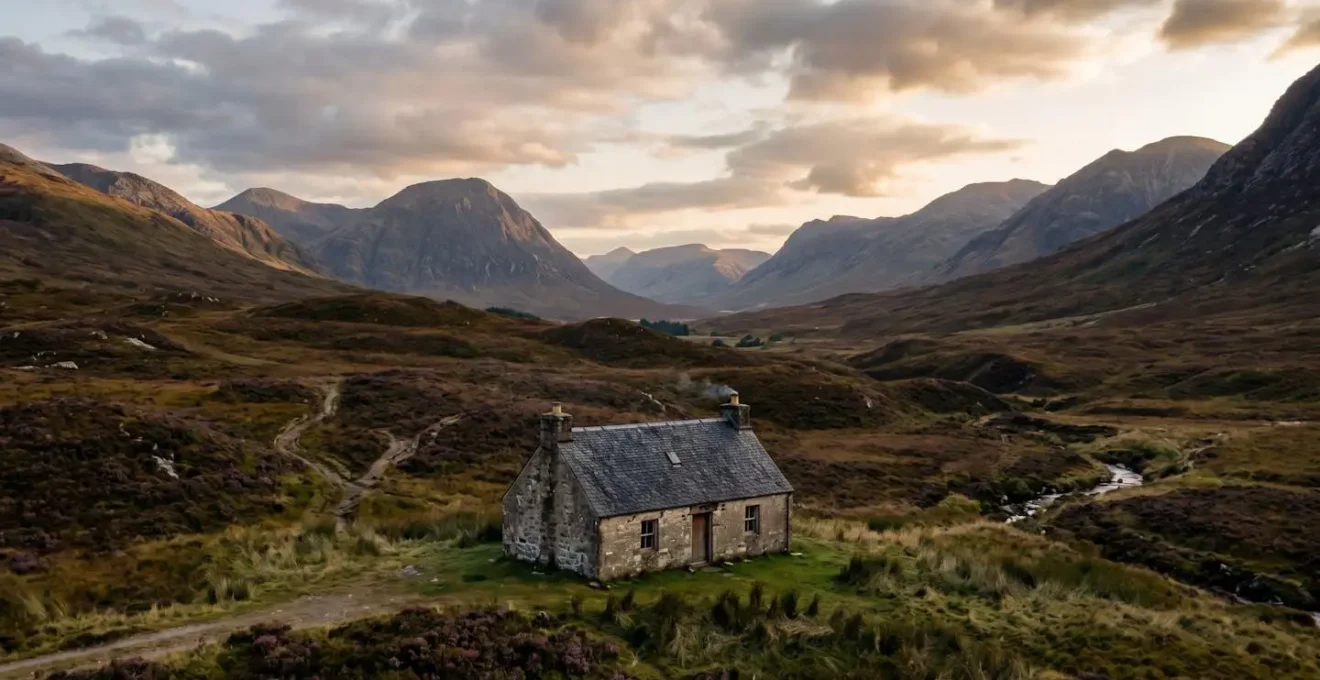
The dream is potent: a stone cottage nestled in a Highland glen or perched on a Hebridean cliff, with nothing but the cry of a curlew and the vast, open sky for company. Many city-dwellers, exhausted by the pace of urban life, imagine this as an escape to a simpler existence. Having lived and worked in some of the UK’s most remote corners, from the isles of Scotland to the valleys of Wales, I can tell you this is the first, and most dangerous, misconception. Thriving in a remote outpost is not about simplification. It is an act of complex, personal engineering.
Most advice focuses on the romantic aspects—the community spirit, the beautiful walks. But these are the rewards, not the foundations. The real work is in building robust, personal systems to replace the invisible infrastructure of the city. We’re talking about your digital lifeline, your personal supply chain, and your thermal security. Forget the dream of escaping modernity; the goal is to selectively import it, on your own terms. This requires a shift in mindset, from passive consumer to active systems architect.
This guide is built on that premise. We will move beyond the platitudes to dissect the core systems you must design and manage. We’ll analyse the critical decision between island and valley living, demystify the real costs of heating, and explore the new technologies making this life more viable than ever. We’ll even examine how to read the subtle social cues of deep rural life, before finally reframing success itself. This is not a deterrent, but a realistic blueprint for making the dream a sustainable reality.
This article will guide you through the critical systems and mindset shifts needed to transition successfully to a remote life. The following sections break down everything from digital connectivity to the unwritten rules of rural communities.
Summary: How to Thrive in Remote UK Outposts Without Sacrificing Modern Comforts
- Why Satellite Broadband Transforms Remote Working Viability in the Highlands
- Starlink vs 4G Bonding: Which Delivers More Reliable Rural Internet for Remote Work in the UK?
- How to Establish Supply Chains for Weekly Essentials 40 Miles From Shops
- The Hidden Heating Cost Newcomers Ignore When Moving to Remote Outposts
- Remote Island Living vs Mountain Valley: Which Offers Better Year-Round Access?
- When to Visit Before Committing: The 3 Seasonal Tests for Remote Living
- Why Single-Track Roads Reveal Traditional Farming Communities Better Than A-Roads
- How Nomadic Culture Redefines Success Beyond Fixed Addresses
Why Satellite Broadband Transforms Remote Working Viability in the Highlands
For decades, the single greatest barrier to professional life in remote areas has been the ‘digital desert’—a lack of reliable, fast internet. Copper lines falter over distance and fibre rollouts stop where the population thins. This has fundamentally changed. Low-Earth Orbit (LEO) satellite services like Starlink are not just an improvement; they are a revolution. This technology provides a genuine digital lifeline, making high-demand, modern careers viable from the most isolated postcodes.
The impact is profound. It’s no longer just writers and artists who can make a remote life work. A case study from the UK space sector highlights this shift, showing how software developers now remotely control satellite operations from rural properties. This demonstrates that niche, high-tech jobs, previously tethered to urban hubs, are now accessible. This isn’t just about checking emails; it’s about participating in the global economy with low-latency video calls, large file transfers, and real-time collaboration. The rapid adoption, with projections showing over 110,000 UK customers by mid-2025, underscores its transformative power for rural economies.
This transforms the property search. A house with a clear view of the northern sky is now more digitally connected than one in a valley ‘dead zone’, regardless of its proximity to a village. This newfound connectivity is the foundation upon which all other aspects of modern remote living are built.
As this image of a minimalist Highland workspace suggests, the dream of combining a professional career with a spectacular environment is now a logistical reality. The key is understanding that your connectivity is a piece of infrastructure you must now own and manage yourself, just like your water supply or septic tank. It’s the first and most critical system for a modern remote life.
Starlink vs 4G Bonding: Which Delivers More Reliable Rural Internet for Remote Work in the UK?
Simply deciding on “satellite internet” isn’t the end of the decision-making process. For anyone whose income depends on their connection, a deeper analysis is required. The two primary contenders for high-performance rural internet are LEO satellite (like Starlink) and 4G/5G bonding. They are not interchangeable, and the right choice depends entirely on your specific work and location.
Starlink’s main advantage is low latency. With typical performance of 25-60ms, it’s suitable for the most demanding real-time applications like Zoom calls, remote consultations, or online gaming. Its primary geographic requirement is a clear, unobstructed view of the northern sky, making it vulnerable in densely wooded areas or deep, north-facing valleys. While rain fade is a theoretical concern, it’s rare in UK conditions, and performance analysis shows that Reliability Experience scores surged by more than 30% in the UK as the network matured.
4G/5G bonding offers redundancy. This technology uses a special router to combine the signals from multiple SIM cards from different mobile networks (e.g., EE, Vodafone, O2). Its key strength is resilience; if one network goes down or becomes congested, the others pick up the slack. This makes it excellent for asynchronous tasks like large file transfers or automated backups. However, its biggest weakness is a dependency on having a line-of-sight to multiple, different network masts. Latency is also more variable (30-150ms), which can lead to frustrating call dropouts. If your property can only ‘see’ one mast, bonding is pointless.
Ultimately, the decision is a trade-off. For the video-call-heavy professional needing consistent low latency, Starlink is often the superior choice, despite its single point of failure. For those prioritizing upload bandwidth and resilience for non-real-time tasks, a well-sited 4G bonding setup can provide more peace of mind. Some professionals even opt for both: Starlink as the primary, with a single-SIM 4G dongle as a low-cost backup for total system resilience.
How to Establish Supply Chains for Weekly Essentials 40 Miles From Shops
Once you have your digital lifeline, the next system to engineer is physical: your supply chain. The convenience of the corner shop or 24-hour supermarket is the first thing to disappear when you move remotely. Achieving logistical sovereignty means designing a system that is resilient to weather, distance, and delivery failures. A 40-mile trip for a pint of milk is not a quirk; it’s a logistical problem that demands a strategic solution.
The first step is to accept the real cost. Research on rural logistics shows that rural deliveries cost 30% more on average than in urban areas, a cost absorbed in either fuel, time, or higher delivery fees. To counter this, you need a structured approach. I recommend a three-tier pantry system:
- Emergency Tier: This is your baseline resilience. Maintain a two-week supply of non-perishable essentials (tins, pasta, rice, UHT milk) that require no electricity to access or prepare. This is your buffer against power cuts or being snowed in.
- Bulk Tier: This is your cost-saving layer. Schedule quarterly trips to a wholesaler or, even better, form a micro-cooperative with neighbours to share bulk orders and delivery slots. Calculating the ‘landed cost’ (price + fuel + time) of items is a crucial mindset shift.
- Fresh Tier: This is for your weekly needs. The key is to automate. Establish recurring subscriptions for vegetable boxes, butchers, and dairies. Many use the Royal Mail’s universal service obligation, making them surprisingly reliable in deep rural areas. Aim to cover 80% of your fresh needs this way, reducing the need for frequent, costly shopping trips.
This system isn’t about hoarding; it’s about managing flow. You also need a logistics buffer: know your alternative collection points (like a friendly post office 20 miles away) for when a courier refuses to come down your track. By thinking like a logistics manager, you replace anxiety with a sense of control and turn a major stressor of remote life into a point of pride.
The Hidden Heating Cost Newcomers Ignore When Moving to Remote Outposts
The romantic image of a roaring fire in a stone cottage conceals a harsh financial reality. Heating a poorly-insulated, remotely-located property is often the single largest, and most underestimated, expense of rural life. Unlike in a city with mains gas, you are now responsible for the entire ‘total cost of warmth’: fuel logistics, system maintenance, and capital depreciation. Ignoring this is the fastest way to turn the remote dream into a financial nightmare.
Mains gas is a rarity. You’ll likely be reliant on heating oil, Liquid Petroleum Gas (LPG), or biomass, all of which come with logistical challenges and price volatility. You don’t just pay for the fuel; you pay for its delivery. A tanker needs to be able to reach your property, and you need space for a large storage tank. Furthermore, older stone properties, while full of character, are often thermal sinks. They can lose heat through uninsulated stone walls, drafty chimneys, and single-glazed windows at an alarming rate, sometimes increasing heat loss by 30-40% depending on wind exposure.
The key is to move from thinking about the monthly bill to calculating the total annual cost of the entire heating system. Before purchasing any remote property, a thermal imaging survey is non-negotiable. It will reveal the hidden deficits that don’t appear on a standard survey. You must budget not just for fuel, but for the eventual replacement of the entire system—a new oil boiler or heat pump can be a five-figure expense.
Action Plan: Calculating Your Total Cost of Warmth
- Annual Fuel Base Cost: Calculate heating oil at current wholesale rates (bulk-buy co-ops can reduce by 15-20%), LPG at premium rural rates, or biomass pellet delivery logistics and storage.
- System Capital Depreciation: Factor an annual replacement fund for your oil boiler (£3,000-£5,000 every 15-20 years) or heat pump system (£8,000-£14,000 every 20-25 years).
- Emergency Backup Provisions: Budget for generator fuel costs for electric heating during power cuts (rural areas experience 3x more outages than urban zones).
- Mandatory Annual Servicing: Budget for oil boiler servicing (£100-£150), heat pump servicing (£150-£250), and chimney sweeps for wood burners (£60-£100).
- Insulation Hidden Deficits: Commission a pre-purchase thermal imaging survey to identify stone wall moisture penetration, drafty chimneys, and wind exposure issues.
Thinking about warmth as a complete, managed system is essential. It allows you to make informed decisions, whether that’s negotiating a community bulk-buying contract in summer to hedge against winter price spikes or investing in insulation before you even think about redecorating.
Remote Island Living vs Mountain Valley: Which Offers Better Year-Round Access?
Not all remote locations are created equal. The type of isolation you experience is profoundly different between living on a remote island and living in a mountain valley. Newcomers often focus on the scenic differences, but a seasoned consultant looks at the infrastructure’s ‘failure points’. The critical question isn’t “which is more beautiful?” but “which system of access is more likely to fail, and can I tolerate that specific type of failure?”
Island life is defined by its primary access point: the ferry. This creates a binary state of connection. When the ferry runs, you are connected. When it doesn’t—due to storms, high seas, or mechanical issues—you are completely cut off. This isolation is sudden, unpredictable, and can be highly stressful. The aging Scottish ferry fleet is a well-documented issue, with government data revealing that 10,809 CalMac ferry sailings were cancelled in just over two years. This isn’t a minor inconvenience; it’s a fundamental risk to supply chains, medical appointments, and personal freedom.
Mountain valley life, conversely, is often characterised by a single point of failure in its road access: a single-track road vulnerable to snow, ice, or landslides. However, this isolation is often more predictable and seasonal. You know that from November to March, there is a higher risk of being snowed in. This predictability allows for preparation. While a landslide can cause sudden closure, the primary risk is seasonal, allowing residents to build their lives and supplies around it. Emergency access is also different, relying on Mountain Rescue teams rather than the Coastguard or air ambulance, each with its own weather-dependent limitations.
The following table breaks down these critical differences, focusing on the failure points rather than the romantic ideals.
| Access Factor | Remote Island (e.g., Outer Hebrides) | Mountain Valley (e.g., Scottish Highlands) |
|---|---|---|
| Primary Failure Point | Ferry reliability (72% cancellation rate recorded on some routes in October 2022) | Single-track road vulnerability to landslides, snow, flooding |
| Weather Dependency | Unpredictable isolation during storms; sea state cancellations | Predictable seasonal isolation (November-March snow/ice risk) |
| Digital Connectivity | Variable mobile signal over water; satellite primary option | Consistent valley-floor coverage if line-of-sight to masts exists |
| Emergency Services | Coastguard/RNLI response; air ambulance weather-dependent | Mountain Rescue response time 45-90 minutes; road access critical |
| Psychological Impact | Sudden, unpredictable isolation creates higher stress | Seasonal, predictable isolation allows advance preparation and coping |
Ultimately, there is no ‘better’ option, only the option whose risks you are better equipped to manage and psychologically prepared to endure. Understanding the specific nature of your potential isolation is a far more important decision than choosing between a sea view and a mountain view.
When to Visit Before Committing: The 3 Seasonal Tests for Remote Living
The most common advice given to prospective remote dwellers is “visit before you buy.” This is dangerously incomplete. A two-week holiday in August in a sun-drenched Highland glen tells you absolutely nothing about the reality of living there in a damp, dark November. To make an informed decision, you must move beyond being a tourist and become an auditor. I advise a rigorous process of seasonal stress-testing, designed to test the limits of the location, the infrastructure, and, most importantly, yourself.
This process involves three distinct, targeted visits throughout a year:
- The Peak Misery Test (November): This is the most crucial test. Visit during the absolute worst-case scenario for that location—a rainy, midge-filled week in a Scottish glen, or a storm-battered week on the coast. Your goal is to experience the place when it has lost all its scenic charm. You must test your genuine tolerance for prolonged darkness (sun setting at 15:45), persistent dampness, and the psychological weight of isolation when the landscape itself feels oppressive. Keep a daily journal of your emotional state. This is your baseline for mental resilience.
- The Infrastructure Stress Test (January-February): This mid-winter visit is a technical audit. Your sole focus is on system resilience. Are the roads gritted? How consistent is the Royal Mail delivery? Time the restoration of power after the inevitable outages—it’s often 3-4 times longer than in urban areas. Check your mobile signal strength indoors during a storm, not on a clear day. How does the heating system cope on a sub-zero night? Order something online and track its actual delivery time. This visit provides the hard data to back up your emotional response from the misery test.
- The Social Landscape Test (July/August & February): This is a two-phase test. First, visit during peak tourist season. Does the community feel vibrant or invaded? Do you, as a potential resident, resent the influx of visitors? This is a crucial test of your long-term attitude. Second, return in the deep off-season (February) to see what’s left. Is the local pub still open? Does a social life still exist beyond holiday acquaintances? This is when you can see if it’s possible to build genuine, year-round friendships.
This structured approach costs time and money, but it is a fraction of the financial and emotional cost of a failed relocation. It replaces a hopeful gamble with a data-driven decision, ensuring you are committing to the reality of a place, not just its postcard-perfect image.
Key Takeaways
- System Resilience is Paramount: True success in remote living comes from actively engineering robust systems for your digital, logistical, and energy needs, not from escaping modernity.
- Location is About Failure Points: Choose your location based on an honest assessment of its infrastructure’s weak points (ferries vs. roads) and your personal tolerance for those specific risks.
- Audit, Don’t Holiday: Before committing, conduct a three-season “stress test” of any potential location, visiting in the worst weather to test both the place and your own resilience.
Why Single-Track Roads Reveal Traditional Farming Communities Better Than A-Roads
For the newcomer, a single-track road is often a source of anxiety—a narrow, winding challenge to be navigated. But for those who learn to read them, these roads are a living map of the local community and its agricultural economy. They are where the unwritten rules of rural life are played out in real-time. Mastering the “Passing Place Dance” is your first, most visible test of cultural integration.
This ‘dance’ is the unwritten protocol of yielding, waving, and acknowledging other drivers. It’s a direct reflection of community interdependence. A working Land Rover pulling over well in advance for your car is a sign of respect and an acknowledgement of your shared space. A pristine SUV impatiently forcing its way through signals an outsider who doesn’t understand the cooperative nature of the road.
As one rural delivery driver’s account from the Highlands illustrates, the road itself tells the story. The presence of livestock grids signals active sheep or cattle farming. The state of gates and fences indicates the prosperity of the local farms. The condition of the passing places themselves shows the level of community cooperation on maintenance. Even the addresses speak volumes. As experts at Pegasus Couriers note:
Many remote homes don’t have typical street addresses—instead, you might be looking for ‘Rose Cottage’ or ‘The Old Farm’ which can be quite a puzzle!
– Pegasus Couriers, Multi-Drop Route Optimization in Rural Areas
This indicates a community that predates modern postal systems, one where everyone knows everyone else’s location by name, not by number. In this context, your vehicle and your driving style become your passport. Driving slowly and considerately, acknowledging others with a wave, and showing you understand the etiquette of the passing place is the fastest way to earn a measure of local respect. It shows you’re not just passing through; you’re learning to belong.
How Nomadic Culture Redefines Success Beyond Fixed Addresses
The final system to engineer is psychological. The biggest fear for many contemplating a remote move isn’t the logistics; it’s the permanence of the decision. What if it’s the wrong choice? This is where adopting a ‘nomadic’ mindset can be transformative. It reframes the move not as an irreversible life sentence, but as a reversible, skill-building phase. This dramatically lowers the psychological barrier to entry.
The core of this approach is to build an exit strategy from the very beginning. This isn’t planning for failure; it’s designing for flexibility. A rental-first approach is non-negotiable. Committing to a 6-12 month lease in a fully-equipped property allows you to conduct your seasonal stress tests without the crippling financial burden of a mortgage. Some of the most extreme locations, like Fair Isle with its 60 residents, offer seasonal rentals specifically for this purpose.
Next, you must maintain an urban anchor. This could be as simple as a small storage unit or a rented room in a friend’s flat. This serves a practical purpose—a postal address for banking and legal documents—but its main value is psychological. It’s your escape route, a tangible connection to your previous life that prevents the feeling of being trapped. Prioritise investment in portable infrastructure: a Starlink dish, modular furniture, and battery power stations can all move with you. Avoid investing in fixed assets like oil tanks or permanent heating systems until you are 100% committed.
This mindset also redefines success. Instead of measuring success by property value appreciation, you measure it by the reduction in your cost of living, the unique experiences gained, and the portfolio of practical skills acquired. Documenting the new capabilities you learn—from off-grid systems management to emergency first aid—turns the entire experience into a net gain, regardless of whether you stay for two years or twenty. This phased commitment model (Trial rental > Extended lease > Purchase) transforms a terrifying leap of faith into a series of manageable, data-driven steps.
Ultimately, making this life work is about embracing the role of a systems architect for your own existence. By thoughtfully designing your digital, logistical, thermal, and social systems, you can build a life that offers both modern opportunity and profound connection to the natural world. Your next step is to begin the audit of your own needs and risk tolerance to see which systems you need to build first.