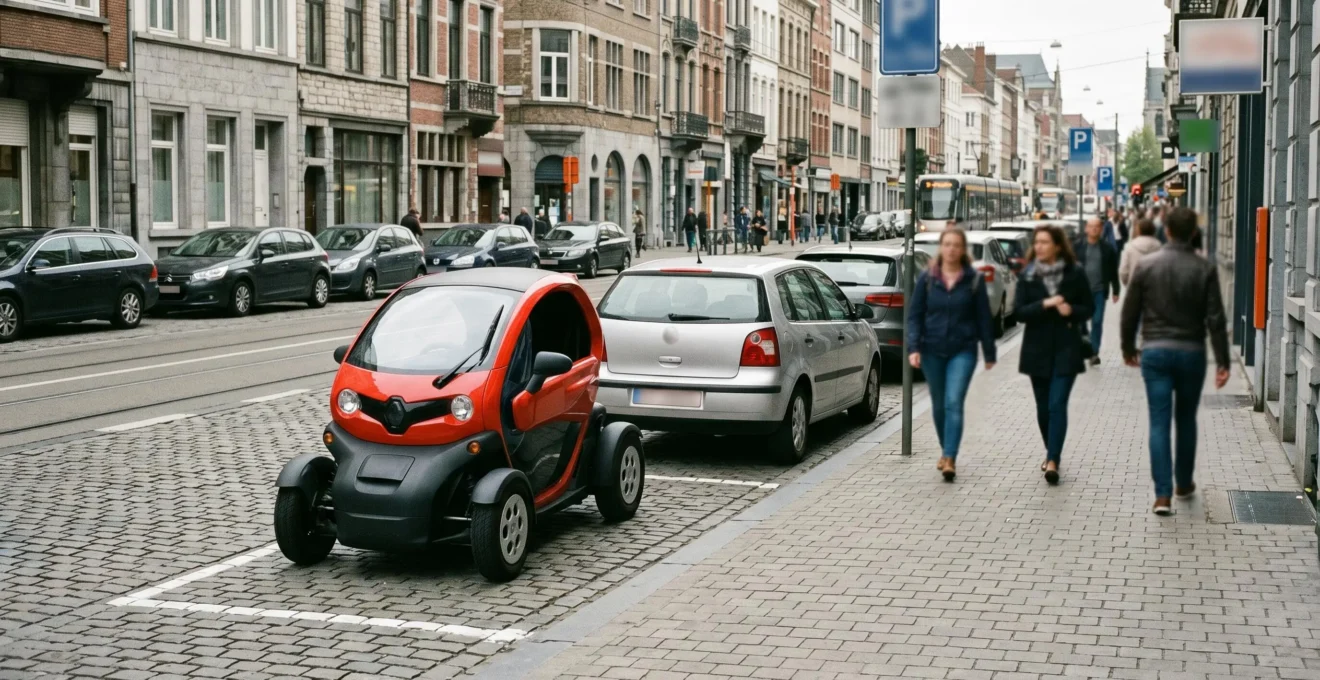
The true revolution of micro-mobility isn’t just about being green; it’s about mastering urban space and time efficiency.
- Compact vehicles exploit “spatial arbitrage,” using regulatory loopholes and physical size to access parking unavailable to cars.
- The most significant time savings come from eliminating the parking search, which can account for up to 30% of a car journey’s emissions and duration.
Recommendation: Re-evaluate your commute not by vehicle top speed, but by total door-to-door time, including the final, crucial step of parking.
The daily grind of urban commuting is a shared frustration. For many, the most stressful part isn’t the journey itself, but the final, agonising hunt for a parking space. Circling the block, watching the minutes tick by, feeling the pressure mount—this is the reality for city commuters and delivery drivers alike. Standard solutions like public transport have their own limitations, and the default to a personal car often means accepting parking scarcity as an unavoidable cost.
Discussions around micro-mobility—e-scooters, e-bikes, and microcars—often gravitate towards their environmental benefits or lower running costs. While valid, these points miss the fundamental disruption these vehicles introduce. They don’t just offer an alternative mode of transport; they offer a different relationship with the urban environment itself, one built on the principles of spatial and temporal efficiency. We’ve become accustomed to the idea that commuting is inefficient, but what if that’s a problem of tooling, not of a flawed cityscape?
The true, game-changing advantage of micro-mobility lies in its ability to reclaim time lost to the inefficiencies of car-centric infrastructure. This isn’t about simply moving faster; it’s about a smarter, more granular navigation of the urban landscape. This article moves beyond the surface-level benefits to dissect the mechanics of this efficiency. We will analyse how vehicle size unlocks restricted zones, compare travel times in real-world traffic, demystify hidden costs like insurance, and identify the precise threshold where switching makes undeniable financial sense.
This analysis provides a detailed breakdown of the strategic advantages offered by micro-mobility. By understanding the underlying principles of space efficiency, urban commuters can make more informed decisions to significantly reduce their daily travel friction and reclaim valuable time.
Table of Contents: A Consultant’s Guide to Urban Mobility Efficiency
- Why Microcars Under 2.5 m Length Access Restricted Parking Zones in London
- How to Legally Use E-Scooters for Commuting in UK Cities Without Penalties
- Electric Microcar vs E-Bike for 5-Mile Urban Commutes: Which Is Faster in Traffic?
- The Insurance Mistake Microcar Owners Make Assuming Moped-Level Rates
- When Micro-Mobility Makes Financial Sense: The 3-Mile Daily Commute Threshold
- Docked Bike-Share vs Dockless E-Scooters: Which Delivers Better Utilisation Rates?
- Car Club vs Personal Car Ownership: Which Saves Money for Under 5,000 Miles Per Year?
- How Urban Micro-Mobility Solutions Reduce City Centre Car Trips by 25%
Why Microcars Under 2.5 m Length Access Restricted Parking Zones in London
The core challenge for any vehicle in a city like London is not movement, but storage. The intense pressure on space is quantifiable; in the 2024-25 period, a staggering 9,462,185 Penalty Charge Notices were issued across the capital, a 13.5% increase highlighting the fierce competition for legal parking. This is where the concept of spatial arbitrage comes into play. Vehicles under a certain size, like microcars shorter than 2.5 metres, can physically and legally fit into spaces that are off-limits or impractical for standard cars.
Many boroughs have designated parking for “short vehicles” or motorcycle bays where compact quadricycles can park, spaces that a typical 4.5-metre-long family car could never use. This isn’t just about finding a spot; it’s about accessing a completely different, less-congested layer of parking infrastructure. The time saved is not incremental; it’s transformative. Instead of circling for 15-20 minutes in a high-demand area, a microcar driver can often park immediately in a designated or overlooked spot.
This efficiency has a direct impact on the driver and the city. As noted in analysis by smart parking experts, the hunt for parking is a major source of urban pollution and congestion. By drastically reducing this search time, microcars offer a powerful lever for improving urban air quality and traffic flow. They win the commuting game not by being the fastest vehicle on the open road, but by being the most efficient at the journey’s end, where time is most often lost. The strategy is not to outrun other cars, but to out-manoeuvre them spatially.
How to Legally Use E-Scooters for Commuting in UK Cities Without Penalties
While privately owned e-scooters remain illegal on UK public roads, a legitimate and growing pathway for their use exists through government-approved rental trials. For commuters frustrated by last-mile gaps in their journey, understanding this legal framework is key to avoiding penalties. The “penalty” isn’t just a fine; it’s a safety issue. Figures from the UK Department for Transport are a stark reminder of the risks, showing that in 2022, 11 riders and 1 pedestrian died in e-scooter crashes, with 1,480 injuries recorded. Using approved schemes ensures the vehicle is maintained and, crucially, includes third-party insurance.
The process is managed entirely through smartphone apps, which act as the gateway to legal ridership. These platforms handle everything from licence verification to payment and ensure the scooter can only be activated and used within the designated trial zone. This digital tether is what makes the system work, enforcing compliance automatically.
As the image suggests, the interaction is seamless and digital. However, behind this simple interface is a strict set of rules that users must follow to remain compliant. Riding on pavements, exceeding the 15.5 mph speed limit, or attempting to use the scooter outside the geofenced trial area can result in immediate fines and account suspension. Adhering to the legal requirements is not just about avoiding a penalty; it’s about participating in a system designed to test and prove the viability and safety of this new mobility form.
Your Checklist for Legal E-Scooter Use in the UK:
- Only rent e-scooters through official government-approved rental schemes in designated trial areas.
- Ensure you hold a full or provisional UK driving licence (categories AM, A1, A2, A, or B).
- Ride only on public roads and in cycle lanes; never on pavements or motorways.
- Verify the rental operator provides the mandatory third-party motor insurance coverage for your ride.
- Follow the 15.5 mph speed limit and always use lights in darkness or poor visibility.
Electric Microcar vs E-Bike for 5-Mile Urban Commutes: Which Is Faster in Traffic?
When comparing urban commute speeds, the top speed of a vehicle is a misleading metric. The real measure is “door-to-door” time, which accounts for traffic, infrastructure use, and parking. For a typical 5-mile urban journey, the battle between an electric microcar and an e-bike is a classic trade-off between comfort and agility. An e-bike’s primary advantage is its ability to filter through traffic and use dedicated cycle lanes, bypassing the congestion that traps cars. Research has shown that e-bikes are significantly faster than conventional bicycles, particularly on varied terrain, giving them a strong baseline of efficiency.
The electric microcar, while subject to the same traffic as a standard car, counters with two key advantages: a fully enclosed cabin providing weather protection and meaningful cargo space. This makes it a more viable year-round, all-purpose commuter. However, its biggest time cost is the parking search. In contrast, an e-bike’s “parking” is as simple as finding a railing to lock it to. This final-stage efficiency is often where the e-bike gains its decisive time advantage.
The following table breaks down the practical differences, sourced from a comprehensive analysis of urban commuting options.
| Factor | Electric Microcar | E-Bike |
|---|---|---|
| Average Speed (urban) | 25-30 km/h in traffic | 25-45 km/h (lane filtering) |
| Door-to-Door Time (5 miles) | 15-20 min + parking search | 12-18 min + immediate lock-up |
| Weather Protection | Full enclosed cabin | Exposed to elements |
| Cargo Capacity | Trunk space for laptop/groceries | Limited to backpack/panniers |
| Infrastructure Dependency | Requires car parking spaces | Uses bike lanes, flexible parking |
| Physical Effort | None (passive travel) | Moderate pedal assistance |
Ultimately, the “faster” vehicle depends on the journey’s specific conditions and the commuter’s priorities. For a trip with no cargo on a clear day, the e-bike will almost certainly win on time. For a rainy day with a load of groceries, the microcar’s practicality and comfort may be worth the extra few minutes, especially if a dedicated small-vehicle parking spot is available at the destination.
The Insurance Mistake Microcar Owners Make Assuming Moped-Level Rates
A common and costly assumption made by prospective microcar owners is that a small vehicle equates to small insurance premiums. The logic seems sound: if it’s the size of a moped, it should be insured like one. However, this overlooks the critical factor of vehicle classification. In the UK, despite their size, microcars (or quadricycles) are classified as motor vehicles that require full car insurance, not the typically cheaper motorcycle or moped policies. This is the essence of the insurance miscalculation.
This misunderstanding is often perpetuated by general observations that microcars have “relaxed requirements for registration and licensing,” which can lead to the false belief that all associated costs are lower. The reality on the ground can be a shock, as many insurers treat them as a niche, non-standard risk, leading to disproportionately high premiums. The vehicle’s unique construction and repair costs can also be a factor.
The badge on the vehicle, denoting its classification, is the detail that matters to insurers, not its physical footprint. A real-world example perfectly illustrates this financial pitfall.
Case Study: The £700 Microcar Insurance Shock
A 50-year-old UK driver with a clean driving record spanning 20 years was quoted £700 annually to insure a 2003 Aixam 500 microcar. As detailed in an advisory report on the matter, the driver, who held a B1 licence through motorcycle entitlement, was expecting costs comparable to a moped. They discovered that insurers categorize the Aixam as a full-fledged car, demanding premiums that reflect this classification, a stark contrast to the low rates anticipated. This case highlights the critical gap between owner expectation and the reality of insurance underwriting for quadricycles.
This discrepancy underscores the importance of due diligence. Before investing in a microcar, potential buyers must obtain actual insurance quotes rather than relying on assumptions based on size. The perceived running cost savings can be significantly eroded if the insurance premium is three or four times higher than expected.
When Micro-Mobility Makes Financial Sense: The 3-Mile Daily Commute Threshold
The decision to switch from a car to a micro-mobility solution is often triggered by a financial calculation. While the exact breakeven point varies with individual circumstances, a widely recognized tipping point is the short, daily commute, typically around three miles. At this distance, the high fixed costs of car ownership (insurance, tax, depreciation) and the per-mile running costs (fuel, parking) become disproportionately expensive compared to the utility gained. For these short, regular trips, the lower operational costs of an e-bike or e-scooter create a compelling financial case.
This isn’t just theory; it’s a demonstrated pattern of behavioural change. The primary impact of shared micro-mobility is its ability to replace car journeys. A 2022 study revealed that 37% of shared micromobility trips directly replaced vehicle trips, leading to a tangible reduction in daily vehicle miles traveled. Every car trip replaced is a direct saving for the commuter and a reduction in congestion and pollution for the city.
The “Commute Threshold” is therefore not just about distance, but about frequency. An e-bike might not replace a car for a weekly long-distance trip, but it can easily replace it for the five-day-a-week, three-mile commute to the office or train station. Research shows that e-bike users tend to ride more frequently than conventional cyclists because the electric assistance lowers the physical barrier to entry. This increased usage frequency solidifies the e-bike as a reliable daily commuter tool, maximizing its financial return on investment. The financial sense is found in the consistent, day-in, day-out replacement of more expensive car miles. It is the consistency of use on short trips that unlocks the greatest savings.
Docked Bike-Share vs Dockless E-Scooters: Which Delivers Better Utilisation Rates?
Comparing the utilisation rates of docked bike-share schemes and free-floating dockless e-scooters is a classic urban mobility debate. A simplistic view might be to count the number of trips per vehicle per day. However, this misses the crucial point: they are not direct competitors. As one mobility analysis succinctly puts it, they serve fundamentally different trip intents. This is the utilisation rate paradox: a lower rate doesn’t necessarily mean a less useful system.
The citation below clarifies this distinction perfectly:
Docked bikes excel for planned, longer A-to-B commutes (e.g., station to office), while dockless scooters excel at spontaneous, short, ‘last 500m’ trips, meaning their utilisation rates aren’t directly comparable as they serve different needs.
– Urban mobility analysis, Micromobility trip intent research
Docked systems, with their fixed stations, thrive on predictability and are optimized for commuting corridors between transport hubs and business districts. Their utilisation is concentrated during peak morning and evening hours. Dockless e-scooters, by contrast, are designed for spontaneity. They solve the “first-mile/last-mile” problem—the short, often unplanned journey from a bus stop to a final destination, or a quick trip to a local shop. Their usage pattern is more distributed throughout the day.
The success of these systems also hinges on the technology of “parking”. Dockless systems have struggled with vehicle clutter, leading cities to demand better parking solutions. Interestingly, precision matters immensely. Testing in Prague and Madrid demonstrated that new Bluetooth-based parking antennas achieved a 90.6% success rate in correctly identifying a parked vehicle’s location, compared to just 38.4% for traditional GPS. Better utilisation, therefore, is not just about how often a vehicle is ridden, but also how efficiently it can be located, managed, and parked at the end of a trip.
Car Club vs Personal Car Ownership: Which Saves Money for Under 5,000 Miles Per Year?
For the low-mileage urban driver—someone covering less than 5,000 miles per year—the economics of personal car ownership are often hard to justify. The significant fixed costs of insurance, tax, maintenance, and depreciation weigh heavily on a per-mile basis. This is the exact scenario where “access over ownership” models, like car clubs and micro-mobility, present a powerful financial alternative. The choice is no longer simply “my car” versus “public transport.” It’s about building a personal, flexible mobility stack.
A car club offers the convenience of a car for occasional, necessary trips (like a large grocery run or a trip out of the city) without the burden of ownership. For the vast majority of shorter, daily trips, a personally owned micro-mobility vehicle like an e-bike or a microcar becomes the primary mode of transport. This hybrid approach allows the user to select the most cost-effective and time-efficient tool for each specific journey.
Even if a user opts for a personally owned microcar, the running costs are substantially lower. With manufacturer specifications showing that many microcars can achieve 75 mpg fuel economy, the savings on fuel alone are significant compared to a standard car that might average 30-40 mpg. When this is combined with lower tax brackets and potentially cheaper parking, the financial case becomes even stronger. As one analysis notes, once you have the initial asset, like an e-bike, the ongoing costs are minimal compared to a car, especially with rising fuel prices. The key is to match the tool to the job: a large, expensive car should not be the default for a two-mile commute.
Key Takeaways
- The true value of micro-mobility is measured in door-to-door efficiency, not top speed.
- Vehicle size and classification are strategic tools for bypassing car-centric limitations like parking and traffic.
- Always verify insurance costs based on vehicle classification (quadricycle vs. motorcycle), as assumptions can be expensive.
How Urban Micro-Mobility Solutions Reduce City Centre Car Trips by 25%
The individual time and cost savings offered by micro-mobility are compelling, but their true power is realised at a collective, city-wide scale. The cumulative effect of thousands of commuters choosing a scooter or e-bike over a car is a measurable reduction in urban congestion and a fundamental reshaping of the cityscape. The goal stated in the title—a 25% reduction in car trips—is ambitious but achievable, built on the principle of modal shift at scale. The rapid adoption rates, with e-scooter trips in the US showing a 130% increase in a single year before the pandemic, demonstrate a clear public appetite for these alternatives.
This shift from private cars to shared and personal micro-vehicles directly attacks the problem of spatial inefficiency. A standard car requires a vast amount of space, not just for travel but, more critically, for parking. As a Planetizen report on urban planning highlights, widespread adoption of micro-mobility can fundamentally alter this equation.
As more and more people use micromobility, the need for parking private motor vehicles can decrease. Robust shared micromobility programs, and incentives such as subsidies and proper infrastructure to promote use, may lead to a decline in vehicle ownership and subsequent reductions in the need to provide both on- and off-street parking.
– Planetizen urban planning report, Leading Micromobility Trends for 2024
Reducing car trips by a quarter means freeing up vast swathes of urban real estate currently dedicated to on-street parking. This space can be repurposed for wider pavements, dedicated cycle lanes, green spaces, or outdoor seating—amenities that improve the quality of urban life for everyone. The reduction in car trips is not just a transportation metric; it is a catalyst for urban transformation, enabling a move away from cities designed for cars to cities designed for people.
To truly benefit from these insights, the next logical step is to analyze your own daily journeys. Evaluate them not by habit, but through the critical lens of spatial and temporal efficiency to identify where a smaller, smarter vehicle could reclaim your time and money.