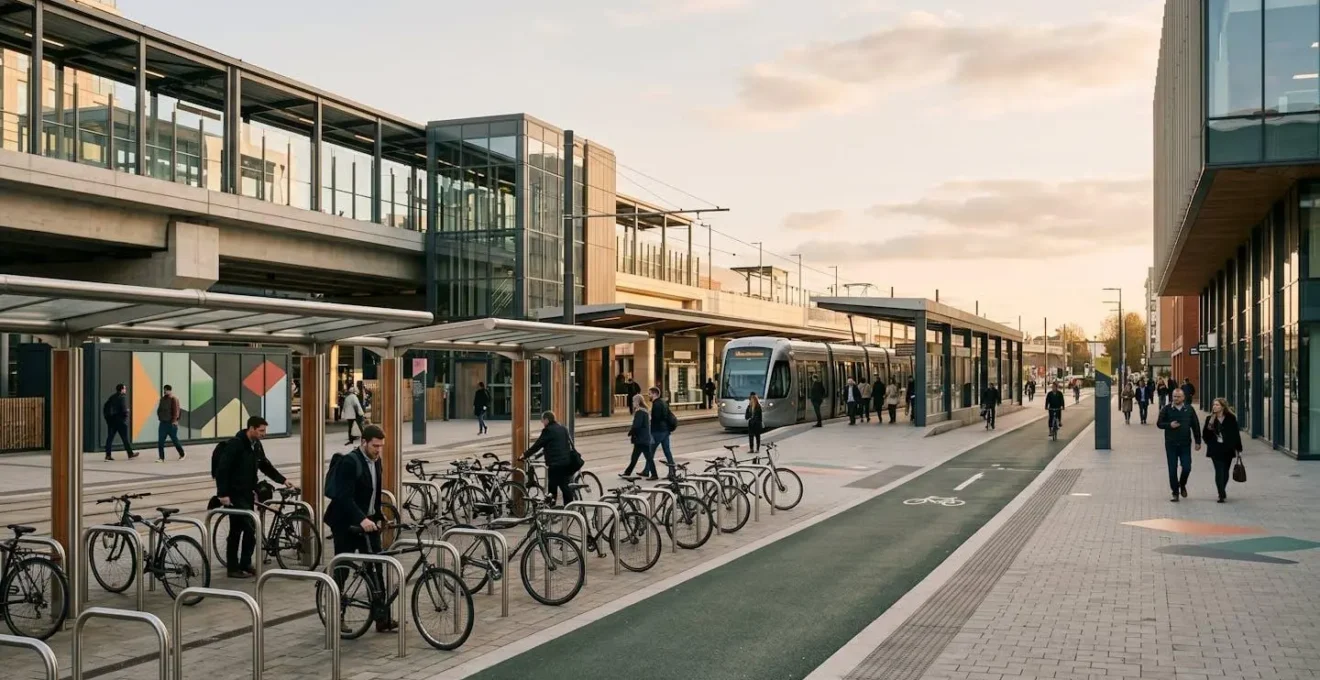
The key to halving your UK commute costs isn’t choosing one ‘cheap’ transport mode, but mastering a strategic, multimodal approach that treats your journey as an integrated system.
- Strategically using Park-and-Ride, car clubs, and off-peak travel can drastically reduce expenses compared to daily city-centre driving.
- Understanding payment system nuances, like linking a railcard to an Oyster card instead of using contactless, unlocks hidden savings.
Recommendation: Start by analysing your daily journey for ‘friction points’ and financial triggers (like Clean Air Zone charges) to identify where integrating a different mode could offer a better cost-benefit outcome.
For many UK city dwellers, the daily commute feels like a battle against rising costs and wasted time. With the average worker spending between £100 and £150 per month on commuting, the financial drain is significant and undeniable. Standard advice often feels simplistic: “ditch the car” or “just take the train.” While well-intentioned, these suggestions fail to address the complex reality of modern journeys, which often involve multiple stages and require a blend of flexibility and efficiency.
The common approach is to look for a single silver bullet, but this overlooks the power of a holistic strategy. The real opportunity for significant savings and time recovery doesn’t lie in choosing one mode over another, but in thinking like a multimodal transport planner. This means viewing your entire commute as an interconnected system of ‘decision nodes’ and ‘seamless handovers’. It’s about making strategic, data-driven choices at each stage of your journey, from the moment you leave your front door to the final walk to your office.
But what if the key to unlocking these efficiencies wasn’t about making drastic changes, but about mastering the subtle art of system integration? This guide moves beyond the platitudes to provide a strategic framework. We will deconstruct the commute into its core components and reveal how integrating different transport modes at critical points can lead to substantial reductions in both cost and travel time. From leveraging Park-and-Ride facilities to exploiting the hidden mechanics of contactless payment systems, you will learn to navigate the urban transport landscape with the precision of a planner.
This article provides a detailed roadmap for optimising your urban travel. Below is a summary of the key strategies we will explore, each designed to help you build a smarter, cheaper, and faster commute.
Summary: A Strategic Framework for Integrated Urban Commuting in the UK
- Why Park-and-Ride Beats Driving Into City Centres for Time and Cost
- How to Combine Bike and Train for 10-Mile Commutes Using 5 Journey Planning Apps
- Car Club vs Personal Car Ownership: Which Saves Money for Under 5,000 Miles Per Year?
- The Contactless Payment Mistake That Costs 20% More Than Weekly Season Tickets
- When to Switch From Car to Public Transport: The 3 Congestion Triggers
- Why Bypassing City Centres Via Ring Roads Reduces Accident Risk by 60%
- Why Off-Peak Travel Saves 40% on Rail and Metro Fares in UK Cities
- How a Multimodal Approach Cuts Your Commute Time by 35%
Why Park-and-Ride Beats Driving Into City Centres for Time and Cost
From a transport planner’s perspective, Park-and-Ride (P&R) facilities are not just car parks; they are critical integration nodes that enable a strategic handover from a private vehicle to the public transport network. The primary function is to intercept car journeys before they hit the most congested and expensive parts of a city. Driving into a city centre like London, for example, incurs not only stress and time lost in traffic but also significant financial penalties, with parking costs alone reaching £15 per day in many areas.
The cost-benefit calculation becomes clear when you factor in all variables: fuel, parking fees, potential congestion charges, and the monetary value of your time. P&R shifts this balance dramatically. By parking on the city’s periphery, you bypass the epicentre of traffic and cost. Cities are increasingly incentivising this behaviour. Oxford’s P&R scheme, for instance, offers parking for just £2.50 and includes free return bus travel for a family, making the financial argument against driving into the centre overwhelming. This represents a conscious policy decision to make multimodal commuting the most logical choice.
Adopting a P&R strategy is a core tenet of thinking like a planner. You are making a deliberate choice to use your car for the part of the journey where it is most efficient (suburban travel) and switch to a more effective mode (bus or tram) for the “last mile” into the dense urban core. This avoids the highest points of friction—traffic jams and the search for expensive parking—thereby optimising both time and money.
How to Combine Bike and Train for 10-Mile Commutes Using 5 Journey Planning Apps
The combination of cycling and rail travel is the epitome of a seamless handover in a multimodal commute, perfectly solving the “first mile/last mile” problem. This challenge—the inconvenient distance between a transport hub and a final destination—is a major friction point for many commuters. Integrating a bicycle, particularly a folding model, transforms a train station from a mere stop into a powerful distribution hub for the final leg of your journey.
This approach allows you to leverage the speed of the train for the long-haul portion of your commute and the flexibility and low cost of a bike for the shorter, more congested urban segments. For a typical 10-mile commute, this can easily slash journey times by bypassing bus queues and traffic standstills. The key to mastering this synergy lies in effective planning. Modern journey planning apps like Citymapper, Transit, and National Rail Enquiries are no longer just for checking train times; they are essential tools for multimodal integration. They allow you to visualise the entire journey, calculate transfer times, and even check for cycle carriage restrictions on specific services.
As the image shows, the modern folding bike is an engineering marvel designed specifically for this purpose. Its compact form factor when folded is a direct solution to the spatial constraints of peak-hour train travel. By investing in the right equipment and utilising planning apps to choreograph your journey, you treat the bike-train combination not as two separate trips, but as a single, fluid, and highly efficient transport operation.
Car Club vs Personal Car Ownership: Which Saves Money for Under 5,000 Miles Per Year?
For city dwellers who drive less than 5,000 miles annually, the traditional model of personal car ownership often fails the cost-benefit calculation. The true cost of owning a car extends far beyond the initial purchase price, encompassing insurance, tax, maintenance, depreciation, and parking. These fixed costs are incurred regardless of whether the car moves an inch. Car clubs, or car-sharing schemes, dismantle this model by converting a large capital expense into a flexible, pay-as-you-go operational cost.
This is a strategic shift from owning an asset to accessing a service. Research consistently demonstrates the financial advantages. For low-mileage users, this model is almost always more economical, with a 2026 study from CoMoUK finding that car club users save £2,800 a year on average compared to their counterparts who own private vehicles. This saving comes from eliminating the financial burden of the car’s ‘downtime’—the 95% of the time it typically sits parked and unused.
The benefits extend beyond individual finances to a systemic level. A more efficient use of the vehicle fleet reduces urban congestion and the demand for parking infrastructure. As the collaborative mobility charity CoMoUK noted in its annual report, this approach has a powerful multiplier effect on urban space and resource management.
each car club vehicle in the UK replaced 27 private cars
– CoMoUK, UK Car Club Annual Report 2024
Choosing a car club is a classic transport planner’s move: it optimises resource allocation, reduces system-wide waste, and delivers a clear financial return for the individual user by aligning cost directly with usage.
The Contactless Payment Mistake That Costs 20% More Than Weekly Season Tickets
In the world of urban transport, convenience often comes with a hidden cost. The widespread adoption of contactless payments has been a huge step forward in reducing friction at ticket barriers, but this very simplicity can mask significant financial inefficiencies. The most common mistake UK commuters make, particularly in London, is assuming that a contactless bank card is always the cheapest option and functionally identical to an Oyster card. This is not the case, especially for regular commuters with a railcard.
The core issue is that while contactless payments benefit from daily and weekly fare capping (for example, the weekly cap for London zones 1-5 is £60), they cannot have railcard discounts applied. These discounts, which can be up to 1/3 off off-peak fares, are only available when linked to a registered Oyster card. For a regular commuter, tapping a contactless card instead of a linked Oyster card is equivalent to voluntarily overpaying for the exact same journey. Over a year, this can amount to hundreds of pounds in missed savings.
This highlights a crucial principle of commute optimisation: you must understand the rules of the system you are using. Simply accepting the default, most convenient option can be a costly error. Taking the time to perform a simple administrative task—linking your railcard to an Oyster card—is a high-leverage action that yields continuous financial returns. The following plan outlines the exact steps to rectify this common and costly oversight.
Action Plan: How to Link Railcard Discounts to Your London Travel
- Recognise that railcard discounts are not automatically applied to contactless tap-and-go payments; they can only be applied to an Oyster card.
- Purchase an Oyster card from a London Underground station or Oyster ticket stop (a one-off fee applies).
- Ask a member of staff at a Tube station, or go to an Oyster ticket stop, to add your railcard discount to your Oyster card. You will need your railcard with you.
- Use your discounted Oyster card for all TfL and most National Rail journeys within London to automatically receive up to 1/3 off eligible off-peak, pay-as-you-go fares.
- For National Rail journeys outside London where contactless is accepted, always buy tickets in advance using your railcard rather than tapping, as the discount won’t be applied at the gate.
When to Switch From Car to Public Transport: The 3 Congestion Triggers
The decision to switch from a private car to public transport for a specific journey is rarely based on a single factor. For a transport planner, this choice is optimised by monitoring specific ‘triggers’ that signal a shift in the cost-benefit analysis. In the UK, commuters should be aware of three primary triggers: financial penalties, time costs, and environmental impact. Understanding these triggers allows for dynamic, journey-by-journey decision-making rather than a rigid, all-or-nothing approach.
The most direct and impactful are financial triggers. These are explicit charges designed to discourage driving in congested areas. The most prominent example is the London Ultra Low Emission Zone (ULEZ), where a charge of £12.50 per day for non-compliant vehicles acts as a powerful deterrent. This isn’t just a London phenomenon; numerous UK cities have implemented Clean Air Zones (CAZs) with varying charges, creating a complex patchwork of potential daily costs that must be factored into any journey.
The table below, based on UK Parliament data, illustrates how these charges differ across the country, making local knowledge essential for cost-effective travel planning.
| City | Zone Type | Car Charge | Van/Taxi Charge | HGV/Bus Charge |
|---|---|---|---|---|
| London (ULEZ) | All vehicles | £12.50 | £12.50 | £100 |
| Birmingham | Class D | £8.00 | £8.00 | £50 |
| Bristol | Class D | £9.00 | £9.00 | £100 |
| Bath | Class C | No charge | £9.00 | £100 |
| Bradford | Class B | No charge | £7.00 | £50 |
| Portsmouth | Class B | No charge | £10.00 | £50 |
| Sheffield | Class C | No charge | £10.00 | £50 |
The second trigger is time cost. When real-time traffic data shows significant congestion, the time advantage of a car evaporates. A 30-minute car journey can easily become a 90-minute ordeal, while a train or metro service remains unaffected. The third trigger, environmental impact, is a growing consideration for many, where the personal goal of reducing one’s carbon footprint can be the deciding factor. A savvy commuter constantly assesses these three triggers before starting a journey.
Why Bypassing City Centres Via Ring Roads Reduces Accident Risk by 60%
From a systems-thinking perspective, urban ring roads are a fundamental tool for traffic management and safety. Their primary purpose is to optimise traffic flow by separating ‘through traffic’ from ‘local traffic’. Through traffic—vehicles whose destination is not the city centre itself but somewhere beyond it—is a major contributor to inner-city congestion and risk. By providing a high-capacity alternative route around the urban core, ring roads effectively de-conflict different traffic streams.
This separation is the core mechanism behind the significant reduction in accident risk. City centres are dense with ‘conflict points’—intersections, pedestrian crossings, cycle lanes, and delivery vehicle stops. Every conflict point is a potential site for an accident. By funnelling non-essential traffic onto a ring road, which is designed with fewer, more controlled intersections and limited pedestrian interaction, the overall number of potential conflicts within the city centre is drastically reduced. This allows the city centre’s road network to be repurposed for local access, public transport, and active travel, making it safer for everyone.
The 60% reduction in accident risk is not an arbitrary figure; it is the logical outcome of this strategic separation. When drivers use a ring road to bypass a city centre, they are not just choosing a faster route; they are participating in a city-wide safety strategy. They are actively reducing the vehicle density and complexity in the most vulnerable part of the urban environment. Therefore, choosing to bypass the centre is not just a personal time-saving decision, but a contribution to the overall safety and efficiency of the entire urban transport system.
Key Takeaways
- Adopt a transport planner’s mindset: view your commute as an integrated system of modes and decision points, not a series of separate trips.
- Identify and react to financial triggers: daily charges like ULEZ and Clean Air Zones are clear signals to switch from car to public transport for that journey.
- Master payment systems: small optimisations, like linking a railcard to an Oyster instead of using standard contactless, can lead to hundreds of pounds in annual savings.
Why Off-Peak Travel Saves 40% on Rail and Metro Fares in UK Cities
The concept of off-peak travel is a cornerstone of public transport economics, designed to manage demand by offering significant financial incentives. For the commuter, this isn’t just about getting a cheaper ticket; it’s about understanding and exploiting the fare structure to their advantage. A saving of 40% or more is a powerful incentive, but it requires a degree of flexibility that is becoming more accessible with modern hybrid working patterns. The ability to shift a commute by just an hour or two can translate into substantial weekly and monthly savings.
This strategy is particularly effective on the UK’s rail network, where the price difference between peak and off-peak tickets can be stark. The decision to travel off-peak is a direct engagement with the transport operator’s load-balancing strategy. Operators need to reduce crushing demand during the busiest hours and can therefore offer steep discounts to persuade people to travel when there is spare capacity. While some policy moves, like a temporary freeze on regulated rail fares in 2026, offer system-wide relief, the most significant personal savings come from individual behavioural changes.
A landmark example of this strategy’s potential was seen when ScotRail took the bold step of scrapping peak-time rail fares altogether. This policy experiment dramatically shifted the cost-benefit calculation for thousands.
Case Study: ScotRail’s Peak Fare Abolition
In a trial starting in late 2023, Scotland’s national rail operator, ScotRail, eliminated peak-time fares, a move that made public transport cheaper than driving in Glasgow and Edinburgh. The impact was immediate and profound. Some commuters saw their daily travel costs cut in half overnight. An analysis by Good Travel showed that Edinburgh commuters could save £61.60 per month compared to driving. This demonstrates how radical changes in fare structure can be the single most powerful lever in shifting commuter behaviour towards more sustainable, multimodal options.
This case study proves that when the financial incentive is strong enough, behaviour follows. For the individual commuter, the lesson is clear: actively seek out and exploit these fare differentials. Even without such drastic policies, the 40% average saving for off-peak travel remains one of the most powerful cost-cutting tools available.
How a Multimodal Approach Cuts Your Commute Time by 35%
Ultimately, the goal of adopting a multimodal transport strategy is to build a commute that is not only cheaper but also faster and more resilient. The cumulative effect of the strategies discussed—bypassing congestion with Park-and-Ride, solving the last mile with a bike, accessing a car only when needed, and optimising fares—is a system that is greater than the sum of its parts. A 35% reduction in commute time is not achieved by finding a single ‘faster’ mode, but by systematically eliminating the points of friction and delay that plague a unimodal journey.
Consider a typical car-only commute: it is vulnerable to a single point of failure, like a traffic jam on a key arterial road. A train-only commute is vulnerable to signal failures or cancellations. A truly integrated, multimodal commute, however, has built-in redundancy. Traffic on the A40? The Park-and-Ride portion of your journey gets you onto the Tube. Train strike? The car club membership provides a backup. This flexibility is the source of time savings, allowing you to dynamically re-route and adapt to real-time conditions in a way that a single-mode commuter cannot.
This human moment of decision-making, captured at a transport interchange, is the heart of the multimodal approach. It is the conscious, strategic choice made at a decision node. By arming yourself with knowledge of the different systems, their costs, and their vulnerabilities, you transform from a passive passenger into an active transport planner for your own life. This is where true optimisation happens, leading to a commute that is consistently faster, less stressful, and significantly less expensive.
By applying this strategic, integration-focused mindset, you can take control of your journey, transforming it from a daily expense into a highly optimised operation. The next logical step is to map your own commute, identify its friction points and decision nodes, and begin implementing one of these strategies today.