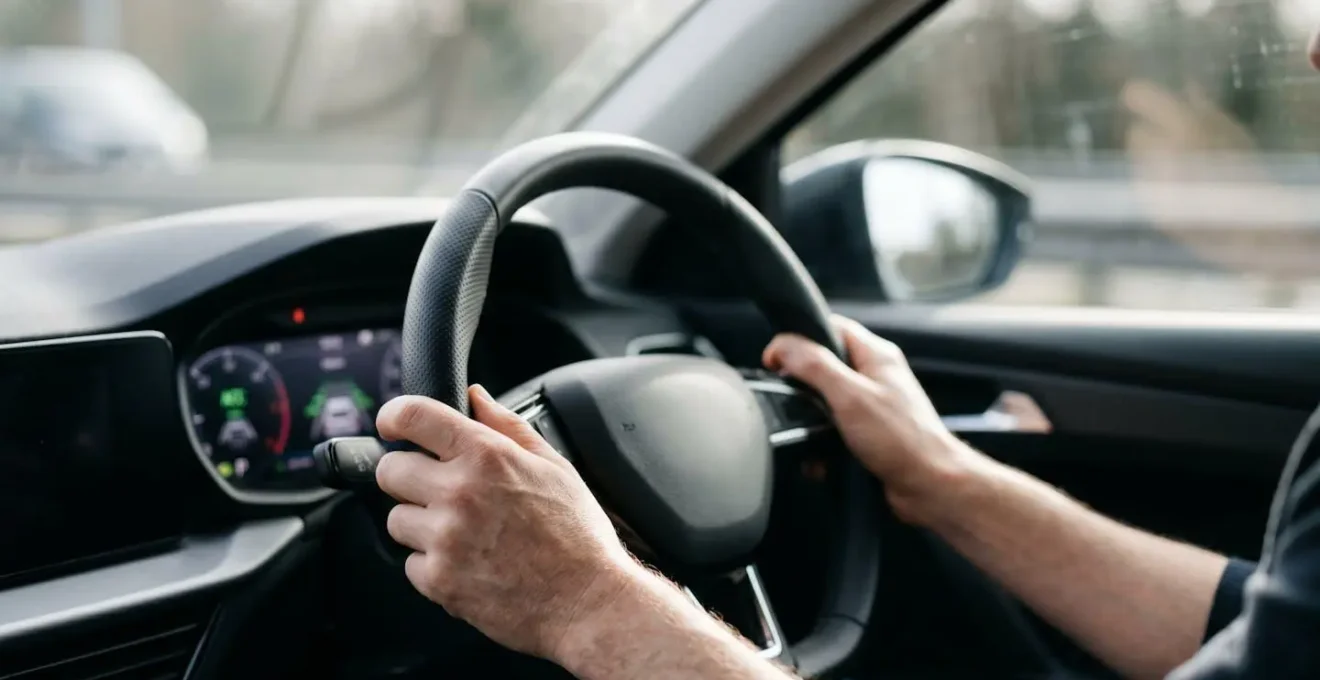
Mastering Adaptive Cruise Control is less about passive activation and more about understanding its sensor logic to proactively manage safety and efficiency.
- ACC with Stop-and-Go eliminates the constant pedal work of traffic jams, drastically cutting mental load.
- System behaviour in curves, during lane changes, and in bad weather is dictated by predictable sensor limitations you can learn to anticipate.
Recommendation: Move from being a passive user to an informed operator by actively calibrating ACC settings for traffic conditions and understanding when to manually override the system for smoother, safer driving.
For many long-distance commuters, Adaptive Cruise Control (ACC) is seen as a simple convenience feature—a ‘set and forget’ tool for maintaining speed on an open motorway. The common advice is to turn it on, select a following distance, and let the car handle the throttle and brakes. However, this superficial understanding misses the technology’s true potential and its inherent limitations. It fails to explain why the system sometimes brakes unexpectedly, feels hesitant in curves, or gets confused by other drivers.
The reality is that ACC is not a step towards full self-driving, but a sophisticated co-pilot that operates on a strict set of rules governed by its sensors. True mastery of ACC, and the fatigue reduction it promises, doesn’t come from blind trust. It comes from understanding the ‘why’ behind its actions—the logic of its radar and camera sensors, its pre-programmed responses to cut-ins, and its vulnerabilities to environmental factors like weather and road geometry.
This guide moves beyond the basics. We will deconstruct ACC’s behaviour, not just as a feature, but as a system to be managed. By learning to think like the system, you can anticipate its reactions, calibrate it for optimal performance in various traffic scenarios, and transform it from a simple convenience into a powerful, proactive tool for enhancing both safety and efficiency on every motorway journey. We will explore its benefits in urban traffic, how to configure it for different speeds, the crucial differences in sensor technology, and the specific scenarios where human oversight is non-negotiable.
This detailed exploration will provide the insights needed to use Adaptive Cruise Control to its full capabilities. The following sections break down the key operational aspects for a comprehensive understanding.
Summary: How Adaptive Cruise Control Reduces Motorway Fatigue by 50%
- Why ACC With Stop-and-Go Capability Transforms Urban Motorway Commuting
- How to Set Safe Following Distances in ACC for Different Motorway Speeds
- Radar-Based vs Camera-Based ACC: Which Handles Motorway Curves Better?
- The Lane-Change Mistake That Confuses ACC and Causes Sudden Hard Braking
- When to Disengage ACC: The 3 Weather Conditions That Defeat Radar Sensors
- Why Reducing Motorway Speed From 70 to 60 MPH Saves 15% Fuel
- How to Calibrate Lane-Keep Assist to Avoid Over-Intervention in 4 Settings
- How Active Safety Systems Prevent Collisions Before Drivers React
Why ACC With Stop-and-Go Capability Transforms Urban Motorway Commuting
The term ‘motorway driving’ often evokes images of open roads, but for the daily commuter, it frequently means dense, slow-moving, or stop-start traffic. This environment is a primary source of driver fatigue, not from high speed, but from high cognitive and physical load. The constant cycle of accelerating, braking, and monitoring a tight space demands relentless focus and physical coordination. It’s a scenario where the driver is performing dozens of micro-actions every minute, creating significant mental stress.
Case Study: The Physical Demand of Traffic Jams
During urban traffic jams, drivers are not resting. Research into driving ergonomics reveals the intense activity involved. In typical stop-and-go conditions, a driver must perform approximately 20-30 coordinated feet and hands actions per minute, primarily involving pedal switching and steering adjustments. ACC systems equipped with Stop-and-Go capability completely automate this repetitive cycle. By taking over the throttle and brake, the system liberates the driver from this low-level, high-frequency task, significantly reducing physical and mental stress and allowing for a greater focus on higher-level hazard awareness.
This is where ACC with Stop-and-Go functionality becomes a transformative tool, not just a convenience. Unlike standard ACC which often disengages below a certain speed, this advanced version can bring the vehicle to a complete halt behind a stopped car and resume moving automatically when traffic flows again. This single capability eliminates the most draining aspect of the urban motorway commute. The driver’s role shifts from active pedal manipulator to strategic supervisor, monitoring the environment for anomalies while the car handles the tedious mechanics of crawling through traffic.
The result is a substantial reduction in cumulative fatigue. Arriving at a destination after an hour of congested traffic feels vastly different when the system has managed the stop-start ballet. The driver remains more alert, less stressed, and has more cognitive bandwidth available to anticipate the actions of other road users, making the entire journey not just more comfortable, but demonstrably safer.
How to Set Safe Following Distances in ACC for Different Motorway Speeds
A core function of any Adaptive Cruise Control system is the ability to set the following distance to the vehicle ahead. Most systems present this as a series of ‘bars’ on the dashboard, typically three or four. However, these bars are not fixed units of distance; they represent a time gap in seconds. This is a crucial distinction, as the actual physical distance in metres will expand or contract based on your speed to maintain that set time.
Understanding what these settings mean in real-world terms is essential for both safety and driving harmony. A setting that feels comfortable in dense, 50 mph traffic might feel dangerously close at 70 mph, while a long setting in heavy congestion can create what’s known as the ‘courtesy gap’—an inviting space for other drivers to merge into, causing your vehicle to brake and disrupt traffic flow. As a feature-education specialist, I advise drivers to think of these settings as a dynamic tool to be adjusted based on conditions, not a static preference.
The following table translates these abstract bar settings into concrete time and distance values, providing a clear framework for selecting the appropriate gap. It shows how a 2.0-second gap (a common default) translates to a 45-metre distance at 50 mph, but extends to 63 metres at 70 mph.
| Distance Setting | Following Time (seconds) | Distance at 50 mph (meters) | Distance at 70 mph (meters) | Recommended For |
|---|---|---|---|---|
| Bar 1 (Shortest) | ~1.0s | ~22m | ~31m | Dense traffic only, heightened vigilance required |
| Bar 2 | ~1.5s | ~34m | ~47m | Moderate traffic, balanced safety-flow |
| Bar 3 | ~2.0s | ~45m | ~63m | Light traffic, enhanced comfort and fuel efficiency |
| Bar 4 (Longest) | ~2.5s | ~56m | ~78m | Optimal safety, maximum reaction time, eco mode |
The key is to proactively manage this setting. In dense but flowing traffic, temporarily shortening the distance to ‘Bar 2’ can discourage cut-ins. As traffic thins, extending it to ‘Bar 3’ or ‘Bar 4’ provides a greater safety buffer, increases comfort with smoother system reactions, and can even improve fuel efficiency by allowing for more gradual acceleration and deceleration.
Radar-Based vs Camera-Based ACC: Which Handles Motorway Curves Better?
Not all ACC systems perceive the world in the same way. The performance, especially in challenging situations like motorway curves, is largely dictated by the primary sensor technology used: radar, camera, or a fusion of both. A radar-based system, the most common type, uses radio waves to detect the position and speed of vehicles ahead. Its major strength is its robustness in poor weather. However, radar has a relatively narrow field of view, which becomes a critical limitation on bends.
As a vehicle enters a curve, the radar’s narrow beam can continue straight ahead, momentarily ‘losing’ the vehicle it was tracking as that vehicle follows the bend. This can cause the ACC system to think the path is clear and begin to accelerate, only to abruptly brake when it reacquires the target. Conversely, it might ‘lock on’ to a vehicle in an adjacent lane that has entered its line of sight. This is a fundamental limitation of the technology’s geometry.
Modern systems mitigate this with sensor fusion, combining radar data with information from a forward-facing camera. The camera, with its wider field of view, excels at identifying lane markings and tracking the path of the road. By combining the camera’s understanding of the curve with the radar’s precise distance measurement, the system can more accurately predict the path of the vehicle ahead. However, even these sophisticated systems are not infallible, a point underscored by automotive systems research.
The range sensor may lose detection of the target, the preceding vehicle, on curvy roads or steep hills due to limited angle of view.
– Automotive ACC Systems Research, Comparison of Lidar-Based and Radar-Based Adaptive Cruise Control Systems
This limitation requires driver vigilance. On sharper motorway bends, an informed driver anticipates this potential for hesitation or unwanted acceleration. By lightly resting a foot over the brake or accelerator, they are prepared to smoothly override the system’s momentary confusion, ensuring a seamless and safe progression through the curve.
The Lane-Change Mistake That Confuses ACC and Causes Sudden Hard Braking
One of the most jarring experiences for an ACC user is the sudden, hard braking that occurs when another vehicle merges into the gap ahead. From the driver’s perspective, the merge may have seemed predictable, but the system’s reaction feels overly aggressive. This is not a system flaw, but a predictable outcome based on the ACC’s rigid “threat assessment box.” The system operates within a defined safety zone, and when another vehicle suddenly appears inside this zone, its only programmed response is to brake firmly to re-establish the minimum safe following time.
The ‘mistake’ is not on the part of the system, but in the human expectation that the ACC possesses human-like foresight. It cannot anticipate a merge based on a turn signal or lane drift. It only reacts once the other vehicle crosses into its sensor’s path. This lag between human perception and system reaction is what causes the abruptness.
Understanding Target Re-acquisition Lag
The system’s logic prioritises safety over smoothness. When a tracked vehicle moves out of the lane and a new vehicle merges in, the ACC must perform a target re-acquisition. Patent documentation on ACC logic reveals a crucial detail: if the system loses its primary target, it is explicitly programmed not to accelerate into the open space, as it cannot be certain the path is truly clear. This split-second hesitation, followed by the detection of a new, closer target, is what leads to the often-abrupt braking as it recalculates the safe distance. The driver’s role is to bridge this re-acquisition gap.
An expert driver learns to manage these cut-in scenarios proactively. By developing situational awareness and scanning for merge intentions, you can override the system before it has a chance to react harshly. Feathering the brake pedal disengages ACC and allows you to manually and smoothly create the necessary space. Once the merge is complete, a simple press of the ‘resume’ button hands control back to the automated system. This transforms a potentially stressful event into a smooth, controlled maneuver.
Action Plan: Managing Cut-In Scenarios
- Develop Situational Awareness: Actively scan adjacent lanes for vehicles with active turn signals or those drifting from their lane position, which indicate a potential intention to merge.
- Pre-empt the System: When you observe a vehicle preparing to merge into your lane, pre-emptively feather the brake pedal. This manually disengages ACC, giving you smooth control to create a gap.
- Understand the ‘Threat Box’: Recognise that sudden braking occurs when a vehicle materialises inside the system’s pre-defined minimum safe zone, which is often smaller and more rigid than a human’s comfort zone.
- Re-engage After Stabilisation: Once the merging vehicle has settled in the lane and the gap has stabilised, re-engage ACC by pressing the resume button to return to automated distance keeping.
When to Disengage ACC: The 3 Weather Conditions That Defeat Radar Sensors
While Adaptive Cruise Control significantly enhances comfort and reduces workload, it is not an all-weather, all-conditions system. Its sensors, primarily radar and camera, are subject to the laws of physics, and there are specific weather conditions that can degrade or completely disable their function. Understanding these limitations is non-negotiable for safe operation. The driver must always be prepared to take full manual control when the system’s ‘eyes’ are compromised.
The most significant challenge for ACC is precipitation. While the system can often handle light rain, heavy downpours or snow can severely impact the radar sensor. The electromagnetic waves it emits are absorbed and scattered by dense water droplets or snowflakes, a phenomenon known as signal attenuation. This drastically reduces the effective detection range, potentially shrinking it from hundreds of metres to just a few dozen, leaving insufficient time for the system to react safely to changes in traffic.
An even more definitive failure occurs with freezing rain. An icy layer forming directly over the sensor housing creates a physical signal blockage. The radar waves cannot be transmitted or received, effectively blinding the system. Most vehicles will display a “Sensor Blocked” warning in this scenario, requiring the driver to immediately disengage ACC. Similarly, dense fog can degrade the camera component of a sensor fusion system, and while radar penetrates fog better than the human eye, the lack of camera validation can lead to system deactivation or unreliable performance.
The three primary weather-related failure modes are:
- Heavy Rain or Snow: Causes radar signal attenuation, drastically reducing the system’s detection range and reaction time. The system may fail to see vehicles ahead until they are dangerously close.
- Freezing Rain or Ice: Leads to physical blockage of the sensor surface, completely preventing the radar from emitting or receiving signals. This is a total system failure.
- Low, Direct Sunlight: Can temporarily ‘blind’ the camera sensor in a fusion system, especially at sunrise or sunset, forcing the vehicle to rely solely on radar and potentially disabling features like lane tracking.
These conditions are not edge cases; they are predictable scenarios where the technology reaches its operational limits. The informed driver recognises the onset of these conditions and proactively disengages ACC, resuming full manual control long before a system warning appears.
Why Reducing Motorway Speed From 70 to 60 MPH Saves 15% Fuel
Beyond safety and comfort, optimising your use of ACC can yield significant gains in fuel efficiency. While many drivers associate efficiency with gentle acceleration, one of the most impactful factors on the motorway is managing top-end speed. The energy required to overcome aerodynamic drag does not increase linearly with speed; it increases with the square of your speed. This means that the jump from 60 to 70 mph requires far more energy than the jump from 50 to 60 mph.
Reducing your cruising speed from 70 mph to 60 mph can result in fuel savings of around 15%, a substantial amount on a long commute. The trade-off is a marginal increase in journey time—a trip that takes 60 minutes at 70 mph will take 70 minutes at 60 mph. For many, this 10-minute difference is a small price to pay for a significant reduction in fuel consumption and running costs.
ACC plays a crucial role in maximising these savings. Human drivers, even with the best intentions, struggle to maintain a perfectly constant speed. We make tiny, unconscious adjustments to the throttle, which lead to inefficient fuel use. ACC, by contrast, maintains the set speed with digital precision, eliminating these wasteful micro-accelerations. This smooth, consistent operation is inherently more efficient. In fact, studies have shown that the use of ACC alone can reduce fuel consumption by 2.8 percent on highways by smoothing out driver inputs.
By combining a deliberate reduction in cruising speed with the smooth application of power from the ACC, drivers can achieve a powerful two-pronged approach to efficiency. Setting the cruise control to 60 or 65 mph instead of 70 mph transforms the system from a simple comfort feature into an active eco-driving tool, directly lowering the financial and environmental cost of every motorway journey.
How to Calibrate Lane-Keep Assist to Avoid Over-Intervention in 4 Settings
Adaptive Cruise Control rarely works in isolation in a modern vehicle. It is part of a suite of Advanced Driver-Assistance Systems (ADAS), and its most common partner is Lane-Keep Assist (LKA). When properly calibrated and working in synergy, these two systems create a powerful ‘safety corridor,’ with ACC managing longitudinal (forward/backward) control and LKA managing lateral (side-to-side) control. This combination is what delivers the greatest reduction in driver workload on long, well-marked motorways.
However, a poorly calibrated LKA can actively work against the fatigue-reduction benefits of ACC. Many LKA systems offer settings for intervention timing (e.g., ‘Early,’ ‘Standard,’ ‘Late’) or steering assistance strength. An ‘Early’ or aggressive setting can cause the system to make constant, tiny steering corrections to keep the vehicle perfectly centered in the lane. While this may seem safer, it can be counterproductive.
Drivers often find themselves subconsciously ‘fighting’ these micro-corrections, creating tension in their hands and arms. This constant, low-level resistance can paradoxically increase driver tension and fatigue, negating the relaxation provided by the ACC.
Study: The Synergy and Conflict of ACC and LKA
Research examining the interplay between ACC and LKA confirms this dynamic. A study highlighted in workload and attention analysis found that the optimal configuration for reducing driver workload is not the most aggressive LKA setting. Instead, using a ‘Late’ intervention setting proved more effective. In this mode, the LKA acts as a true safety net, only intervening if the vehicle is about to cross a lane line, rather than acting as an active co-pilot. This complements the driver’s natural, smooth inputs instead of conflicting with them, preserving the fatigue-reducing benefits of the overall ADAS suite.
The ideal calibration involves setting the LKA to its least intrusive mode. This allows the driver to make minor, natural adjustments within the lane without resistance from the system, while still providing a crucial alert and correction if attention wanders. This creates a harmonious partnership where ACC handles the speed and the driver guides the direction, with LKA standing by as a silent guardian.
Key Takeaways
- Mastery of ACC means moving from passive user to informed operator who understands the system’s sensor logic.
- The biggest benefit of ACC is not just comfort, but the creation of a ‘digital crumple zone’ that proactively prevents collisions.
- The driver’s ultimate responsibility is to know the system’s limitations, especially in bad weather and on curves, and be ready to take manual control.
How Active Safety Systems Prevent Collisions Before Drivers React
Perhaps the most profound benefit of Adaptive Cruise Control, especially when integrated with Forward Collision Warning (FCW) and Automatic Emergency Braking (AEB), is its function as a proactive safety system. It is not merely a convenience; it is an active tool for collision prevention. Human reaction time, while impressive, is finite. In the time it takes for a driver to perceive a hazard, process the threat, and move their foot to the brake pedal, a vehicle traveling at motorway speeds can cover a significant distance. ADAS systems operate on a timescale of milliseconds.
By continuously monitoring the road ahead, these systems can detect a rapidly slowing or stopped vehicle far sooner than a momentarily distracted driver. Research by the Insurance Institute for Highway Safety (IIHS) provides stark evidence of their effectiveness. Their findings show that vehicles equipped with FCW and AEB see a massive drop in the most common types of motorway incidents. This technology reduces rear-end crashes by 50% and rear-end injury crashes by 56%.
This is where ACC’s role becomes clear. It is the foundation of this preventative safety. By default, it maintains a safe following distance, creating a buffer of time and space. Safety engineers refer to this buffer as a ‘digital crumple zone’. Unlike a physical crumple zone that absorbs energy during a crash, this digital zone absorbs variations in traffic speed *before* they escalate into a critical, emergency-braking event. It is constantly working to de-risk the driving environment.
The ‘Digital Crumple Zone’ Concept
The IIHS has championed the idea that ACC is a fundamental layer of proactive safety. Its research frames the system’s primary benefit as creating this ‘digital crumple zone.’ By managing the gap, ACC prevents drivers from entering high-risk situations in the first place. The IIHS quantified the potential impact of this technology, estimating that if all vehicles were equipped with this integrated system, almost 1 million U.S. police-reported rear-end crashes could be prevented annually. This highlights that ACC’s greatest contribution is not the crashes it helps mitigate, but the countless incidents it prevents from ever happening.
When you activate ACC, you are not just setting your speed. You are deploying a vigilant, tireless system that actively manages your safety margin. It acts as a preventative measure, reducing the likelihood that the more aggressive AEB system will ever need to intervene. This proactive stance is what fundamentally reduces the stress of motorway driving and makes it quantifiably safer.
To truly benefit from these advanced systems, the next logical step is to ensure they are properly configured and maintained. For a complete understanding of your vehicle’s capabilities, consult your owner’s manual and consider a discussion with a qualified dealership technician about calibration.