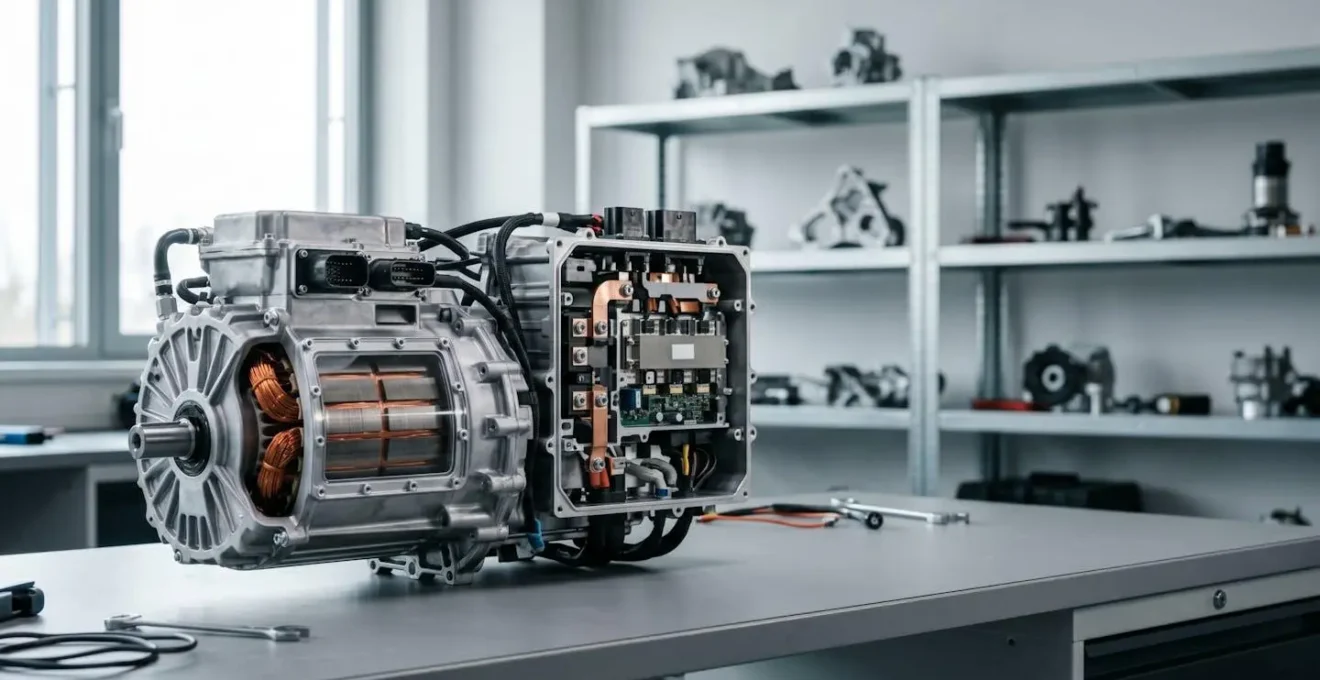
The 90% efficiency of an electric vehicle is not a single feature but the result of a “system efficiency cascade,” where the motor, inverter, and aerodynamics are deeply interconnected to minimize energy loss at every stage.
- Specific motor choices, like Permanent Magnet designs, directly impact partial-load efficiency and, therefore, real-world range.
- Rated efficiency is a baseline; real-world factors such as temperature, high-speed driving, and inadequate component cooling can easily reduce a vehicle’s practical efficiency by 20-40%.
Recommendation: To master your EV’s performance, focus on understanding how these core engineering trade-offs affect energy consumption and adapt your driving and vehicle choice accordingly.
The claim that an electric vehicle is 90% efficient while a traditional internal combustion engine (ICE) struggles to reach 30% is a cornerstone of EV marketing. For the tech-savvy owner, however, this figure raises more questions than it answers. It’s easy to grasp the basic benefits of an EV—instant torque, silent operation, and zero tailpipe emissions. But these are surface-level observations. The true engineering story lies deeper within the powertrain, in a series of deliberate design choices that systematically eliminate the catastrophic energy waste inherent in burning fossil fuels.
Most discussions stop at generalities. They mention regenerative braking or the simplicity of an electric motor. But they fail to dissect the system from an engineering perspective. The genuine innovation is not in one single component, but in the total integration of the system. It’s a cascade of efficiency, starting from the battery chemistry, flowing through the inverter’s power electronics, and materializing as torque in the motor’s magnetic field. Understanding this cascade is the key to unlocking and mastering an EV’s true performance potential.
This technical guide moves beyond the marketing claims. We will deconstruct the EV powertrain, component by component, to reveal precisely where this remarkable efficiency comes from. We will analyze the trade-offs between different motor types, interpret real-world efficiency ratings, and investigate the critical role of thermal management and aerodynamics. This is not just about appreciating the technology; it’s about gaining the knowledge to operate it at its peak potential.
To provide a complete technical overview, this guide is structured to explore each critical component of the EV powertrain. The following sections will break down motor technology, real-world efficiency metrics, drivetrain layouts, and the often-overlooked factors that define a vehicle’s ultimate performance.
Summary: A Technical Guide to Electric Powertrains
- Why Permanent Magnet Motors Offer 5-10% Better Range Than Induction Motors
- How to Interpret EV Efficiency Ratings in Miles Per kWh for Real-World Driving
- Front-Wheel-Drive vs Rear-Wheel-Drive EVs: Which for Traction and Efficiency?
- The Inverter Cooling Mistake That Throttles Performance in Hot Weather
- When to Upgrade EV Motor Software: The 3 Performance Unlock Opportunities
- Why Electric Motors Deliver Instant Torque Compared to Petrol Engines From 0 RPM
- Why a 0.25 Cd Sedan Saves £200 Per Year Compared to a 0.35 Cd Model
- How Electric Powertrains Work: The Complete Owner’s Technical Guide
Why Permanent Magnet Motors Offer 5-10% Better Range Than Induction Motors
At the heart of an EV’s efficiency is the motor itself, and the choice between a Permanent Magnet Synchronous Motor (PMSM) and an AC Induction Motor (ACIM) has significant consequences for real-world range. While both are highly efficient, the fundamental difference lies in how they generate a magnetic field in the rotor. An ACIM must use a portion of its incoming energy to induce a magnetic field in the rotor—this is its “magnetizing current.” This process inherently consumes power, creating what are known as rotor losses, even when the motor isn’t under heavy load.
In contrast, a PMSM uses powerful rare-earth magnets embedded directly in the rotor. This design eliminates the need for magnetizing current. The magnetic field is always “on” without continuous energy input. The result is a significant reduction in rotor losses, particularly during the low-to-medium load conditions typical of city driving and steady-state cruising. This translates to a 5-10% efficiency advantage for PMSMs in most driving scenarios, directly contributing to longer range from the same battery capacity.
However, the analysis of induction motors reveals a specific advantage. Well-designed ACIMs for EVs can reach peak efficiencies of 90-93% under optimal load. Their key benefit appears in dual-motor configurations. When one motor is not needed for propulsion (e.g., during gentle highway cruising), an induction motor can be completely de-energized. With no permanent magnets to create resistance, it can freewheel with minimal drag. This is why some manufacturers use a PMSM on one axle for primary drive and an ACIM on the other, balancing constant-load efficiency with the ability to reduce parasitic losses when the second motor is inactive. The choice is a classic engineering trade-off between peak efficiency and system flexibility.
Ultimately, while induction motors offer design simplicity and cost advantages, the superior partial-load efficiency of permanent magnet motors makes them the preferred choice for maximizing range in most consumer EVs.
How to Interpret EV Efficiency Ratings in Miles Per kWh for Real-World Driving
While motor choice sets the baseline, official efficiency ratings like EPA or WLTP figures are the next layer in understanding performance. These ratings are expressed in miles per kilowatt-hour (miles/kWh) or kWh per 100 miles/kilometers. This metric is the EV equivalent of MPG, quantifying how far the vehicle can travel on a set amount of electrical energy. The higher the miles/kWh figure, the more efficient the vehicle. However, these lab-tested numbers represent an ideal scenario. Real-world conditions can dramatically alter a vehicle’s actual energy consumption.
Data shows that the efficiency of modern EVs can vary wildly, with real-world figures ranging from 1.5 to 4.2 miles per kWh across 2024 models. This vast difference isn’t just due to vehicle design; it’s heavily influenced by external factors. A large, heavy electric SUV will naturally be less efficient than a small, aerodynamic sedan. But even for a single vehicle, factors like ambient temperature, driving speed, and driving style create significant deviations from the sticker rating.
This is where understanding the “why” behind efficiency loss becomes critical. For example, aerodynamic drag does not increase linearly with speed; it increases with the square of the velocity. This means doubling your speed from 35 mph to 70 mph quadruples the aerodynamic resistance, causing a disproportionate drop in efficiency. This exponential relationship is the single biggest factor in reduced highway range.
As the visualization suggests, there is an efficiency “sweet spot” at lower speeds where aerodynamic drag is minimal. Pushing beyond this, especially above 65 mph, enters a zone of rapidly diminishing returns where more and more energy is spent fighting the air rather than moving the car forward. To truly master EV performance, an owner must learn to translate the official rating into a practical, real-world expectation using a mental adjustment formula.
Action Plan: Adjusting for Real-World EV Efficiency
- Cold Weather Impact: For winter highway drives with the cabin heater active, plan for a 20-40% reduction from the official EPA/WLTP efficiency rating.
- High-Speed Driving: When cruising at 80 mph instead of 65 mph, anticipate a 20-30% drop in efficiency due to the exponential increase in aerodynamic drag.
- Driving Style: Account for a 5-10% efficiency penalty for aggressive driving with frequent full-throttle launches compared to smooth, progressive acceleration.
- Temperature Extremes: In very cold weather (below freezing), be aware that many EVs can use 20-50% more energy for the same distance due to battery chemistry and heating demands.
- Tire Pressure Maintenance: Regularly check tire pressure, as under-inflation increases rolling resistance and reduces efficiency, just as it does with gasoline cars.
By internalizing these factors, you shift from being a passive consumer of energy to an active manager of your vehicle’s performance, capable of maximizing range in any condition.
Front-Wheel-Drive vs Rear-Wheel-Drive EVs: Which for Traction and Efficiency?
The layout of the drivetrain—which wheels the motor powers—is another critical engineering decision influencing both efficiency and driving dynamics. Unlike ICE vehicles, where packaging constraints often dictate the choice, EV architecture offers more flexibility. The decision between front-wheel-drive (FWD), rear-wheel-drive (RWD), and all-wheel-drive (AWD) is a deliberate trade-off between efficiency, traction, and cost.
From a pure efficiency standpoint, a single-motor FWD configuration often holds a slight edge. An industry analysis highlights that FWD EVs are typically lighter because they integrate the motor, inverter, and gearbox into a single, compact unit on the front axle. This reduced overall mass decreases the energy required for acceleration and helps improve battery efficiency. FWD also tends to provide more predictable traction in low-grip conditions like rain or light snow for the average driver, as the weight of the powertrain is positioned over the driven wheels.
RWD, on the other hand, is often favored for performance-oriented EVs. During acceleration, the vehicle’s weight naturally shifts to the rear axle. An RWD setup leverages this physical phenomenon, pressing the driven wheels into the pavement for superior traction during launches and spirited driving. This prevents the front-wheel spin that can occur in powerful FWD cars. The trade-off is often a slightly more complex and potentially heavier rear assembly, which can marginally impact overall efficiency. Dual-motor AWD systems offer the best of both worlds in terms of traction but come with a clear efficiency penalty. Data shows that an AWD system often loses about 10% of range compared to its FWD or RWD counterparts, due to the added weight and parasitic losses of a second motor and inverter.
Ultimately, for a buyer focused purely on maximizing efficiency and predictable handling in all weather, FWD presents a compelling case. For those prioritizing dynamic handling and acceleration performance, RWD remains the engineer’s choice.
The Inverter Cooling Mistake That Throttles Performance in Hot Weather
The inverter is the unsung hero of the EV powertrain, acting as the brain and muscle that converts the battery’s direct current (DC) into the alternating current (AC) needed to power the motor. This high-power conversion process, managed by sophisticated semiconductors like IGBTs (Insulated-Gate Bipolar Transistors) or SiC (Silicon Carbide) MOSFETs, is remarkably efficient but not perfect. A small percentage of energy is inevitably lost as heat, and managing this heat is one of the most critical challenges in EV engineering. An overlooked or undersized cooling system for the inverter is a direct path to a thermal bottleneck that can severely throttle performance.
When you demand high power from the motor—during rapid acceleration, climbing a steep grade, or on a racetrack—the inverter’s semiconductors switch electricity at extremely high frequencies. This generates a tremendous amount of waste heat in a very small area. To prevent them from overheating and failing, these components are mounted on a liquid-cooled plate, which is part of a dedicated thermal management circuit. If this cooling system cannot dissipate heat fast enough, the inverter’s internal temperature will rise rapidly.
Once the temperature exceeds a predefined safety limit, the vehicle’s control unit will initiate thermal throttling. This is a self-preservation mechanism where the software deliberately reduces the amount of current flowing to the motor. The driver experiences this as a noticeable and often dramatic loss of power. The car feels sluggish and unresponsive, even with the accelerator fully depressed. This is a common issue in some early or less-engineered EVs when driven hard in hot climates. The mistake is assuming the motor is the limiting factor, when in fact, it’s the inverter’s inability to stay cool that is capping the entire system’s performance.
For a tech-savvy buyer, inquiring about the specifics of the inverter’s cooling system—whether it’s integrated with the battery’s cooling loop or has its own dedicated circuit—is a sign of a well-engineered vehicle designed for sustained high output.
When to Upgrade EV Motor Software: The 3 Performance Unlock Opportunities
Unlike an internal combustion engine, where performance is largely fixed by its mechanical components, an EV’s character is heavily defined by software. The Motor Control Unit (MCU) and inverter software dictate how electricity is translated into torque, governing everything from acceleration response to peak power output. This creates opportunities to enhance performance long after the vehicle has left the factory, but understanding the types of available upgrades is key to making an informed decision.
There are three primary avenues for software-based performance enhancement, each with different levels of benefit and risk:
- Official OEM Over-the-Air (OTA) Updates: Many manufacturers, pioneered by Tesla, offer paid software upgrades that unlock the pre-existing, but dormant, capabilities of the vehicle’s hardware. For example, an “Acceleration Boost” is often just an algorithm change that allows the inverter to draw more current from the battery and deliver it to the motor for a short period. This is the safest and most reliable upgrade, as it is engineered and warrantied by the manufacturer.
- Warranty-Approved Third-Party Software: Some brands, like Volvo with its Polestar Performance Software, partner with approved tuners. These packages offer optimized motor response, recalibrated throttle mapping, and enhanced power delivery while keeping the vehicle’s factory warranty intact. This provides a middle ground for owners seeking more performance without the risks of aftermarket tuning.
- Aftermarket Performance Tuning: This is the highest-risk, highest-reward option. Aftermarket “tuning boxes” or software flashes can bypass OEM software governors to deliver significant power gains. However, they almost always void the manufacturer’s powertrain warranty. More critically, they can push drivetrain components like the motor windings, inverter, or battery beyond their designed thermal and electrical limits, potentially leading to premature wear or catastrophic failure.
In addition to these performance-focused upgrades, manufacturers also regularly push free MCU software updates aimed at improving efficiency. These progressive updates often refine motor control algorithms based on fleet data and user feedback, improving the effectiveness and overall efficiency of the propulsion system over time.
For the vast majority of owners, sticking to official OEM or warranty-approved software is the most prudent path, ensuring that any performance gains do not compromise the long-term reliability of the powertrain.
Why Electric Motors Deliver Instant Torque Compared to Petrol Engines From 0 RPM
The sensation of “instant torque” is perhaps the most defining characteristic of the electric driving experience. From the moment the accelerator is touched, an EV delivers a powerful and linear surge of acceleration, a stark contrast to the lag and build-up of power in an internal combustion engine. This phenomenon is not a software trick; it’s a fundamental principle of electromagnetic physics. An electric motor can generate its maximum turning force, or torque, from a complete standstill (0 RPM).
An ICE must complete a four-stroke cycle—intake, compression, combustion, exhaust—just to produce a single power pulse. It needs to reach a certain rotational speed (its “power band”) to operate efficiently and produce meaningful torque. In contrast, an electric motor works by creating interacting magnetic fields. When you press the accelerator, the inverter sends a powerful three-phase AC current to the stator (the stationary part of the motor). This creates a rotating magnetic field.
This stator field immediately interacts with the magnetic field of the rotor (the spinning part), pulling it along with immense force. Because this magnetic interaction is happening at the speed of electricity, the resulting torque is available almost instantaneously. There is no mechanical latency, no waiting for pistons to cycle or for a turbo to spool. The motor is capable of delivering 100% of its available torque the instant the magnetic fields are energized.
This close-up view of the motor’s windings reveals the intricate architecture that enables this capability. The precisely wound copper conductors and laminated steel core are engineered to create and channel powerful magnetic fields with maximum efficiency. It is this elegant and direct conversion of electrical energy into magnetic force that provides the responsive, immediate acceleration that no petrol engine can match from a standstill.
This inherent advantage in torque delivery is a primary reason why even modest family EVs can feel surprisingly quick in city driving, and why high-performance EVs can achieve supercar-levels of acceleration.
Why a 0.25 Cd Sedan Saves £200 Per Year Compared to a 0.35 Cd Model
After the motor and inverter, aerodynamics is the third pillar of EV efficiency, especially at highway speeds. The Coefficient of Drag (Cd) is a dimensionless number that quantifies how easily a vehicle moves through the air. A lower Cd value signifies a more aerodynamic shape that creates less resistance. While a difference of 0.10 might seem small, its impact on energy consumption and running costs is substantial due to the exponential nature of air resistance.
Consider two EVs with identical battery and motor systems, one a sleek sedan with a Cd of 0.25 and the other a more upright crossover with a Cd of 0.35. At low city speeds, the difference in energy use is negligible. However, as documented in real-world efficiency studies, higher speeds increase energy consumption due to aerodynamic drag. Above approximately 60 mph, air resistance becomes the dominant force the motor must overcome, and the energy penalty of the less-aerodynamic vehicle becomes glaringly obvious.
Let’s quantify this. Assuming an average of 10,000 highway miles per year and an electricity cost of £0.30 per kWh, the crossover with the 0.35 Cd might achieve an efficiency of 3.0 miles/kWh. This would require 3,333 kWh of energy, costing £1,000. The sedan, with its superior 0.25 Cd, might achieve 3.6 miles/kWh under the same conditions. This would require only 2,778 kWh, costing £833. The annual saving is approximately £167, or close to £200 when accounting for slight variations. This cost is a direct “tax” paid for pushing a less-efficient shape through the air. Manufacturers invest millions in wind-tunnel testing to shave off every hundredth of a point from the Cd value for this very reason.
For a tech-savvy buyer, the Cd value is not just a specification; it is a direct indicator of the vehicle’s inherent highway efficiency and a powerful predictor of its long-term running costs.
Key Takeaways
- The core EV efficiency advantage comes from a “system cascade,” where motor design, inverter control, and aerodynamics work together to minimize energy waste.
- Real-world efficiency is not a fixed number; it is constantly influenced by external factors like temperature and speed, which can reduce range by 20-40% from official ratings.
- Engineering trade-offs are everywhere: Permanent Magnet motors are more efficient at partial loads, but Induction motors can offer lower drag in dual-motor setups when freewheeling.
How Electric Powertrains Work: The Complete Owner’s Technical Guide
Having examined the individual components, we can now synthesize this knowledge to understand the complete “tank-to-wheel” (or more accurately, “grid-to-wheel”) efficiency of an electric powertrain. The core reason an EV is so much more efficient than an ICE vehicle is its directness. According to comparative propulsion technology analysis, electric motors achieve ~90+% efficiency in converting electrical energy into mechanical force, whereas internal combustion engines top out at a dismal 30-45%. An ICE wastes the majority of its fuel energy as heat through the exhaust and cooling systems before it even begins to turn the wheels.
In an EV, this waste is dramatically reduced. As confirmed by the U.S. Department of Energy, up to 80 percent or more of the energy drawn from the battery is transferred directly to power the car. This system-wide view, or “efficiency cascade,” shows how small losses at each stage compound, but the final result is still vastly superior to combustion. The process isn’t perfect, but it is radically optimized.
This table breaks down the typical energy losses at each stage of the EV powertrain, illustrating how the initial 100% of energy from the grid is incrementally reduced by the time it reaches the wheels.
| Powertrain Stage | Typical Energy Loss | Remaining Efficiency |
|---|---|---|
| AC/DC Charging Conversion | 5-10% | 90-95% |
| Battery Internal Resistance | 2-5% | 85-93% |
| Inverter Switching Losses | 3-7% | 79-90% |
| Motor & Gearbox Losses | 2-5% | 75-88% |
| Overall Grid-to-Wheel Efficiency | – | ~75-88% |
This cascade demonstrates that while no step is 100% perfect, the cumulative efficiency remains exceptionally high. Each component we’ve discussed—the motor type influencing those 2-5% motor losses, the inverter cooling system managing the 3-7% switching losses—plays a vital role in preserving energy as it flows through the system. This holistic understanding moves beyond simplistic comparisons and provides a true engineer’s perspective on why electric propulsion represents a fundamental leap in efficiency.
To truly leverage this knowledge, the next logical step is to apply these efficiency principles during your next test drive and vehicle evaluation. Pay attention to how the car behaves under different loads, inquire about its thermal management, and consider the aerodynamics—this is how you move from being a driver to a master of the technology.