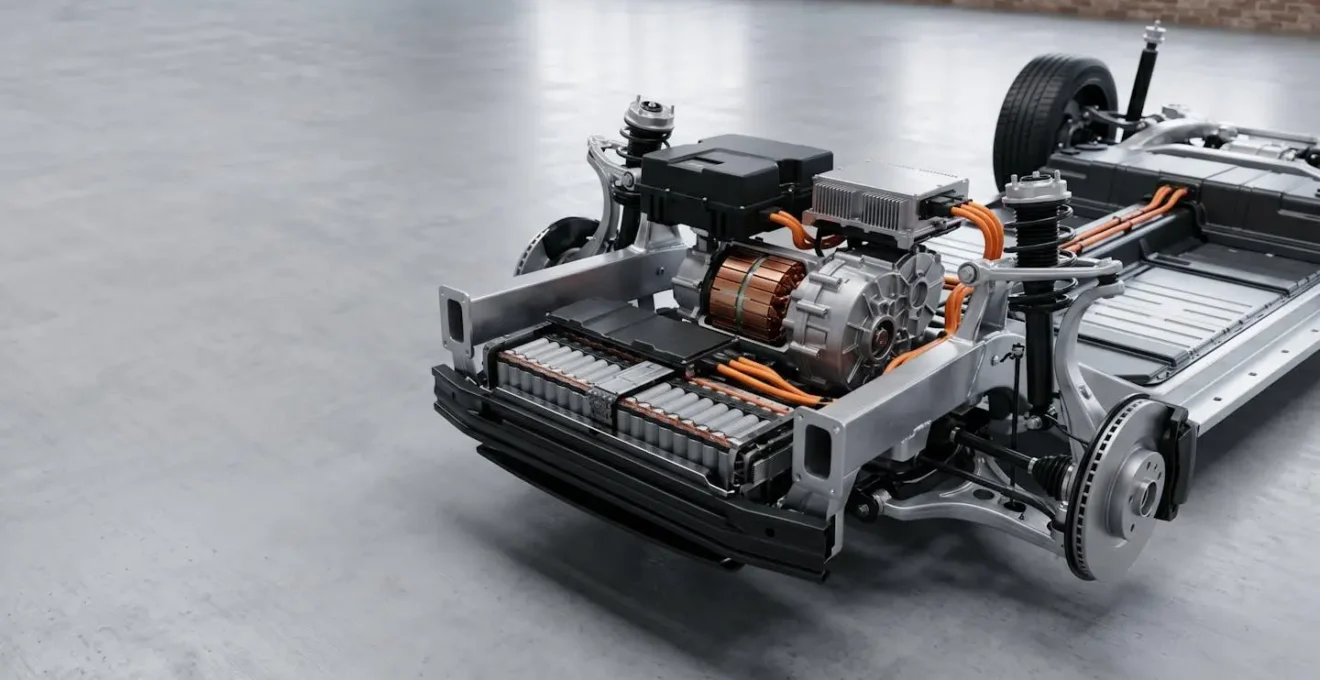
To many, the electric vehicle powertrain is a black box. This guide demystifies the technology by moving beyond surface-level facts. We’ll explore the core engineering principles of electromagnetism, battery chemistry, and software control that define how your EV performs, how its battery ages, and how it achieves its remarkable efficiency, transforming you from a simple driver into a confident and informed owner.
The switch from a petrol car to an electric vehicle is more than a change in fuel; it’s a leap into a different technological paradigm. For decades, drivers understood the familiar rumble of an internal combustion engine (ICE). Now, a silent, instantaneous surge of power greets them. But this silence can be unsettling. What is actually happening between the accelerator pedal and the road? Many owners feel they are driving a sophisticated appliance whose inner workings are a complete mystery. You might hear about “instant torque” or the “20-80% charging rule,” but these are often just fragments of a much larger, more fascinating story.
The common advice often stays superficial, failing to explain the fundamental science that governs your vehicle. This guide is different. Written from the perspective of a powertrain engineer, its purpose is to pull back the curtain. We won’t just tell you *what* to do; we will explain *why* it works. Understanding the principles of electromagnetic flux in the motor, the process of lithium-ion intercalation in the battery, and the logic behind software-driven traction control gives you true mastery over your vehicle. It empowers you to maximize its performance, extend its lifespan, and appreciate the elegant engineering you command every day.
This comprehensive guide is structured to build your knowledge from the ground up. We will begin with the fundamental principles of performance and efficiency before diving into the specific components and the best practices for long-term ownership, giving you the complete technical picture.
Summary: An Engineer’s Technical Guide to Electric Vehicle Drivetrains
- Why Electric Motors Deliver Instant Torque Compared to Petrol Engines From 0 RPM
- How EV Propulsion Systems Deliver 90% Efficiency Compared to 30% in Petrol Cars
- Why Permanent Magnet Motors Offer 5-10% Better Range Than Induction Motors
- Single-Motor vs Dual-Motor EVs: Which Performs Better in UK Weather and Terrain?
- How to Maximise Battery Lifespan Using Optimal Charging Habits in 7 Rules
- When to Replace EV Batteries: The 3 Capacity Thresholds That Trigger Action
- The Regenerative Braking Mistake That Reduces Efficiency by 15% in City Driving
- How to Reduce Phantom Drain to Under 1% Per Day in 5 Settings
Why Electric Motors Deliver Instant Torque Compared to Petrol Engines From 0 RPM
The first thing any new EV driver notices is the startling, instantaneous acceleration. There is no revving, no delay, just a seamless push into the back of your seat. This isn’t a marketing gimmick; it’s a fundamental property of how electric motors work, rooted in the principles of electromagnetism. An internal combustion engine is an air pump that must build rotational speed (RPM) to make power. It has a narrow “power band” where it operates efficiently, requiring a complex multi-speed gearbox to keep it there.
An electric motor, by contrast, operates on a completely different principle. It uses electricity to generate magnetic fields in a stationary outer part (the stator) that interact with the magnetic fields of a rotating inner part (the rotor). By precisely controlling the electric current, the motor’s electronic brain can create a powerful rotating magnetic field that immediately forces the rotor to turn. This means maximum torque (rotational force) is available from the very moment the rotor starts to move—at zero RPM.
This process is incredibly fast and direct. Unlike a petrol engine which needs to ingest air, compress it, ignite it, and expel exhaust—a sequence with inherent mechanical and chemical delays—the electric motor’s response is governed by the speed of electronics. A detailed technical analysis reveals that the torque response time is less than 50 milliseconds for EVs, whereas even the most advanced ICE vehicles can take several hundred milliseconds to respond. It’s this near-instantaneous creation of a powerful magnetic field that provides the thrilling and efficient acceleration unique to electric vehicles.
How EV Propulsion Systems Deliver 90% Efficiency Compared to 30% in Petrol Cars
The “instant torque” sensation is just one symptom of a much larger truth: electric propulsion is fundamentally more efficient than internal combustion. Efficiency in a vehicle is a measure of how much of the energy stored in its “fuel” (be it petrol or a battery) is successfully converted into motion at the wheels. This is where EVs have a staggering, insurmountable advantage.
An internal combustion engine is, at its core, a heat engine. Its primary function is to create controlled explosions to push pistons. This process is incredibly wasteful. A vast amount of the energy stored in petrol is immediately lost as waste heat through the engine block and exhaust system. More energy is then lost to friction from hundreds of moving parts, like pistons, camshafts, and transmission gears. The result is that in a typical petrol car, only about 30% of the fuel’s energy actually makes it to the wheels to move the car forward.
An EV powertrain, on the other hand, is a model of simplicity and efficiency. It consists of the battery pack, an inverter that converts the battery’s DC power to AC power for the motor, and the motor itself, which drives the wheels via a simple reduction gear. The entire process is electrical and magnetic. Because there is no combustion, the primary source of waste—heat—is drastically reduced. As a result, comprehensive engineering analysis shows that over 90% of the stored energy in the battery reaches the wheels. This isn’t just an incremental improvement; it’s a threefold increase in energy efficiency, explaining why EVs can travel so far on a comparatively small amount of energy.
Why Permanent Magnet Motors Offer 5-10% Better Range Than Induction Motors
While all electric motors are highly efficient, not all are created equal. The two dominant types used in modern EVs are the Permanent Magnet Synchronous Motor (PMSM) and the Asynchronous Induction Motor (IM). Understanding the difference is key to understanding why some EVs are more efficient than others. The core difference lies in the rotor—the spinning part of the motor.
As the ACTE Electric Vehicle Powertrain Technical Team explains:
A Permanent Magnet motor’s rotor is ‘naturally’ magnetic, while an Induction Motor must use extra energy from the battery to induce a magnetic field in its rotor.
– ACTE Electric Vehicle Powertrain Technical Team, Electric Vehicle Powertrain Explained 2026 Update
This is the crucial point. A PMSM uses powerful rare-earth magnets (like neodymium) embedded in its rotor. These magnets create a constant magnetic field for free, without consuming any electricity. The motor’s electronics only need to spend energy creating the rotating magnetic field in the stator to pull the rotor along. An Induction Motor’s rotor, typically a “squirrel cage” of copper or aluminum bars, has no inherent magnetism. The motor must first use a portion of the battery’s energy to *induce* a magnetic field in the rotor before it can then use more energy to make it spin. This extra energy step to “excite” the rotor creates an efficiency penalty, meaning a PMSM is generally 5-10% more efficient than an IM, which translates directly to longer range for the same size battery.
However, the choice isn’t always simple, as induction motors have benefits like lower cost and no reliance on rare-earth metals. This has led to innovative engineering solutions.
Case Study: Tesla’s Dual-Motor Hybrid Approach
Tesla pioneered a hybrid dual-motor strategy in vehicles like the Model 3 Long Range. The rear axle uses a highly efficient permanent magnet motor (PMSM) for cruising. The front axle employs an induction motor (IM) that can be completely de-energized during highway driving without creating ‘magnetic drag,’ since it has no permanent magnets. This asymmetric configuration delivers the efficiency of a PM motor when cruising and the raw power of dual-motor AWD when needed, optimizing both range and performance while reducing dependency on rare-earth elements.
Single-Motor vs Dual-Motor EVs: Which Performs Better in UK Weather and Terrain?
The choice between a single-motor (two-wheel drive) and a dual-motor (all-wheel drive) EV goes far beyond simple acceleration figures, especially in the context of the UK’s challenging driving conditions. While a single motor powering either the front (FWD) or rear (RWD) wheels is perfectly adequate for most situations, the dual-motor setup offers a fundamental advantage in traction and stability on wet, greasy B-roads or frosty inclines.
The key difference is not just that two more wheels are driven, but *how* they are controlled. In a traditional mechanical AWD system on a petrol car, power is distributed through shafts and differentials, a process with inherent mechanical latency. In a dual-motor EV, two independent motors on each axle are controlled by software. This allows for millisecond-level active torque vectoring. If the system detects a wheel starting to slip on a patch of wet leaves or ice, it can instantly reduce power to that wheel and send it to the wheels with grip, often before the driver is even aware of the slip. This software-based control is orders of magnitude faster and more precise than any mechanical system.
This superior traction management is invaluable on the UK’s often unpredictable road surfaces. It provides a significant boost in driver confidence during a sudden downpour on the motorway or when navigating a steep, narrow lane in the countryside. While dual-motor versions come at a premium and add weight, their ability to actively and instantly manage torque distribution makes them uniquely suited to the specific challenges of British weather and terrain.
This comparative analysis highlights the key trade-offs between the two configurations.
| Characteristic | Single-Motor EV | Dual-Motor EV |
|---|---|---|
| Drivetrain | RWD or FWD (one axle powered) | AWD (both axles powered independently) |
| Traction Control | Mechanical, slower response | Software-based, millisecond response between axles |
| Wet/Snow Performance | Adequate with modern traction systems | Superior—active torque vectoring prevents slip |
| Efficiency (Highway) | Better—lighter, fewer components | Can match single-motor via motor disconnect feature |
| Weight | Lighter (fewer components) | Heavier (additional motor + inverter) |
| Cost | Lower purchase price | Premium (typically £3,000-£8,000 more) |
| Redundancy | Single point of failure | Limp-mode capability if one motor fails |
| Ideal Use Case | Urban commuting, mild weather | Wet climates, steep terrain, performance driving |
How to Maximise Battery Lifespan Using Optimal Charging Habits in 7 Rules
An EV’s battery is its most expensive and critical component. Maximising its lifespan, or more accurately, its State of Health (SoH), is a primary concern for any owner. SoH is a measure of the battery’s ability to hold a charge compared to when it was new. Degradation is a natural and unavoidable chemical process, but it can be significantly accelerated or slowed by charging habits. The most common advice is the “20-80% rule,” but the engineering principles behind it are what truly matter.
A lithium-ion battery is happiest when it is not at the extremes of its State of Charge (SoC). Keeping a battery at 100% SoC for prolonged periods puts stress on the cathode and accelerates chemical degradation. Similarly, frequently draining it below 20% can damage the anode. The goal is to manage the two primary enemies of a battery: high voltage and high temperature. Slower AC charging generates less heat than DC fast charging, and keeping the battery within the 20-80% window avoids sustained high-voltage stress. Adhering to these principles has a tangible impact; research demonstrates that these habits can extend battery life by 20-30%.
The process of charging involves moving lithium ions from the cathode and inserting them into the layers of the graphite anode, a process called intercalation. When you fast-charge, this process is forced to happen very quickly, which can lead to “lithium plating,” where metallic lithium builds up on the anode surface, permanently reducing capacity. Slow charging allows the ions to intercalate gently and fully. Here are the seven key rules derived from these chemical principles:
- Rule 1: Set your daily charge limit to 80% for routine driving to minimize high-voltage stress.
- Rule 2: Avoid dropping below 20% frequently to prevent deep discharge degradation of the anode.
- Rule 3: Use Level 2 (AC) charging for daily needs, as slower charging allows ions to intercalate properly.
- Rule 4: Reserve DC Fast Charging for long trips only, as high currents risk lithium plating.
- Rule 5: Precondition the battery before charging in cold weather; charging a frozen battery is extremely damaging.
- Rule 6: Charge to 100% only right before a long journey and begin driving shortly after to avoid prolonged high-voltage exposure.
- Rule 7: Enable your vehicle’s built-in charge limit feature; it’s the simplest way to enforce these habits.
When to Replace EV Batteries: The 3 Capacity Thresholds That Trigger Action
Despite best practices, all batteries degrade over time. The question for owners isn’t *if* the battery will degrade, but *when* that degradation will impact the vehicle’s usability to the point of needing action. This decision isn’t based on age or mileage alone, but on a specific engineering metric: the battery’s State of Health (SoH). SoH is expressed as a percentage of its original capacity. A brand new battery is at 100% SoH. As it ages, this number drops. There are three critical thresholds that every owner should be aware of.
These thresholds represent the points at which the battery’s reduced capacity starts to have real-world consequences, from warranty claims to the inability to complete daily journeys. It’s also important to note that as SoH drops, not only does range decrease, but the peak DC fast-charging speed also tends to reduce as the Battery Management System (BMS) works to protect the aging cells. At lower SoH levels, you may also experience more significant “voltage sag,” where the predicted range drops suddenly under heavy load, like going up a steep hill.
When considering action, it’s crucial to understand the costs. A full pack replacement is the most expensive option, with figures upwards of £15,000 for a full pack replacement being common. However, a growing industry of third-party specialists can now perform module-level diagnosis and repair, replacing only the few degraded cell modules within a pack at a fraction of the cost. Knowing these thresholds allows you to plan ahead:
- Threshold 1: 80-85% SoH (The Warranty Boundary). Most EV manufacturers warranty the battery to retain at least 70-80% of its capacity for a set period (e.g., 8 years/100,000 miles). Dropping below this level may trigger a warranty replacement. For the owner, this is often the first point where range reduction becomes noticeable in daily use.
- Threshold 2: 70-75% SoH (The Daily Commute Threshold). At this stage, a car with an original 250-mile range might now only offer around 175 miles. This is the critical point to assess if the degraded range still reliably covers your daily needs with a comfortable safety margin for detours or cold weather.
- Threshold 3: Below 70% SoH (The Trip Viability Threshold). Below this level, the car’s utility can become seriously compromised. Long trips become difficult due to both reduced range and slower fast-charging speeds. This is the point where owners should strongly consider either a module-level diagnosis for targeted repair or a full pack replacement.
The Regenerative Braking Mistake That Reduces Efficiency by 15% in City Driving
Regenerative braking is one of the most celebrated features of EVs, often touted for enabling “one-pedal driving” and recovering energy to extend range. The system works by using the electric motor in reverse. When you lift off the accelerator, the car’s momentum spins the motor, turning it into a generator that recharges the battery and simultaneously slows the car down. However, there’s a common mistake in how drivers interact with this system that can significantly reduce its effectiveness, potentially wasting a large portion of the recoverable energy.
The mistake is abrupt, late braking. The regenerative braking system has a maximum power limit for how much energy it can convert and feed back into the battery at any given moment. If you are driving at speed and suddenly brake hard for a red light, the amount of kinetic energy that needs to be dissipated is far greater than what the regen system can handle. When this happens, the car’s computer has no choice but to engage the traditional hydraulic friction brakes. These brakes work by clamping pads onto discs, converting all that valuable kinetic energy into useless waste heat, just like in a petrol car. You’ve effectively bypassed the biggest efficiency advantage of the EV powertrain.
Case Study: Urban Regenerative Braking Efficiency
A comprehensive urban study using a Hyundai Kona Electric found that the pattern of braking was the single biggest factor in energy recovery. The data showed that drivers who anticipated stops and decelerated smoothly and early, keeping the braking force within the limits of the regenerative system, recovered significantly more energy. In contrast, aggressive drivers who braked late and hard frequently triggered the friction brakes, wasting kinetic energy as heat and drastically reducing the overall efficiency of their urban trips.
The key to maximizing efficiency is to be smooth. By anticipating traffic and lifting off the accelerator early, you allow the car to decelerate using only regenerative braking for a longer period. This keeps the braking force within the motor’s generating capacity, ensuring that as much kinetic energy as possible is converted back into chemical energy in the battery. While the headline figure of a 15% efficiency reduction is a generalisation, failing to use regen effectively means you are leaving a significant amount of “free” energy on the table with every stop.
Key takeaways
- An EV’s powertrain is 3x more efficient (90%) than a petrol engine (30%) primarily because it doesn’t waste energy as heat.
- Battery longevity is a chemical process you can control; avoiding voltage and heat stress by staying in the 20-80% charge window is the most effective strategy.
- Dual-motor AWD is superior in wet conditions not just because of two motors, but because of millisecond-level software control (torque vectoring) that is impossible to replicate mechanically.
How to Reduce Phantom Drain to Under 1% Per Day in 5 Settings
One of the most confusing aspects for new EV owners is “phantom drain,” or “vampire drain.” This is the phenomenon of the battery losing charge while the car is parked, turned off, and unplugged. While a small amount of daily loss is normal for monitoring key systems, excessive drain can be a frustrating surprise. This energy loss isn’t a fault; it’s the cost of the car’s many “always-on” convenience and security features.
A modern EV is a powerful computer on wheels, and many of its subsystems remain in a low-power standby state even when parked. The Telematics Control Unit (TCU) that allows you to communicate with the car via a smartphone app, the sensors for the security system, and the modules that monitor battery temperature all consume a small but steady amount of power. When you add up these small draws over 24 hours, they can lead to a noticeable drop in the State of Charge. The key to minimizing this drain is to be mindful of which of these convenience features you truly need active all the time.
By consciously disabling non-essential background processes, you allow the vehicle’s main computer to enter a “deep sleep” state, where power consumption is minimal. Each feature may seem insignificant on its own, but their cumulative effect can be the difference between losing less than 1% per day and losing 5% or more. The following checklist outlines the most impactful settings you can control to tame phantom drain.
Your Action Plan: Taming Phantom Drain
- Disable Sentry Mode/Security Monitoring: Continuously active cameras and processors are the biggest energy consumers, using up to 1% per hour. Use this feature only when parked in high-risk areas.
- Turn Off Cabin Overheat Protection: This feature periodically runs the climate control system. Disable it unless you are parking in extreme heat and need to protect the cabin’s contents.
- Reduce App Polling Frequency: Constantly checking your car’s status on your phone prevents the vehicle from entering deep sleep. Limit checks to when they are essential.
- Disable “Always-Connected” Features: Functions that provide live traffic or weather updates keep the car’s communication modules active. Switch these to update on-demand rather than continuously.
- Allow the Car to Enter Deep Sleep: After parking, avoid opening doors, checking the app, or sending remote commands for at least 30 minutes to allow the vehicle’s systems to fully shut down into their lowest power state.