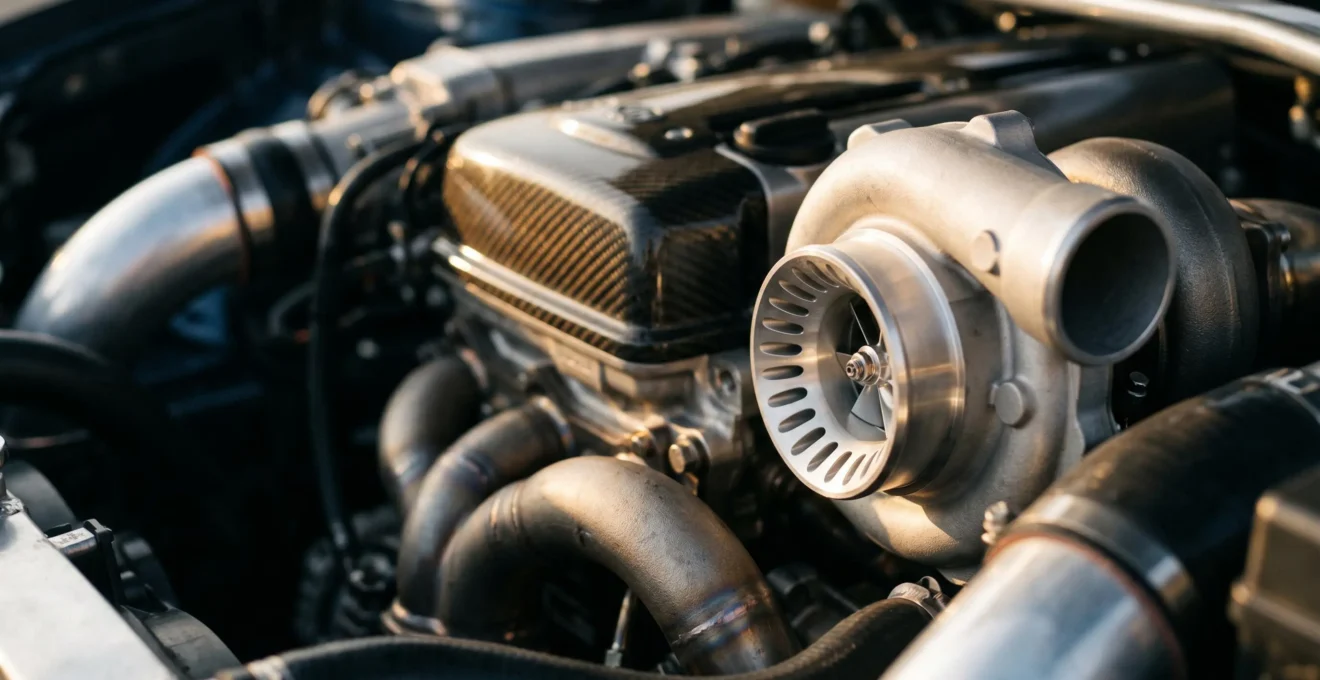
True engine performance isn’t about bolting on parts; it’s about understanding the engine as a complete system and making data-driven adjustments that respect its engineered limits.
- Most “common sense” tuning advice, like arbitrary RPM rules, can cause catastrophic damage like Low-Speed Pre-Ignition (LSPI) in modern engines.
- The biggest risks to a tuned engine come not from the extra power itself, but from secondary systems—like oil cooling—that can no longer cope with the increased thermal load.
Recommendation: Stop thinking like a parts-fitter and start thinking like an engineer. Prioritise diagnostics, monitoring, and understanding the ‘why’ behind each modification to achieve sustainable and reliable power.
For every car enthusiast, the desire for more is a familiar feeling. More response, more power, more efficiency. The internet is saturated with seemingly simple solutions: bolt on a new air intake, fit a louder exhaust, and chase horsepower figures. This path is well-trodden, often leading to a collection of parts that may or may not work in harmony, and sometimes, can lead to compliance issues or even premature engine failure. This approach treats the engine as a simple sum of its parts, a view that fundamentally misunderstands the complex machine at its heart.
The truth is, your engine is not a Lego set. It’s a highly integrated thermodynamic system where every component’s function is intricately linked to the others. A change in one area—like boost pressure—has cascading effects on fuel delivery, ignition timing, and most critically, heat management. Ignoring these systemic relationships is the single biggest mistake enthusiasts make, often turning a promising project into a costly lesson in mechanical failure. This is where a shift in mindset is required.
What if the key to unlocking sustainable, reliable, and legal performance wasn’t in a catalogue of aftermarket parts, but in adopting the mindset of a performance tuning engineer? This approach prioritises understanding over assumption, and data over guesswork. It’s about working *with* the engine’s design, optimising its existing parameters, and respecting its operational limits to unlock the potential the manufacturer built into it, but kept in reserve for the sake of mass-market reliability and emissions compliance.
This guide will walk you through applying this engineering mindset. We will deconstruct common tuning myths, explore the science behind genuine performance gains, analyse the critical differences between petrol and diesel tuning, and provide the diagnostic knowledge needed to ensure your pursuit of power doesn’t compromise the longevity of your engine. We will explore how to make intelligent choices about fuel, ECU mapping, cooling, and even your driving style to extract the maximum performance your engine can legally and safely deliver.
This article delves into the core principles of safe and effective engine optimisation. The following summary outlines the key areas we will cover, from the foundational role of fuel to advanced driving techniques for maximising efficiency.
Contents: An Engineering Approach to Engine Performance
- Why Premium Unleaded Fuel Adds Up to 10 BHP in Turbocharged Engines
- How to Safely Remap Your ECU Without Damaging Engine Components in 5 Checks
- Petrol vs Diesel Engines: Which Responds Better to Performance Tuning?
- The Cooling System Mistake That Destroys Tuned Engines Within 5,000 Miles
- When to Rebuild an Engine: The 3 Wear Indicators in High-Mileage Units Over 150,000 Miles
- Turbocharged Engines vs Naturally Aspirated: Which Lasts Longer Beyond 100,000 Miles?
- When to Shift Gear for Maximum Efficiency: The 2,000 RPM Rule in Manual Cars
- How to Cut Your Fuel Costs by £400 Per Year Using 5 Driving Techniques
Why Premium Unleaded Fuel Adds Up to 10 BHP in Turbocharged Engines
The debate over premium fuel is often simplified to a question of cost versus benefit, but for a turbocharged engine, it’s a matter of fundamental combustion science. The power increase isn’t a marketing gimmick; it’s a direct result of the engine’s control unit (ECU) being able to leverage the fuel’s superior properties. The key is octane rating, which measures a fuel’s resistance to detonation or “knock.” As leading tuning experts at HP Tuners state, “Higher octane fuels can withstand higher cylinder pressures without detonating, making them suitable for high-performance or turbocharged engines.” This knock resistance is the key that unlocks the door to more power.
Modern turbocharged engines are equipped with sophisticated knock sensors and adaptable ignition timing maps. When you use lower-octane fuel, the ECU detects the onset of detonation under high load and immediately retards the ignition timing to protect the engine. This is a safety measure, but it comes at the direct cost of power and efficiency. When you fill up with high-octane fuel (like 97 or 99 RON), you give the ECU the “headroom” it needs to advance the ignition timing towards its optimal setting, known as MBT (Minimum Best Timing for Maximum Torque). This allows the spark to occur earlier, creating peak cylinder pressure at the most effective point in the piston’s power stroke, thus extracting more energy from the same amount of fuel.
The gains are not theoretical. Real-world research on engines like the BMW M5’s twin-turbo V8 and the Ford F-150’s twin-turbo V6 confirms that premium fuel doesn’t just prevent knock; it actively increases horsepower and torque by allowing the ECU to run its more aggressive, performance-oriented timing maps. In some cases, dyno testing revealed a gain of 20 horsepower and 14 lb-ft of torque simply by switching from regular to premium fuel on a modern 2.4L turbocharged engine. For the owner of a turbocharged vehicle, using premium fuel isn’t an expense; it’s an investment in unlocking the performance that was engineered into the car from the start.
How to Safely Remap Your ECU Without Damaging Engine Components in 5 Checks
An ECU remap is arguably the most effective single modification for extracting performance from a modern engine. It adjusts critical parameters like fuel injection, ignition timing, and boost pressure. However, a poorly executed remap is the fastest way to cause catastrophic engine damage. The difference between a safe, reliable tune and a destructive one lies in a thorough, data-driven validation process. A generic “off-the-shelf” file uploaded without verification is a gamble. A professional tune involves logging and analysing the engine’s real-time response to ensure it’s operating safely within its mechanical limits.
The most critical parameter to monitor is the Air-Fuel Ratio (AFR) under load. A tune that runs the engine too lean (too much air, not enough fuel) can cause sky-high combustion temperatures, leading to melted pistons and valves. Conversely, a tune that is too rich wastes fuel and can wash oil from the cylinder bores. The goal is a precise AFR that delivers power without risking detonation or excessive heat. This requires specialist diagnostic tools that can log data directly from the vehicle’s OBD-II port, allowing the tuner to see exactly what the engine is doing on a second-by-second basis.
This illustration symbolises the core of a professional tuning process: the interface between the engine’s complex systems and the tuner’s diagnostic equipment. It’s not about guesswork; it’s about interpreting data to make informed decisions.
Beyond AFR, a safe remap must respect the physical limits of components like the turbocharger and fuel system. The tuner must verify that the requested boost pressure doesn’t exceed the turbo’s efficiency range and that the fuel injectors and pump can supply the required volume of fuel without a drop in pressure. A safe remap is a conservative one that leaves a safety margin, rather than pushing every component to its absolute breaking point. Before committing to any remap, a thorough health check of the engine is non-negotiable. This pre-tuning audit ensures the engine is healthy enough to handle the increased stress.
Your 5-Point ECU Remap Sanity Check
- Hardware Health Check: Before any software changes, conduct a full diagnostic scan for existing fault codes. Perform a compression or leak-down test to verify the base mechanical health of the engine. A remap will only amplify existing problems.
- Tuner Reputation & Data Logging: Choose a tuner who insists on data-logging your specific vehicle. Ask to see pre- and post-tuning logs. Do they use a dynamometer (rolling road) for validation under controlled load? Avoid “flash-and-go” services.
- AFR and EGT Monitoring: Verify the remap maintains safe Air-Fuel Ratios under full load (typically around 12.5:1 for turbocharged petrol engines). If possible, monitor Exhaust Gas Temperatures (EGTs) to ensure they remain within safe limits.
- Boost Control and Knock Detection: Analyse the data logs for boost pressure. Does it hold steady or spike dangerously? Check the knock sensor activity. Constant timing pull indicates the tune is too aggressive for the fuel or conditions.
- Component Duty Cycles: Ask the tuner to check the duty cycle of the fuel injectors and fuel pump. If they are running at or near 100% capacity, they are at their limit and cannot safely support the new power level, creating a dangerous lean condition.
Petrol vs Diesel Engines: Which Responds Better to Performance Tuning?
Both petrol and diesel engines can see significant performance gains from tuning, but they respond in fundamentally different ways due to their distinct combustion processes. The choice of which is “better” depends entirely on the driver’s desired power characteristics. A turbocharged diesel engine is a king of torque, often seeing huge gains in low-to-mid RPM pulling power. In contrast, a turbocharged petrol engine offers a broader, more flexible powerband, with gains focused on higher RPMs and a more linear power delivery.
The primary focus of diesel tuning is on increasing fuel duration and boost pressure. Because diesels operate via compression ignition and don’t have to worry about knock in the same way petrol engines do, tuners can be very aggressive with boost and fuelling, resulting in massive torque increases of 30-40% from a simple Stage 1 remap. However, this immense torque places enormous strain on drivetrain components. The Dual-Mass Flywheel (DMF), clutch, and automatic gearbox torque converter are often the first components to fail on a tuned diesel.
Petrol tuning is a more delicate balancing act. The primary goal is to optimise the air-fuel ratio and ignition timing to operate as close as possible to the threshold of knock, without crossing it. While percentage gains are typically lower than diesel (around 15-25% for a Stage 1 tune), the power is delivered across a much wider RPM range, making it more suitable for spirited driving. The weak points in a tuned petrol engine are typically internal: connecting rods, pistons, and piston rings bear the brunt of the increased cylinder pressure, especially at high RPM. The following table summarises the key characteristics and trade-offs.
To understand the trade-offs, a detailed comparative analysis of tuning responses provides clear insights into how each engine type behaves under increased stress and what weak points to anticipate.
| Characteristic | Diesel Tuning | Petrol Tuning |
|---|---|---|
| Primary Tuning Focus | Boost pressure, injection timing, fuel duration | Air-fuel ratio, ignition timing, boost control |
| Typical Power Gains | 30-40% torque increase, larger percentage gains | 15-25% power increase, wider powerband |
| Powerband Character | Massive low-RPM torque, narrow usable range | Linear delivery, wider RPM range for spirited driving |
| Primary Weak Points | Dual-Mass Flywheel, automatic gearbox, DPF systems | Connecting rods, piston ring lands, fuel injectors at high RPM |
| Cost per HP (Stage 1) | Lower cost per ft-lb torque gained | Higher initial cost, cheaper for Stage 2+ top-end power |
| Tuning Complexity | Compression ignition – fuel timing focused | Spark ignition – knock prevention critical |
The Cooling System Mistake That Destroys Tuned Engines Within 5,000 Miles
Here lies one of the most common and catastrophic mistakes made in the world of engine tuning: focusing solely on coolant temperature while completely ignoring oil temperature. A performance remap dramatically increases cylinder pressures and friction, which in turn generates a massive amount of additional heat. While the factory coolant system might just about cope, the oil is often pushed far beyond its operational limits. The factory dashboard temperature gauge typically shows coolant temperature, lulling the driver into a false sense of security while the engine’s lifeblood is being cooked.
Engine oil does more than just lubricate; it’s a critical component of the engine’s cooling system, responsible for drawing heat away from punishingly hot areas like piston skirts and turbocharger bearings. As a case study on tuned engine failures reveals, when oil temperatures skyrocket above 120-125°C, the oil’s viscosity rapidly breaks down. It loses its ability to maintain a protective film between moving parts. This leads to a deadly cascade: the oil film on the connecting rod and main bearings thins and fails, resulting in metal-to-metal contact and catastrophic bearing failure. Your engine is effectively eating itself from the inside out, and you’ll have no warning until it’s too late.
Manufacturers know this, which is why engine computers are programmed to protect components when oil temperature reaches a critical threshold, often around 255°F (124°C), by cutting power and forcing the engine into a “limp mode.” If your tuned engine doesn’t have this safeguard, or if you regularly push it into that zone, you are on borrowed time. The critical mistake is assuming an upgraded radiator is the solution. While helpful, it doesn’t address the core problem. The only robust solution for a seriously tuned engine used for track days or fast road driving is the installation of an external thermostatic oil cooler. This dedicated system ensures the oil stays within its optimal temperature range, preserving its lubricating properties and, by extension, the life of your entire engine.
When to Rebuild an Engine: The 3 Wear Indicators in High-Mileage Units Over 150,000 Miles
For enthusiasts with high-mileage vehicles, the question of engine health is paramount, especially when considering performance modifications. The idea of an engine rebuild can be daunting, but making the decision with data is far better than waiting for a catastrophic failure. Vague signs like “feeling tired” or a puff of smoke on startup are subjective. To make an informed decision, you need objective, measurable indicators of internal wear. There are three key diagnostic tests that provide a definitive look inside your engine without a complete teardown.
The first is a leak-down test. Unlike a simple compression test which only tells you if pressure is low, a leak-down test pressurises each cylinder and measures the percentage of air that escapes. Crucially, by listening for where the air is escaping from (the intake, exhaust, or crankcase), it pinpoints the exact source of the leak. A leakage rate of over 15-20% is a clear sign of significant wear on piston rings or valves, indicating that the engine is no longer sealing effectively.
This macro photograph of a worn piston brings the reality of engine wear into sharp focus. The scoring on the piston skirt and the heavy carbon build-up in the ring lands are the physical evidence that diagnostic tests are designed to detect before they lead to failure.
The second indicator is found through used oil analysis. By sending a small sample of your used engine oil to a laboratory, you can get a detailed report on its contents. The presence of elevated levels of specific metals is a direct window into the health of your engine’s internals. High levels of copper, lead, and tin are the tell-tale signature of wearing connecting rod and main bearings—a clear warning of impending bottom-end failure, long before you hear the dreaded “rod knock”. The final indicator is a progressive increase in oil consumption. A high-mileage engine that consistently consumes more than one litre of oil between changes, often accompanied by a sooty black residue inside the tailpipe, is clearly burning oil due to worn piston rings or valve stem seals. When these three indicators align, a rebuild is no longer a choice, but a necessity to prevent total failure.
Turbocharged Engines vs Naturally Aspirated: Which Lasts Longer Beyond 100,000 Miles?
The conventional wisdom has long been that simpler is better, and therefore naturally aspirated (NA) engines, with their lower complexity, should inherently last longer than their turbocharged counterparts. However, in the context of modern engineering, this is a dangerous oversimplification. The longevity debate is less about the presence of a turbocharger and more about design philosophy, material science, and, most importantly, maintenance discipline. In fact, a well-maintained modern turbo engine can easily outlast a neglected NA engine.
One of the key factors often overlooked is that manufacturers are not naive to the stresses of turbocharging. As tuning specialists from Revamp360 point out, “Modern turbocharged engines are often built with stronger components from the factory (forged rods, piston oil squirters, better metallurgy) specifically to handle the increased stress.” This means many turbo engines, designed from the outset to handle higher cylinder pressures, can paradoxically be more robust in their core construction than an NA engine that was only built to be “strong enough” for its lower output.
The determining factor in turbocharged engine longevity is not the hardware itself, but how it’s treated. This is where the concept of “mechanical sympathy” becomes critical. The life of a turbocharger is entirely dependent on the quality and temperature of the oil lubricating its bearings, which can spin at over 150,000 RPM. A proper warm-up procedure to get the oil to temperature before applying heavy load, and a cool-down period to allow the turbo to shed heat and prevent oil “coking” (burning onto the bearings) after a hard run, are non-negotiable. A driver who meticulously follows these procedures will see incredible longevity from their turbo engine. Conversely, an NA engine that is thrashed from cold and poorly maintained will inevitably suffer. Ultimately, the question is not “turbo vs. NA,” but “disciplined owner vs. careless owner.”
When to Shift Gear for Maximum Efficiency: The 2,000 RPM Rule in Manual Cars
The “2,000 RPM rule”—the idea that shifting up as early as possible to keep revs low saves the most fuel—is one of the most pervasive and dangerous myths in driving. While born from a well-intentioned desire for efficiency, it can cause severe, and expensive, engine damage in modern cars. Applying heavy throttle at very low RPM in a high gear, a practice known as “lugging,” places immense strain on connecting rod bearings and wrist pins. It’s the mechanical equivalent of trying to pedal a bicycle uphill in top gear; the strain on your knees is immense, and it’s the same for your engine’s internals.
The driver’s tactile connection to the gear lever is central to mastering efficient driving. It’s about feeling the engine’s response, not just watching the tachometer. Shifting should be a fluid response to the load on the engine.
Even more critically, in modern turbocharged, direct-injection engines, lugging can induce a phenomenon called Low-Speed Pre-Ignition (LSPI). This is a highly destructive event where the fuel-air mixture ignites uncontrollably before the spark plug fires, creating a massive pressure spike that can shatter pistons and bend connecting rods in an instant. The 2,000 RPM rule is a recipe for LSPI. The correct approach is not based on an arbitrary RPM number, but on engine load. As performance specialists will attest, an engine’s peak efficiency is not at its lowest possible RPM, but in a specific “efficiency island” on its Brake Specific Fuel Consumption (BSFC) map. This sweet spot is typically where the engine is producing 40-70% of its maximum torque at a relatively low-to-mid RPM, where it feels responsive and unstrained.
Forget the tachometer. Learn to feel the engine. If you press the accelerator and the car struggles, groans, or vibrates, you are in too high a gear for that load. Shift down. The goal is to keep the engine in its happy place—a state of unstressed, efficient operation. This “load-based shifting” is far more efficient and infinitely safer for your engine’s health than blindly following a simplistic RPM rule.
Key Takeaways
- True performance comes from systemic understanding, not just adding parts. Focus on data and engineering principles.
- Ignoring secondary systems like oil cooling is the fastest way to destroy a tuned engine, regardless of how strong the internal components are.
- Maintenance discipline and mechanical sympathy are more significant factors in engine longevity than whether it is turbocharged or naturally aspirated.
How to Cut Your Fuel Costs by £400 Per Year Using 5 Driving Techniques
Extracting maximum performance from your engine isn’t just about horsepower; it’s also about maximising its efficiency. By applying an engineering mindset to your driving style, you can significantly reduce your fuel consumption, potentially saving hundreds of pounds a year. These techniques go beyond the simple advice to “drive slower” and instead focus on managing energy, reducing resistance, and using the car’s systems as they were designed to be used.
The first and most impactful technique is Active Energy Management, often called “driving without brakes.” Every time you touch the brake pedal, you are wasting kinetic energy that you spent fuel to create. The key is to look 15-30 seconds ahead, anticipating traffic lights and junctions. Instead of rushing up to a red light and stopping, ease off the throttle much earlier and aim to coast towards the light, ideally arriving just as it turns green. This preserves your momentum and dramatically reduces fuel use.
Next is mastering engine braking. When you decelerate in gear, modern engine management systems activate a fuel cut-off mode. The wheels are turning the engine, not the other way around, and zero fuel is consumed. This is far more efficient than shifting into neutral and coasting, which requires the engine to burn fuel to maintain its idle speed. Use engine braking to slow for corners and descents. The final three techniques focus on fighting the physical forces that work against your car: rolling resistance and aerodynamic drag. A rolling resistance and aerodynamic audit of your vehicle can uncover significant savings. For instance, research shows that roof boxes and carriers create a 15-25% fuel consumption increase at motorway speeds—one of the single biggest parasitic losses you can easily eliminate. Similarly, switching from C-rated to A-rated tyres for rolling resistance can save up to 6% on fuel, while simply maintaining correct tyre pressures prevents the drag caused by under-inflation.
By adopting this engineering mindset—whether choosing fuel, validating a tune, or simply driving to work—you transform your relationship with your car. It ceases to be a black box and becomes a system you can understand, influence, and optimise responsibly. The next logical step is to begin applying these diagnostic and efficiency principles to your own vehicle to unlock its full, reliable potential.