In summary:
- The pulsing or grinding sensation from your brake pedal during a hard stop is normal; it means the ABS is working correctly.
- Your correct response is to maintain firm, continuous pressure on the brake pedal. Do not pump or lift your foot off the brake.
- Lifting your foot when you feel the pulse is a direct command to the system to stop braking, significantly increasing your stopping distance.
- ABS preserves your ability to steer during an emergency stop, but its effectiveness is entirely dependent on proper tyre condition and brake system maintenance.
That violent, grinding shudder from the brake pedal is one of the most unnerving sensations in modern driving. It happens when you need to stop fast on a slippery surface like ice or wet leaves. Your instinct, honed from years of non-emergency driving, screams at you to lift your foot. It feels wrong, like you’re breaking something. This single, intuitive reaction is the most common and dangerous mistake a driver can make with an Anti-Lock Braking System (ABS).
For decades, the advice has been simple: “don’t pump the brakes.” But this advice fails to address the psychological barrier. It doesn’t explain what that pulsing feeling actually is. The truth is, that vibration isn’t a sign of failure; it is the physical evidence that the system is operating at peak efficiency, preventing your wheels from locking up and sending you into an uncontrolled skid. It is the sensory feedback loop telling you that you are at the absolute limit of available grip.
But if the real key to safety isn’t just *not* pumping the brakes, but actively fighting the instinct to lift off? This guide is built on a single, technique-corrective principle: you must retrain your brain to interpret the ABS pulse as a command to press harder and hold. We will deconstruct this system, explaining why that counter-intuitive response is the only correct one. We’ll cover the physics on different surfaces, the critical maintenance that underpins the system, and how this all integrates with Electronic Stability Control (ESC) to create a complete safety net.
This article provides a complete breakdown of how your vehicle’s most critical safety systems work and, more importantly, how your inputs determine their success or failure. The following sections will guide you through mastering this essential driving skill.
Summary: Mastering Emergency Braking with ABS and ESC
- Why ABS Pulsing Means You Should Press Harder, Not Lift Off the Brake
- How to Threshold-Brake on Cars Without ABS for Maximum Stopping Power
- ABS on Gravel vs Tarmac: Which Surface Sees Greater Stopping Distance Improvement?
- The Brake Maintenance Mistake That Reduces ABS Effectiveness by 40%
- When ABS Cannot Prevent Collisions: The 3 Conditions That Exceed System Limits
- How to Feel ESC Activating and Adjust Your Inputs in Real Time
- Why Tyre Pressure Checks Prevent 40% of Motorway Tyre Blowouts and Accidents
- How Electronic Stability Control Saves You in Skids You Cannot Correct
Why ABS Pulsing Means You Should Press Harder, Not Lift Off the Brake
The pulsing you feel is the system’s heartbeat. It is a rapid-fire application and release of braking pressure to each individual wheel. When a sensor detects a wheel is about to lock and skid, the hydraulic unit momentarily reduces brake pressure to that specific wheel, allowing it to rotate again and regain traction. It then immediately reapplies the pressure. According to brake system mechanics, this cycle can happen up to 15-20 times per second, a speed no human can replicate. The vibration you feel is the physical manifestation of this digital braking process working at its limit.
Your foot on the brake pedal acts as a system command. When you apply firm, continuous pressure, you are telling the ABS module, “I require the maximum possible deceleration right now.” The system then takes over, modulating the pressure to each wheel to stay on the knife-edge of grip. The moment you lift your foot, even slightly, in response to the pulsing, you are issuing a new command: “Cancel maximum deceleration.” The system obeys instantly, braking stops, and your stopping distance lengthens dramatically. You have just overridden the one system designed to save you.
The correct technique is therefore a counter-intuitive response. You must train yourself to feel the pulse and associate it with success. Your job is simple, but not easy: STOMP, STAY, STEER. Stomp on the pedal with firm, decisive force. Stay on the pedal, maintaining that pressure no matter how much it vibrates or makes noise. And Steer around the obstacle, because the primary benefit of ABS is that it prevents wheel lock-up, thus preserving your steering control.
How to Threshold-Brake on Cars Without ABS for Maximum Stopping Power
Before ABS became ubiquitous, skilled drivers used a technique called threshold braking. This is the analog, human–powered version of ABS. The goal is the same: to apply brake pressure right up to the point just before the wheels lock up, thereby achieving the maximum possible stopping force without skidding. It requires immense concentration and a sensitive feel for the vehicle’s dynamics. Unlike the on/off digital nature of ABS, threshold braking is about modulation.
The technique involves applying firm brake pressure until you feel the tyres begin to lose traction and are on the verge of skidding. On a non-ABS car, you might feel a slight squirm through the steering wheel or hear the tyres start to “howl.” At that exact moment, you must slightly ease off the brake pressure—just enough to allow the wheels to continue rotating—before reapplying pressure back to that threshold of lock-up. You are manually “feathering” the brakes to keep them at the most effective point, a task ABS performs automatically hundreds of times per second.
Mastering this requires practice in a safe environment. You must learn to interpret the subtle feedback from the car through the steering, pedals, and chassis. It’s an art form that highlights the incredible workload modern ABS systems have removed from the driver. While it is a critical skill for classic or race car drivers, it is a technique that should never be used on a car equipped with ABS. Attempting to manually pump or modulate the brakes on an ABS car will only confuse the system and prevent it from working effectively.
ABS on Gravel vs Tarmac: Which Surface Sees Greater Stopping Distance Improvement?
The effectiveness of ABS is highly dependent on the surface you’re braking on. On high-grip surfaces like dry or wet tarmac, the benefit is unequivocal. ABS allows the tyres to maintain their optimal slip ratio for maximum grip while preventing lock-up, resulting in significantly shorter stopping distances compared to a locked-wheel stop. More importantly, it preserves your ability to steer around an obstacle, which is often more critical than stopping a few feet shorter.
However, on loose surfaces like gravel, snow, or sand, the physics change in a surprising way. This is where a phenomenon known as the “wedge effect” comes into play.
The Wedge Effect on Loose Surfaces
On loose surfaces like gravel and deep snow, locked wheels without ABS create a ‘wedge effect’ where material builds up in front of the tire, actually providing additional stopping force through a plowing action. According to analysis on the topic, ABS prevents this wedge formation by keeping wheels rotating. This design choice trades some raw stopping power for the critical ability to maintain steering control and vehicle stability during emergency maneuvers. A non-ABS car might stop slightly shorter in a straight line on gravel by plowing material, but it would have zero steering control. ABS prioritizes control over absolute distance in these specific, low-traction scenarios.
This demonstrates a core philosophy of modern vehicle safety systems: controllability is paramount. While a non-ABS vehicle might, in some rare straight-line instances on loose material, stop shorter, it becomes an unguided projectile. The ABS-equipped vehicle may take slightly longer to stop but allows the driver to actively steer away from danger. Therefore, the greatest *safety* improvement is always on the side of ABS, even if the absolute stopping distance on tarmac shows a more dramatic reduction.
The Brake Maintenance Mistake That Reduces ABS Effectiveness by 40%
You can have the most advanced ABS and ESC systems in the world, but they are rendered ineffective by one simple, often-neglected maintenance item: old brake fluid. Brake fluid is hygroscopic, meaning it absorbs moisture from the atmosphere over time. This moisture contamination is the silent killer of braking performance. As water content increases, the boiling point of the brake fluid plummets. During a hard stop, the heat generated can cause this water to boil, creating vapor bubbles in the brake lines.
Unlike liquid, which is incompressible, vapor is highly compressible. When you press the brake pedal, your force is wasted compressing these bubbles instead of applying pressure to the brake calipers. This results in a spongy, ineffective pedal feel and drastically increased stopping distances. The ABS hydraulic modulator, which relies on precise, instant pressure changes, cannot function correctly with air in the lines. In fact, technical research on brake fluid contamination shows that as little as 2% water content can significantly compromise braking efficiency and system response.
Forgetting to flush your brake fluid is the single most critical maintenance error that undermines your vehicle’s active safety systems. It’s not about mileage; it’s about time. Most manufacturers recommend a flush every 2-3 years, regardless of how much you drive. Ignoring this service is like asking a firefighter to use a hose full of holes—the pressure will never get to where it’s needed most.
Your Essential Brake Fluid Audit Checklist
- Check Records: When was your brake fluid last flushed? If it’s been over two years, it’s time for a service, regardless of mileage.
- Test Moisture: Use an electronic brake fluid tester to check the moisture content. If it reads 3% or higher, an immediate flush is required.
- Inspect Color: Check the fluid in the master cylinder reservoir. Fresh fluid is clear to light amber. If it’s dark brown or black, it is contaminated and needs replacement.
- Evaluate Pedal Feel: In a safe location, pay attention to your brake pedal feel. Any sponginess or excessive travel before the brakes engage is a red flag for contamination.
- Review Container Policy: Never use brake fluid from a previously opened and unsealed container, as it will have already absorbed moisture from the air.
When ABS Cannot Prevent Collisions: The 3 Conditions That Exceed System Limits
Anti-lock brakes are a phenomenal safety tool, but they are not magic. They operate within the laws of physics, and there are three primary conditions where ABS can be overwhelmed, leading to a collision if the driver isn’t prepared. Understanding these limitations is as crucial as knowing how to use the system correctly.
First is the problem of overwhelmingly low traction. Surfaces like “black ice” offer so little grip that even a perfectly functioning ABS has little to work with. The system can only prevent wheels from locking; it cannot create traction that doesn’t exist. While ABS will still provide a shorter, controlled stop than locked wheels, the distance can be extreme. For example, testing data reveals stopping distances of 46 meters on black ice versus just 12 meters on dry pavement under identical conditions. The system helps, but physics dictates the outcome.
Second is excessive speed for the conditions. ABS manages the “traction budget” of your tyres, but this budget is finite. If you enter a corner too fast, the tyres need all available grip just to handle the cornering forces. There is little to no traction left for braking. If you brake hard in this scenario, ABS will do its best, but the total force required may exceed the total available grip, resulting in a skid. ABS cannot defy physics; it can only optimize what is available.
Third, and most critically, is poor tyre condition. The entire braking system—calipers, pads, fluid, and ABS module—transmits its force to the road through four contact patches the size of your hand. If those tyres are worn, improperly inflated, or the wrong type for the conditions (e.g., summer tyres in snow), the ABS system has nothing to work with. Worn tyres with no tread depth cannot channel away water, leading to hydroplaning where ABS is useless. Bald tyres on ice have virtually no grip for the system to manage.
How to Feel ESC Activating and Adjust Your Inputs in Real Time
Electronic Stability Control (ESC) is the next layer of safety built upon the ABS foundation. While ABS prevents skidding in a straight line, ESC prevents skidding during cornering or swerving. When it activates, the sensory experience is similar to ABS but more complex. You’ll likely see a flashing indicator light on your dashboard (often a car with squiggly lines). You may also hear the familiar grinding/buzzing of the ABS pump and feel the brake pedal pulse, even if your foot isn’t on it. The system is using the brakes automatically to correct your trajectory.
The most important feedback is what you feel through the chassis and steering. The car may feel like it’s momentarily “bogging down” or resisting your steering input. This is the system braking individual wheels to pivot the car back onto your intended path. If you’re understeering (the front end is pushing wide), ESC might brake the inside rear wheel to tuck the nose back in. If you’re oversteering (the rear end is sliding out), it might brake the outside front wheel to stabilize the vehicle. This is the system working faster than humanly possible to save you from a skid.
Your response must be calm and supportive of the system’s actions. The number one rule is: look and steer where you want to go, not at the obstacle or in the direction of the skid. Your brain and body will naturally follow your eyes. Continue making smooth, deliberate steering inputs toward your safe path. Do not make sudden, jerky steering corrections or fight the resistance you feel from the system. If you were braking, maintain steady pressure. If you were accelerating, ease off the throttle. Trust that the system is making thousands of calculations per second to stabilize the vehicle—your job is to guide it with your vision and smooth inputs.
Why Tyre Pressure Checks Prevent 40% of Motorway Tyre Blowouts and Accidents
The most sophisticated electronic safety systems are entirely at the mercy of the four small patches of rubber connecting your car to the road. This is a fundamental truth of vehicle dynamics. As one analysis by Automotive Safety Research states, “All advanced electronic safety systems (ABS, ESC) are entirely dependent on the four small contact patches of the tires.” An underinflated tyre is a compromised tyre, and it directly sabotages the effectiveness of your ABS.
When a tyre is underinflated, its sidewalls flex excessively. This generates immense heat, the number one enemy of rubber, and the leading cause of motorway blowouts. But even before a catastrophic failure, it cripples performance. The contact patch deforms, reducing the tyre’s ability to provide stable grip. During an emergency stop, an underinflated tyre will squirm and lose its shape, making it impossible for the ABS to maintain optimal braking force. The system may activate, but the compromised tyre simply can’t deliver the requested deceleration.
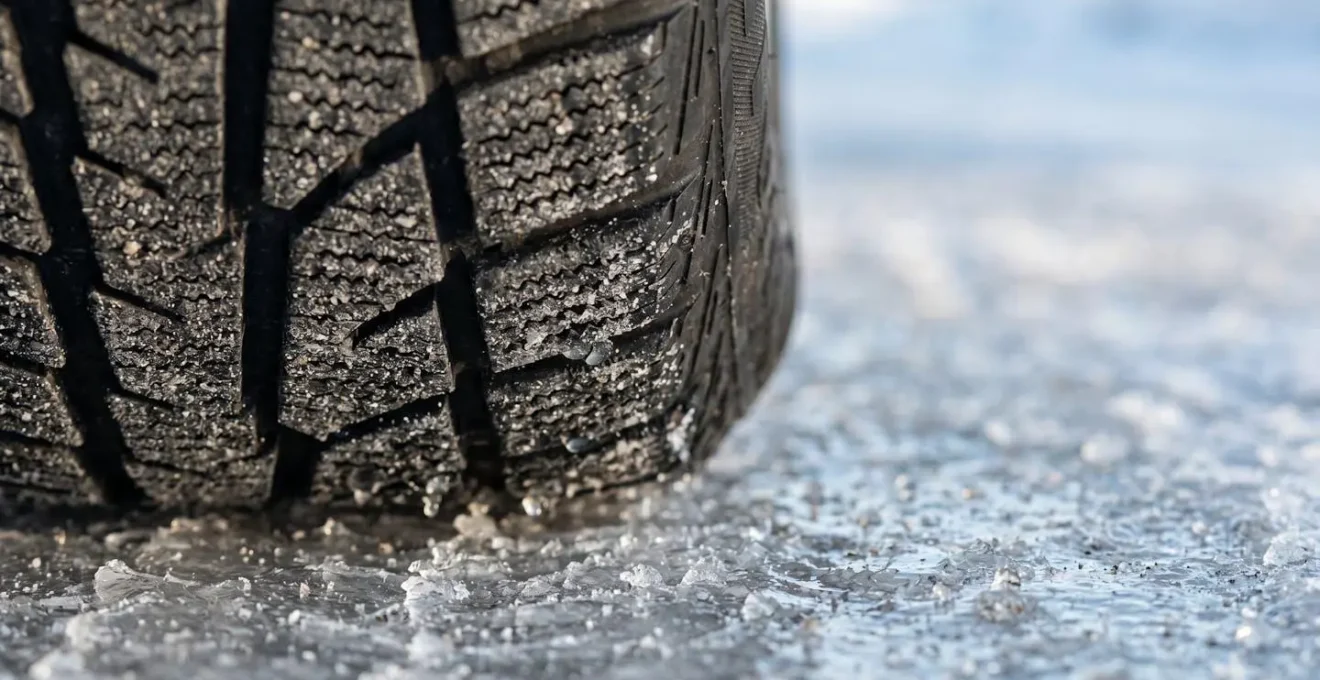
Furthermore, proper tyres for the conditions are just as critical. The difference between all-season tyres and dedicated winter tyres on ice is not marginal; it is massive. Research has found that winter tyres can stop up to 30% faster on ice and snow than all-seasons. This is because their rubber compounds remain flexible at low temperatures and their tread patterns are designed with thousands of tiny slits (sipes) that bite into ice. Equipping your car with the right tyres is like giving your ABS system the right tools to do its job. Neglecting tyres and tyre pressure is like asking your brakes to work with one hand tied behind their back.
Key takeaways
- Trust the Pulse: The grinding or pulsing from the brake pedal is a sign of success, not failure. It means ABS is working at maximum capacity.
- Maintain Pressure: Your only job is to apply and hold firm, continuous pressure on the brake pedal. Do not lift off or pump the brakes.
- Steer to Safety: The primary advantage of ABS is that it allows you to maintain steering control during an emergency stop. Look and steer where you want to go.
- Maintain the System: ABS and ESC are only as good as the components they control. Proper tyre pressure, good tread depth, and fresh brake fluid are non-negotiable.
How Electronic Stability Control Saves You in Skids You Cannot Correct
Electronic Stability Control (ESC) represents the pinnacle of active vehicle safety, acting as an intelligent layer above ABS. While a skilled driver might be able to correct a minor skid, ESC intervenes in situations that are physically impossible for a human to manage. Its secret lies in its ability to brake wheels individually and automatically, something no driver can do with a single brake pedal. It constantly compares the driver’s intended path (measured by the steering wheel angle sensor) to the vehicle’s actual path (measured by yaw rate and lateral acceleration sensors).
When a discrepancy is detected—the beginning of a skid—ESC acts in milliseconds. It can apply precise braking pressure to one or more wheels to create a “yaw moment,” a rotational force that pivots the car back in line. It is a proactive system that catches a skid before it fully develops.
ESC Individual Wheel Braking for Understeer Correction
When a vehicle enters an icy corner too fast and begins to understeer (the front-end plows straight ahead), the ESC system detects the discrepancy between the driver’s steering angle and the vehicle’s actual trajectory. Within milliseconds, it commands the ABS hydraulic system to apply braking force specifically to the inside rear wheel. This creates a rotational moment that pivots the car’s nose back toward the intended direction, correcting the understeer before the driver can even physically react. This individual wheel control is physically impossible for any human driver to replicate.
The speed of this intervention is staggering. Computer-controlled systems can make multiple corrections in the time it takes a human to just react to the initial feeling of a skid. ESC is the ultimate safety net, correcting for driver error, sudden changes in grip, or unexpected obstacles. It transforms a potentially catastrophic loss of control into a managed, stable event. It is the silent partner in the cockpit, constantly monitoring and ready to intervene with a precision and speed that no human can match.
The next time you are in a safe, empty, and slippery area like a vacant car park after a snowfall, practice feeling the ABS engage. Learn to trust the sensation. Internalizing this correct, counter-intuitive response is the final step to truly mastering your vehicle’s most important safety systems and ensuring they can protect you when you need them most.