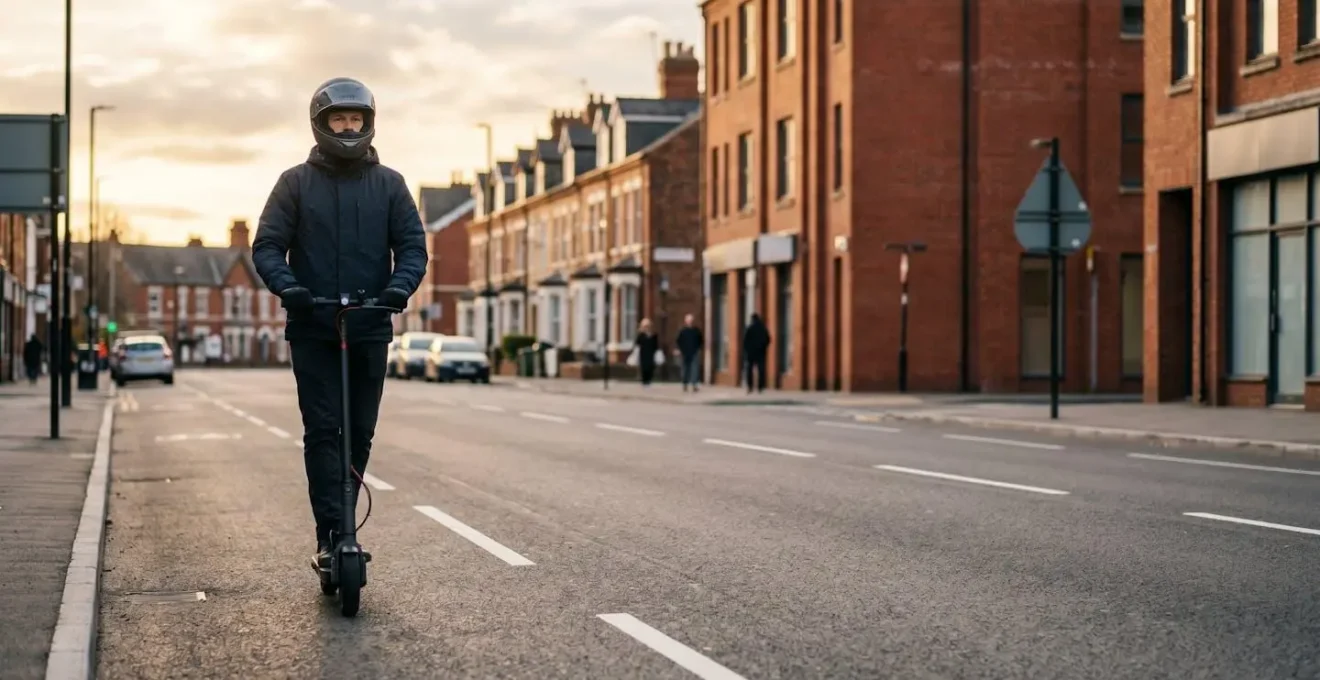
In summary:
- Private e-scooters are illegal on UK public roads because they are classified as motor vehicles but cannot meet legal standards for tax and insurance.
- To ride legally, you must use a rental e-scooter within a designated trial zone and hold at least a provisional driving licence.
- Avoiding collisions requires proactive skills like scanning 12 seconds ahead and maintaining a safe position away from parked cars.
- Fines for illegal riding are severe, including a £300 fine and up to six penalty points on your driving licence.
- Safety is a combination of legal compliance, using the right gear like a properly fitted helmet, and understanding how to handle hazardous road surfaces.
The rise of e-scooters on UK streets has brought both convenience and considerable confusion. For every rider gliding through city traffic, there are questions about legality, safety, and the very real risk of hefty fines or serious injury. Many users operate under the assumption that if the vehicle is sold in a shop, it must be legal to use, or that basic precautions like “being careful” are enough to stay safe. This misunderstanding creates a significant gap between perceived risk and the harsh reality of UK road traffic laws.
The common advice to “wear a helmet” or “don’t ride on the pavement” is correct but dangerously incomplete. It fails to address the fundamental reason these rules exist. The critical piece of information that most riders miss is that, under UK law, e-scooters are classified as motor vehicles. This single fact is the key to unlocking a true understanding of how to ride safely and legally. It’s not about memorising a list of prohibitions; it’s about adopting the mindset of a vehicle operator who is responsible for managing risk and complying with a clear legal framework.
This guide moves beyond generic tips to provide a law-compliant perspective. We will dissect the legal distinction between rental and private scooters, detail the defensive riding techniques required to navigate urban environments, and explain the specific equipment choices that can be the difference between a minor stumble and a life-altering injury. By understanding the “why” behind the rules, you can protect both your licence and your well-being.
To navigate this topic clearly, this article covers the essential legal foundations, practical safety manoeuvres, and the critical gear required for safe operation. The following sections break down everything you need to know to become a responsible and confident e-scooter rider in the UK.
Summary: A Law-Compliant Guide to E-Scooter Use in the UK
- Why Rental E-Scooters Are Legal but Private Ones Remain Banned in the UK
- How to Avoid the 5 Most Common E-Scooter Collision Scenarios in Urban Traffic
- 15 MPH Speed Limit vs 25 MPH Capable Scooters: Which Models Stay Legal?
- The Helmet Mistake That Turns Minor E-Scooter Falls Into Serious Head Injuries
- When to Ride vs Walk Your E-Scooter: The 3 Surface Conditions That Make Riding Unsafe
- How to Legally Use E-Scooters for Commuting in UK Cities Without Penalties
- Why Scanning 12 Seconds Ahead Reduces Collision Risk by 70%
- How Urban Micro-Mobility Vehicles Cut Parking Time by 70% in City Centres
Why Rental E-Scooters Are Legal but Private Ones Remain Banned in the UK
The central point of confusion for many e-scooter users is the legal paradox: how can rental scooters be permitted while privately owned ones are illegal on public roads? The answer lies in their classification. The Department for Transport (DfT) defines e-scooters as “powered transporters,” which places them in the same legal category as motor vehicles. Consequently, they are subject to the same requirements as cars and motorcycles: they must be taxed, insured, and have visible registration plates, and the rider must hold a valid driving licence. Since private e-scooters currently sold on the market cannot meet these stringent requirements, they are restricted to use on private land only, with the landowner’s permission.
Riding a private e-scooter on a public road, pavement, or cycle lane can result in a £300 fixed-penalty notice and six points on your driving licence. This legal reality is starkly reflected in accident data; government data reveals that over 60% of e-scooter casualties occur outside the approved trial zones, indicating widespread illegal use. The government-approved rental trials create a legal exception. Rental operators are required to provide third-party insurance for their riders, and the scooters are built to specific safety standards, including speed limiters and geofencing to prevent use outside designated areas. This controlled environment is what makes them legal. As one legal analysis points out, the core issue is the vehicle’s fundamental design.
Under existing legislation e scooters are classed as motor vehicles. This means they would need insurance, registration, tax, and compliance with vehicle construction standards – requirements that current e scooters cannot meet.
– Weightmans Legal Analysis, E-scooters laws in the UK legal briefing
Therefore, legality is not about the scooter itself but the entire regulatory framework surrounding its use. Rental schemes meet these legal obligations on behalf of the user, while a private owner cannot. This distinction is the absolute foundation of current UK e-scooter law.
How to Avoid the 5 Most Common E-Scooter Collision Scenarios in Urban Traffic
Understanding the law is the first step; mastering defensive riding is the second. Collisions often happen in predictable scenarios that a trained rider can anticipate and avoid. Research has shown that while external factors play a role, rider behaviour is a significant contributor. In fact, one study found that in 20% of e-scooter safety-critical events, the incident was caused by deliberate risky behaviour from the rider. Proactive risk assessment is therefore not just a recommendation but an essential skill. By learning to recognise high-risk patterns, you can significantly reduce your chances of becoming a statistic.
Here are five common collision scenarios and how to defend against them:
- The “Dooring” Zone: This occurs when a rider passes too close to a line of parked cars and a driver opens their door unexpectedly. Defence: Always maintain a lateral distance of at least one full car door’s width from parked vehicles. This means riding outside the “dooring zone,” often closer to the centre of the lane. This defensive positioning gives you time and space to react.
- The Left-Turning Vehicle: A frequent collision involves a car turning left at an intersection, cutting across the e-scooter’s path. The driver often fails to see the smaller, faster-moving scooter. Defence: Never assume a driver has seen you. As you approach an intersection, make eye contact with drivers, slow down, and be prepared to brake. Avoid overtaking vehicles on their left side at junctions.
- The Sudden Pedestrian: Pedestrians, especially those looking at their phones, can step into the road without warning. Defence: Scan pavements and pedestrian crossings far ahead. Cover your brakes when passing busy areas, bus stops, or between parked cars where your view is obscured.
- The Blind Spot Merge: When a car, bus, or lorry changes lanes, an e-scooter can easily be hidden in its blind spot. Defence: Actively manage your position relative to other vehicles. Either stay well behind or accelerate to a position where you are clearly visible in the driver’s side mirror. Never linger in a vehicle’s blind spot.
- The Intersection Cross-Traffic: This involves a vehicle pulling out from a side street into your path. Defence: Slow down when approaching any intersection, even if you have the right of way. Scan left and right for approaching traffic and be ready for a vehicle to misjudge your speed and pull out.
These scenarios highlight the importance of anticipation. By actively looking for potential threats instead of simply reacting to them, you shift from being a passive road user to an active, defensive operator. This mindset is at the heart of staying safe in complex urban traffic.
Texas E-Scooter Collision Pattern Study
To better understand why these incidents occur, researchers analyzed 24 e-scooter collisions in Texas during 2021. By using a perceptual cycle model, they broke down how riders and other road users perceived (or failed to perceive) risks in the moments leading up to a crash. The study examined both fatal and injury collisions, comparing the patterns to develop clear policy recommendations. The findings reinforced the need for riders to adopt defensive strategies, as many collisions resulted from a failure to anticipate the actions of other road users, particularly at intersections and near parked vehicles.
15 MPH Speed Limit vs 25 MPH Capable Scooters: Which Models Stay Legal?
Speed is a critical factor in both the legality and safety of e-scooter use. For the UK rental trials, the law is unambiguous: UK rental e-scooter regulations stipulate that the maximum speed is 15.5 mph (25 km/h). Rental operators are legally required to enforce this limit using software governors on their devices. Some trial zones may even have lower speed limits in designated “go-slow” areas, which are automatically enforced by geofencing technology. This strict speed control is a core condition of the government trials, designed to manage kinetic energy and reduce the severity of potential collisions.
In contrast, many private e-scooters available for purchase are advertised with top speeds of 25 mph, 30 mph, or even higher. While these speeds might be achievable on private land, they automatically render the scooter illegal for any potential future use on public roads, should the law change without imposing a speed cap. Possessing a high-speed scooter creates a constant temptation to use its full capability, which is not only illegal but dramatically increases risk. The braking systems, tyre grip, and frame stability of many consumer-grade scooters are not engineered for safely handling the kinetic energy generated at such speeds, especially during an emergency stop or when encountering a road hazard.
The distinction is not just about the number on a speedometer; it’s about a fully regulated system versus an unregulated one. A legal rental scooter’s 15.5 mph limit is part of a safety package that includes manufacturer standards, insurance, and accountability. A private scooter capable of 25 mph exists in a legal vacuum, with no such protections. The table below clearly outlines the fundamental differences between these two categories.
This table compares the key legal and safety characteristics of rental e-scooters used in official UK trials against privately owned models, highlighting why one is permitted on public roads while the other is not.
| Characteristic | Rental E-Scooters (Trial Zones) | Private E-Scooters |
|---|---|---|
| Legal Status on Public Roads | Legal within designated trial zones | Illegal on all public roads, cycle lanes, pavements |
| Maximum Speed | 15.5 mph (software-limited) | Often 25-30+ mph (no regulatory limit) |
| Speed Limit Enforcement | Hardware speed governors mandatory | No enforcement mechanism |
| Insurance Coverage | Third-party liability provided by operator | Cannot be insured for public road use |
| Safety Features Required | Geofenced zones, indicators, lights, braking standards | No mandated safety standards |
| Accident Involvement Rate | According to a recent comparative analysis, they are involved in 18% of all e-scooter accidents | Involved in 82% of all e-scooter accidents |
For any rider seeking to operate within the law, the choice is clear. The only models that are currently legal are those provided by licensed rental operators, which are mechanically and legally bound to the 15.5 mph speed limit.
The Helmet Mistake That Turns Minor E-Scooter Falls Into Serious Head Injuries
While the UK government strongly recommends wearing a helmet, it is not currently a legal requirement for riding a rental e-scooter. This legal gray area leads many riders to make a critical error: either forgoing a helmet entirely or wearing one improperly. A minor fall at 15 mph can generate significant impact forces, and an improperly fitted helmet can be as ineffective as no helmet at all. The most common mistake is wearing a helmet that is too loose. If it can shift forward, backward, or side-to-side on your head, it will likely be displaced during the initial impact of a crash, leaving your head unprotected for subsequent impacts with the ground or other objects.
A correctly fitted helmet should be level on your head, not tilted back, and there should only be enough room to fit one or two fingers between the chin strap and your chin. The ‘V’ straps on the side should meet just below your earlobes. Taking 30 seconds to perform these fit checks before every ride is one of the most effective safety actions you can take. However, not all helmets are created equal, especially when dealing with the speeds of micro-mobility vehicles.
Standard bicycle helmets are certified to protect in falls at lower speeds. Given that e-scooters operate at speeds up to 15.5 mph (and high-speed e-bikes even faster), a higher standard of protection is advisable. The NTA 8776 certification is a newer, more rigorous standard developed in the Netherlands specifically for these faster vehicles.
NTA 8776 is a Dutch safety standard created specifically for high-speed e-bikes, which can travel up to 28 mph. Helmets that meet this standard offer more protection than conventional CPSC-certified bicycle helmets, particularly in the areas that matter most during a high-speed impact: the temples, back of the head, and the crown.
– XNITO Helmet Safety Research, What Is NTA 8776 Certification and Why It Matters for E-Bike Riders
Investing in an NTA 8776-certified helmet provides a greater margin of safety by protecting against higher impact forces and offering more coverage to vulnerable areas of the skull. While the law may not mandate it, the physics of a 15 mph fall make a high-quality, properly fitted helmet a non-negotiable piece of safety equipment.
Action plan: Critical Helmet Fit Checks for E-Scooter Riders
- Level Positioning Check: Your helmet should sit level on your head and cover your forehead. Check that there is about two fingers’ width of space between your eyebrows and the helmet’s edge.
- Side Strap ‘V’ Shape Check: The side straps must form a perfect ‘V’ shape just below your earlobes. Adjust them until they are snug but not uncomfortable, ensuring the helmet cannot rotate during an impact.
- Chin Strap Tightness Check: Fasten the chin strap and verify that you can only fit one or two fingers between the strap and your chin. A loose strap will allow the helmet to slide off in a crash, rendering it useless.
- Shake Test: Gently shake your head from side to side and front to back. The helmet should not shift noticeably. If it does, tighten the straps or adjust the internal fitting system.
- Re-Check on Every Ride: Straps can loosen over time. Make it a habit to perform these quick checks before you set off on every single journey.
When to Ride vs Walk Your E-Scooter: The 3 Surface Conditions That Make Riding Unsafe
A key aspect of proactive risk assessment is understanding the limitations of your vehicle. E-scooters, with their small, hard wheels and a small contact patch with the road, are particularly vulnerable to sudden changes in surface texture and grip. Unlike a bicycle with larger, more compliant pneumatic tyres, an e-scooter can lose traction with very little warning. A vigilant rider knows that there are times when the safest decision is to dismount and walk. Recognising these high-risk surfaces is a critical skill that separates an experienced rider from a novice.
Riding in wet conditions demands extreme caution, as water acts as a lubricant between your tyres and the road surface, dramatically reducing grip. However, some wet surfaces are far more treacherous than others. An aware rider is constantly scanning the road ahead not just for obstacles, but for these specific, deceptively slick surface types. Ignoring them can lead to a low-side crash, where the wheels slide out from under you during a turn or even while riding in a straight line.
Here are three surface conditions that should prompt you to immediately slow down and consider walking your scooter across them:
- Wet Metal Infrastructure: Manhole covers, utility plates, and metal expansion joints on bridges offer almost zero grip when they are wet. The small, solid wheels of an e-scooter cannot effectively displace the water, causing them to hydroplane instantly. Attempting to turn or brake on these surfaces is exceptionally dangerous.
- Compacted Wet Leaves: In autumn, patches of fallen leaves can become a serious hazard. When wet and compacted by traffic, they form a greasy, unpredictable film that is as slick as ice. Scan far ahead for these accumulations and be prepared to dismount if you cannot safely navigate around them.
- Painted Road Markings When Wet: The paint used for zebra crossings, cycle lane symbols, and directional arrows becomes extremely slippery in the rain. The smooth, non-porous paint surface prevents water from draining away. You must be especially cautious when turning or leaning over these painted areas, as this is a common cause of traction loss.
The core principle is to respect the physics of your vehicle. As safety experts advise, the smaller wheel diameter requires constant vigilance. You must actively look for potholes, cracks, and changes in road material far in front of you. Keeping your eyes focused 10-12 seconds down the road, rather than just a few feet in front of your wheel, gives you the time needed to spot these hazards and make a safe decision: either navigate around them or dismount.
How to Legally Use E-Scooters for Commuting in UK Cities Without Penalties
Despite the ban on private e-scooters, it is entirely possible to use them legally for your daily commute by adhering strictly to the rules of the government’s rental trial schemes. These trials are active in numerous cities across the UK, providing a clear, lawful path for micro-mobility. However, the widespread availability of private scooters has led to a significant enforcement challenge. According to transport safety advisors, there are an estimated 1.2 million private e-scooters being used illegally in the UK. To avoid contributing to this statistic and facing penalties, you must follow the rental process precisely.
First and foremost, you must register with one of the official rental operators in your city (such as Tier, Lime, or Voi). This process involves verifying your identity and, crucially, your driving licence. You must hold at least a provisional driving licence with category Q entitlement to legally ride a rental e-scooter. This is a non-negotiable legal requirement. Once registered, you can only use the scooters within the designated trial zone, which is enforced by geofencing. Attempting to ride outside this area will cause the scooter to lose power.
To ensure your commute is fully compliant and penalty-free, you must adhere to the following legal requirements at all times:
- Hold a Valid Driving Licence: You must have a provisional or full UK driving licence. Specific rules apply to overseas licences, so always check the operator’s terms and conditions. Riding without the correct licence is an offence.
- Stay Within the Approved Trial Zone: Use the operator’s app to view the designated trial area. Rental e-scooters can only be used on public roads (excluding motorways) and in cycle lanes within these zones. Riding on pavements is strictly forbidden.
- Obey All Traffic Laws: As a motor vehicle operator, you are subject to all road traffic laws. This includes obeying traffic lights and signs, and it means that offences such as drink driving or careless driving apply. You can receive fines and penalty points on your licence for these infractions.
- Park in Designated Bays Only: At the end of your journey, you must park the scooter in a designated parking bay shown in the app. Leaving a scooter obstructing a pavement is a hazard and will result in a fine from the operator.
By treating the rental e-scooter with the same legal respect as a car or moped, you can enjoy the benefits of micro-mobility for your commute without risking fines, points on your licence, or the seizure of your vehicle.
Why Scanning 12 Seconds Ahead Reduces Collision Risk by 70%
One of the most powerful and effective techniques for preventing collisions is not about quick reflexes, but about proactive vision. The “12-second scan” is a principle borrowed from advanced defensive driving and motorcycle training, and it is directly applicable to riding an e-scooter. It means you should always be looking far enough down the road to see where you will be in 12 seconds’ time. At 15 mph, this translates to looking approximately 264 feet, or about 80 metres, ahead. While the title’s 70% reduction figure is an illustrative benchmark from road safety principles, the underlying concept is proven: seeing hazards early gives you the time to plan a safe response instead of being forced into a last-second panic reaction.
Looking just a few feet in front of your wheel is a recipe for disaster. This reactive riding style means you only see a pothole, a pedestrian, or a car pulling out when it’s already an immediate threat. Your only options are a sudden swerve or emergency braking, both of which are high-risk manoeuvres on a vehicle with small wheels and a high centre of gravity. By scanning 12 seconds ahead, you identify potential hazards long before they become imminent threats.
Implementing the 12-second scan involves a systematic visual process:
- Identify Your Escape Route: As you scan the road ahead, don’t just look at the traffic. Constantly identify a safe “out” – a gap in traffic, a clear shoulder, or a space you can move into if the situation in front of you suddenly changes.
- Read the “Body Language” of Traffic: Look for clues that predict what other road users will do. Are a car’s wheels turned as if to pull out? Is a pedestrian looking over their shoulder, about to cross the street? Are brake lights illuminating three cars ahead? These are all early warnings.
- Check Your Mirrors and Blind Spots: The 12-second scan is not just about looking forward. Every few seconds, your scan should include a quick check of your surroundings and what is happening behind you, allowing you to build a complete 360-degree picture of the traffic environment.
This technique transforms you from a passenger on a scooter to the pilot of your vehicle. It provides the mental bandwidth to anticipate, plan, and act smoothly and decisively. Mastering this single skill is more valuable than any piece of equipment in preventing a collision, as it addresses the root cause of most incidents: a failure to see and process a hazard in time.
Key takeaways
- UK law classifies e-scooters as motor vehicles, making private models illegal on public roads due to insurance and tax requirements.
- Safe, legal riding is only possible through official rental schemes in trial zones, requiring a valid driving licence.
- Defensive riding, including the 12-second scan and avoiding blind spots, is more critical than reactive skill in preventing collisions.
How Urban Micro-Mobility Vehicles Cut Parking Time by 70% in City Centres
While the title highlights a major benefit of micro-mobility—the drastic reduction in time spent searching for parking—this advantage is entirely conditional on legal and responsible use. The 70% figure represents the ideal scenario where a rider can travel from point A to a designated bay at point B, ending their journey instantly. However, for this to be a reality, riders must understand and adhere to the strict parking rules associated with rental schemes. Failure to do so not only negates the time-saving benefit but also creates public hazards and can lead to financial penalties.
The core principle of legal e-scooter parking is simple: use designated parking bays only. Rental operators have worked with local councils to establish hundreds of marked bays in trial cities. These are clearly shown on the operator’s app map. The system is designed to prevent the chaotic street clutter seen in the early days of micro-mobility. When you end your ride, the app will require you to be within the geofenced perimeter of a designated bay and often asks you to take a photo to prove the scooter is parked correctly.
Parking a rental scooter outside of these zones is a breach of your user agreement. This can result in a “convenience fee” or fine charged to your account, and repeated offences can lead to account suspension. More importantly, improper parking creates serious obstructions for pedestrians, particularly for those with visual impairments or mobility challenges who rely on clear pavements. An e-scooter left lying across a walkway is not just an inconvenience; it’s a dangerous obstacle. Therefore, achieving the time-saving benefit of e-scooters is intrinsically linked to community responsibility.
Your checklist: Legal E-Scooter Parking Rules to Avoid Fines
- Locate Designated Bays in the App: Before you start your journey, identify the location of the nearest designated parking bay to your destination. Plan to end your ride there.
- Use Designated Parking Bays Only: Rental e-scooters must be parked in marked designated parking zones. Parking outside these zones can result in fines and account suspension.
- Avoid Creating Pedestrian Hazards: Never park e-scooters on pavements in a way that obstructs pedestrian flow, particularly near building entrances, bus stops, or tactile paving used by visually impaired pedestrians.
- Park Neatly Within the Bay: Position the scooter upright and in an orderly fashion within the marked area, leaving space for other users.
- Complete the Ride in the App: Follow all in-app prompts to properly end your journey, including taking a photo if required, to ensure you are not charged for incorrect parking.
For private e-scooter owners using their vehicles legally on private property, parking involves a different kind of safety: theft prevention. High-value e-scooters are a target for thieves. They should be secured using a heavy-duty D-lock or folding lock, attaching the frame—not just a wheel—to an immovable object.
To ensure every journey is safe and compliant, the next step is to internalise these principles of risk assessment and legal adherence. Treat every ride as if you are operating a motor vehicle—because in the eyes of the law, you are.