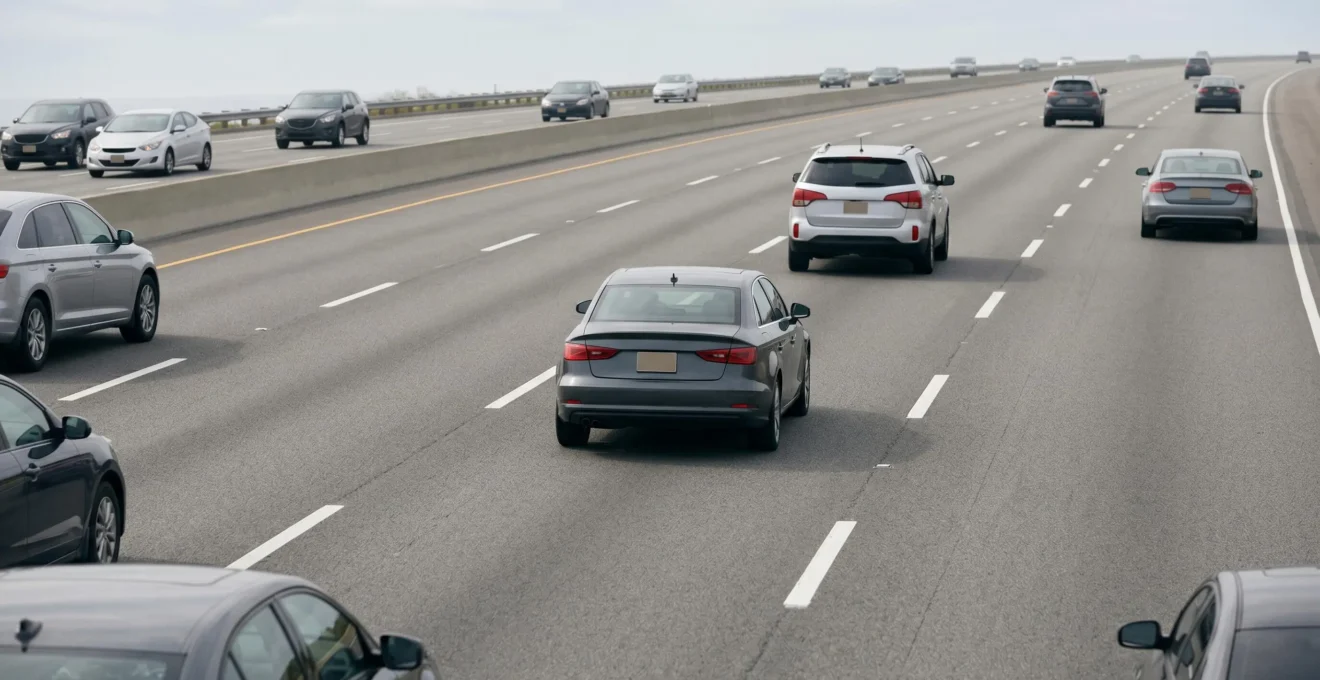
Contrary to popular belief, the key to avoiding accidents isn’t faster reflexes, but a system of proactive anticipation that makes most hazards irrelevant before they materialize.
- Scanning 12-15 seconds ahead gives you the critical time needed to manage risks, not just react to them.
- Actively managing a “dynamic safety bubble” around your vehicle provides pre-planned escape routes before you ever need them.
Recommendation: Shift your mindset from reacting to immediate threats to proactively deconstructing potential risk zones before you even enter them.
Most drivers experience a moment of frustration or fear, feeling like they are at the mercy of unpredictable traffic and other road users’ poor decisions. The common response is to grip the wheel tighter and hope for the best. Conventional wisdom suggests a few simple rules: don’t tailgate, check your mirrors, and avoid distractions. While these are not wrong, they frame safety as a reactive process—a defense against things that have already started to go wrong. The reality is that an estimated 80% of avoidable collisions stem from human error, but this error often occurs long before the moment of impact.
The most significant leap in driving safety isn’t about learning to react faster; it’s about adopting a system of proactive anticipation. This is the core of true defensive driving, a skill that is entirely learnable. As an advanced driving instructor, I can tell you that it’s not about innate talent but a change in mental models. It’s the difference between seeing a car brake ahead and having already anticipated that the driver was distracted and likely to make a sudden move. It’s a shift from being a passenger in a sequence of events to becoming the architect of your own safety.
This guide moves beyond the generic advice. We will deconstruct the mental framework that allows elite drivers to make collisions physically improbable. We will explore how to manage space and time, how to read the road like a language, and how to use psychology to predict other drivers’ actions. By the end, you won’t just know the rules of defensive driving; you will understand the system of proactive risk management that underpins them, empowering you to take definitive control of your safety on the road.
This article provides a structured path to mastering the proactive mindset. Each section builds upon the last, transforming you from a reactive driver into a strategic road user. The following summary outlines the key skills we will dissect.
Summary: The Path to Proactive Collision Prevention
- Why Scanning 12 Seconds Ahead Reduces Collision Risk by 70%
- How to Position Your Vehicle to Maximise Escape Routes in Traffic Using 5 Rules
- Motorway vs Urban Defensive Driving: Which Demands Different Techniques?
- The Mirror-Check Error That Causes 40% of Lane-Change Collisions
- When to Yield Right-of-Way Even When You Have Legal Priority: The 3 Safety Triggers
- Why Bypassing City Centres Via Ring Roads Reduces Accident Risk by 60%
- Blind-Spot Monitoring vs Manual Mirror Checks: Which Catches More Hazards?
- How Active Safety Systems Prevent Collisions Before Drivers React
Why Scanning 12 Seconds Ahead Reduces Collision Risk by 70%
The single most important defensive driving skill is not rapid braking or swerving, but advanced visual scanning. The common advice to “look ahead” is too vague. A certified advanced driver actively scans 12 to 15 seconds down the road. At 60 mph, that’s a quarter of a mile. This isn’t about staring into the distance; it’s a systematic process of proactive hazard deconstruction. By seeing a potential conflict that far in advance—a slow-moving truck, a cluster of brake lights, a car waiting to join from a slip road—you are no longer reacting. You are managing.
This extended timeframe allows you to make small, smooth adjustments to speed and position, neutralizing a threat before it ever becomes critical. Instead of a sudden stop, you have time for a gentle lift of the accelerator. This technique transforms driving from a series of high-stress reactions into a fluid process of planning and execution. It’s the difference between being a victim of circumstance and the conductor of your own journey. The goal is to identify, assess, and decide on a course of action so early that any emergency maneuver becomes unnecessary.
This three-layer scanning method involves constantly shifting your focus between the far horizon (12-15 seconds), the mid-ground (4-6 seconds), and your immediate path (0-2 seconds). This active visual search prevents target fixation and builds a complete, dynamic mental map of the road environment.
As the illustration of the driver’s eye suggests, your vision should be layered, processing information from multiple distances simultaneously. The reflection shows the far, mid, and near zones that a driver must constantly process. Mastering this creates a buffer of time, and in driving, time is the ultimate safety feature. The 70% risk reduction figure associated with this technique isn’t just a statistic; it represents the countless incidents that simply never happen because the driver saw them coming from a quarter-mile away.
How to Position Your Vehicle to Maximise Escape Routes in Traffic Using 5 Rules
While looking ahead gives you time, your vehicle’s position gives you options. A common mistake is to focus only on the space in front. True defensive driving involves creating and managing a “dynamic safety bubble”—a 360-degree zone of protection. This bubble is not a fixed distance; it expands and contracts based on speed, visibility, and traffic density. Your job as a proactive driver is to be the active manager of this space, ensuring you always have an “out” or an escape route.
This means never allowing yourself to be boxed in. When in multi-lane traffic, position your vehicle to have an open lane to one side whenever possible. Avoid driving for extended periods directly alongside another vehicle. In stop-and-go traffic, the rule is to stop far enough behind the vehicle in front that you can see its rear tires touching the pavement. This gap provides the crucial space to steer around it if it breaks down or if you see a threat approaching in your rearview mirror.
Positioning isn’t just about safety from other vehicles; it’s also about maximising your own view. By offsetting your position slightly within your lane (lane offsetting), you can often see around the vehicle in front, giving you an earlier view of developing hazards. This proactive management of space is a constant, conscious process of assessing and adjusting to maintain your options.
Your Action Plan: 5 Rules for Dynamic Safety Bubble Management
- Maintain Visibility of Rear Tires: When stopped behind vehicles, ensure you can see their rear tires touching the pavement to guarantee an escape path and reduce rear-end collision energy transfer.
- Utilize Lane Offsetting: Position your vehicle slightly left or right of your lane’s center to improve sight lines around vehicles ahead and create pre-planned escape paths.
- Actively Manage Side Space: Create lateral buffer zones to prevent being trapped by the panic maneuvers of other drivers. Avoid lingering in another vehicle’s blind spot.
- Adapt the Bubble Size: Expand your safety bubble in conditions of reduced visibility (rain, fog, night) or at high speeds; you can contract it slightly in slow, predictable traffic.
- Continuously Assess and Adjust: Your dynamic safety bubble is not static. It requires constant adjustment based on real-time changes in speed, traffic density, and road conditions.
Motorway vs Urban Defensive Driving: Which Demands Different Techniques?
A defensive driver understands that the environment dictates the strategy. The skills required on a high-speed motorway are fundamentally different from those needed in a complex urban setting. This isn’t just about different speed limits; it’s about managing different types of cognitive load. Failure to adapt your techniques to the environment is a primary cause of collisions.
On the motorway, the primary danger is high kinetic energy and closing speeds. The main cognitive challenge is combating “highway hypnosis”—the relaxed, inattentive state that can set in during long, monotonous drives. Here, the key is sustained vigilance and managing large pockets of space. Urban driving, in contrast, is an exercise in rapid attention switching. The hazard density is far higher, with unpredictable threats from intersecting vehicles, cyclists, opening car doors, and pedestrians. The cognitive demand is to filter a flood of information and prioritize the most immediate, highest-risk threats.
As Rosanna Cousins & Vahid Gharibi highlight in their research for the NCBI, defensive driving strategies are crucial in reducing human-error collisions, which are a global issue. According to the World Health Organization (WHO), over 1.3 million lives are lost annually due to road traffic accidents, underscoring the universal need for these adaptive skills. The following table breaks down the specific demands and techniques for each environment.
| Aspect | Motorway Driving | Urban Driving |
|---|---|---|
| Primary Hazard Type | High-Speed Energy Management: High kinetic energy and closing speeds between vehicles | Complex Hazard Density: Multiple unpredictable intersecting paths (vehicles, cyclists, pedestrians, doors) |
| Cognitive Demand | Sustained Vigilance: Combating highway hypnosis and monotony over long distances | Rapid Attention Switching: Filtering non-critical information to focus on immediate high-risk threats |
| Key Technique | Pacing Pockets: Position in gaps between vehicle clusters to maximize reaction time | Clearing Intersections: Cover brake and scan left-right-left even on green lights for red-light runners |
| Scanning Distance | Far Horizon (12-15 seconds): Monitor traffic flow patterns and signal changes | Immediate Zone (0-4 seconds): Constant near-field hazard detection |
| Auditory Cues | Tire noise changes indicate road surface transitions | Sirens, tire squeals, reverse-beepers provide information beyond line of sight |
The Mirror-Check Error That Causes 40% of Lane-Change Collisions
Lane-change collisions are incredibly common, and the title of this section highlights a stark reality: they account for a huge number of preventable incidents. The root cause is often misunderstood. It’s not just a failure to look; it’s a failure to *see*. This is due to a psychological trap known as confirmation bias. Most drivers glance in their mirror expecting it to be clear, so their brain is primed to confirm that belief. They are looking for clearance, not actively searching for a hazard.
An advanced driver, by contrast, performs a “discovery check.” They assume something *is* in their blind spot and their job is to find it. This mental shift is critical. Furthermore, many drivers make the error of relying solely on mirrors. Mirrors provide a snapshot in time, but they don’t account for the speed and trajectory of other vehicles. The correct procedure is a three-part process: mirror, signal, shoulder check. The shoulder check (or head turn) is non-negotiable. It’s the only way to physically clear the large blind spot that exists on the rear quarter of every car.
Case Study: The NHTSA’s Analysis of Lane-Change Glance Behavior
Federal research on lane-change crashes provides a stark insight into this problem. A study published by the NHTSA found that drivers often fail to use their mirrors and head turns effectively. The analysis revealed that drivers relied more on center mirrors than side mirrors during right-lane changes, and critical head turns to check blind spots were often only observed during the actual lane-change maneuver itself—far too late. This confirms the ‘confirmation bias check’ problem: drivers glance for a fraction of a second expecting clearance rather than actively looking to discover hazards. According to the study, this failure to perform an adequate visual search before initiating a lane change is a leading contributor to collisions. It highlights that the problem is less about not looking at all, and more about the poor quality and timing of the glance.
Further research shows that drivers who fail to properly scan blind spots are a major cause of these incidents. To combat this, your mirror checks must be deliberate and frequent, not just when you plan to change lanes. They are a tool for building your overall situational awareness.
Your 5-Point Lane Change Safety Audit
- Points of Contact: On your next drive, consciously list every time you check your mirrors. Are you only checking before a maneuver, or are you building a constant mental picture?
- Collect Data: For one week, make a mental note of every shoulder check you perform. Is it a quick, token glance or a deliberate turn of the head to see the entire blind spot?
- Check for Coherence: Does your mirror-check frequency increase in dense traffic or at high speeds? If not, your technique is not adapting to the risk level.
- Assess Your Bias: When you check, are you looking for an empty space (confirmation bias) or actively searching for a vehicle (discovery mindset)? Be honest with yourself.
- Plan for Integration: Identify your weakest point (e.g., infrequent shoulder checks) and make it your single point of focus for the next week of driving.
When to Yield Right-of-Way Even When You Have Legal Priority: The 3 Safety Triggers
One of the most difficult but most important lessons in defensive driving is that the highway code is not a suit of armor. Being legally “in the right” is of no comfort if you are involved in a collision. A proactive driver operates on a higher principle: physics overrides traffic law. Your goal is to avoid the collision, not to win the argument. This means being prepared to yield your right-of-way when specific safety triggers tell you that another driver is not going to yield to you.
This isn’t about being passive; it’s about being smart. It’s a calculated decision based on observing other drivers’ behavior and the physical realities of the situation. Insisting on your right-of-way when a multi-ton truck is clearly not going to stop is a recipe for disaster. Advanced driving is about recognizing these moments of conflict long before they become inevitable and choosing the path of maximum safety, even if it means letting the other driver “win.”
This requires you to read the “body language” of other vehicles. The three safety triggers below are clear signals that a driver is either unaware of you or has no intention of stopping, regardless of what the rules say. When you spot one of these triggers, you must be prepared to defensively cede your right-of-way.
As shown in the image, an intersection is a complex web of intentions. The safest driver is the one who correctly reads the intentions of others and positions themselves to avoid conflict, rather than forcing their priority.
Your Action Plan: The 3 Safety Triggers for Defensive Ceding
- Trigger 1 – No Eye Contact: If the other driver is not looking at you, assume they haven’t seen you and will proceed. Never assume visibility equals awareness.
- Trigger 2 – Unstoppable Momentum: If a large truck or speeding vehicle cannot physically stop in time due to its mass and velocity, your legal right-of-way is physically irrelevant. Physics always wins.
- Trigger 3 – Clear Intent: If a driver is aggressively nudging forward or has their wheels already turned toward your path, they are communicating an intention to proceed. Believe their vehicle’s body language, not the traffic rules.
Finally, remember the Post-Yield Reset Protocol: After defensively yielding, immediately re-scan the entire situation. Your action has altered the traffic dynamic and may create unexpected interactions with third vehicles that anticipated you would proceed.
Why Bypassing City Centres Via Ring Roads Reduces Accident Risk by 60%
Defensive driving extends beyond the vehicle itself; it includes strategic decision-making before you even turn the key. One of the most effective risk-reduction strategies is route choice. Specifically, choosing to bypass a dense city center by using a purpose-built ring road can reduce your accident risk by as much as 60%. This is not by chance; it is by design.
City centers are environments of maximum hazard density. They are characterized by a near-infinite number of unpredictable entry and exit points: alleyways, driveways, parking spaces, pedestrian crossings, and complex intersections. Every one of these is a potential point of conflict. Ring roads, by contrast, are engineered to minimize this complexity. They are typically controlled-access highways, meaning that traffic can only enter and exit at specifically designed, well-marked ramps. This drastically reduces the number of variables a driver needs to process.
By standardizing traffic flow and eliminating unpredictable intersecting paths, ring roads lower the cognitive load on the driver. This allows you to focus more on the primary tasks of managing speed and maintaining your safety bubble, rather than constantly reacting to pop-up threats. Choosing a ring road is a proactive decision to place yourself in a statistically safer, more predictable environment.
Case Study: Analysis of Urban Ring Road Traffic Accident Factors
A comprehensive study analyzing 1,250 traffic accidents on urban ring roads confirmed the safety benefits of this design. The research utilized advanced analytical models to evaluate 16 different factors across the driver-vehicle-road-environment system. The study concluded that the controlled-access nature of ring roads is a primary factor in reducing accident complexity. By channeling through-traffic around congested city centers, ring roads standardize traffic variables and eliminate the countless unpredictable conflict points that are inherent to urban grids, thereby lowering overall accident frequency and severity.
Key Takeaways
- Scan Proactively, Don’t Just Look: The 12-second scan is your most powerful tool, turning potential emergencies into manageable events.
- Own Your Space: Your dynamic safety bubble is your personal zone of control. Actively manage it on all four sides to ensure you always have an escape route.
- Adapt to the Environment: The cognitive demands of motorway and urban driving are vastly different. A safe driver fluidly changes their techniques to match the hazard density.
- Yield to Physics, Not Just Law: Being legally “right” doesn’t prevent a collision. Recognize the safety triggers that tell you when to defensively cede your right-of-way.
Blind-Spot Monitoring vs Manual Mirror Checks: Which Catches More Hazards?
Modern vehicles are increasingly equipped with Blind-Spot Monitoring (BSM) systems, which use sensors to detect vehicles you can’t see and provide a visual or audible warning. This technology is a fantastic safety net, but it introduces a new risk: over-reliance. Many drivers begin to treat the BSM light as their primary source of information, replacing rather than augmenting their manual checks. This is a dangerous habit, as technology can and does fail.
BSM systems have known limitations. They can struggle to detect fast-approaching vehicles (those with a high “delta-V” or speed differential), smaller objects like motorcycles, or can be hampered by heavy rain, snow, or even dirt on the sensors. Treating the absence of a warning light as confirmation of a clear lane is a critical error. The system is a co-pilot, not the pilot-in-command.
The correct, safest approach is to use technology as the final verification step in a well-practiced manual routine. The sequence should always be: (1) interior mirror, (2) side mirror, (3) physical shoulder check. Only after completing these three manual steps should you take a final glance at the BSM indicator for confirmation before initiating your maneuver. This approach combines the irreplaceable value of human observation with the backup of technology, creating multiple layers of safety. Remember, you are the ultimate safety system in your vehicle.
How Active Safety Systems Prevent Collisions Before Drivers React
The final layer in a modern defensive driving strategy is the suite of Advanced Driver-Assistance Systems (ADAS), particularly Automatic Emergency Braking (AEB). Unlike systems that merely warn you, active systems like AEB can physically intervene by applying the brakes to prevent or mitigate a collision, often faster than a human ever could. These systems use radar, cameras, and lidar to constantly monitor the road ahead, acting as a tireless digital lookout.
The progress in this technology has been remarkable. Early systems were only effective at very low speeds, but modern AEB is significantly more capable. However, it’s crucial to understand that even the best systems are not infallible. They are a backup, designed to intervene when the driver has failed to act. The entire proactive system of scanning, managing space, and anticipating hazards is your primary defense. ADAS is the last line of defense.
Relying on AEB to save you encourages a passive, inattentive driving style, which ultimately makes you less safe. The goal of a defensive driver is to drive in such a way that the AEB system never has to activate. You are the one who accounts for icy roads, poor visibility, or unusual hazards that a computer might not recognize. Technology is a powerful ally, but it is not a substitute for an alert and engaged driver.
Case Study: AAA’s AEB Performance Progression Study
In a recent study, AAA’s 2024 research on automatic emergency braking found that new vehicles demonstrated significant improvements. On a closed course, 2024 models equipped with AEB successfully avoided 100% of forward collisions with a target vehicle at speeds up to 35 mph. This is a vast improvement over 2017-2018 models, which only achieved 51% collision avoidance under similar conditions. However, the study also highlights the technology’s current limits. The NHTSA’s new mandate for 2029 requires AEB to function at speeds up to 62 mph, indicating that today’s systems are not yet a complete solution, reinforcing the need for driver vigilance as the ultimate failsafe.
By adopting this proactive, anticipation-focused mindset, you are fundamentally changing your relationship with the road. You are no longer just a driver; you are a risk manager. The next logical step is to consciously practice one of these skills on every journey until it becomes an ingrained habit.
Frequently Asked Questions About Defensive Driving Techniques
How can I verify if my vehicle has blind-spot monitoring technology?
The National Highway Traffic Safety Administration (NHTSA) maintains a comprehensive database on their Driver Assistance Technologies page. By entering your vehicle’s make and model, you can quickly determine if your car includes blind spot detection systems and other safety features.
What are the failure modes of blind-spot monitoring systems?
BSM systems can struggle to detect fast-approaching vehicles (high delta-V), motorcycles, and may give false positives during heavy rain or snow. These limitations mean the system should be used as a confirmation tool rather than the primary detection method.
What is the correct sequence for using BSM with manual checks?
The optimal safety sequence is: (1) Interior rearview mirror check, (2) Side mirror check, (3) Physical shoulder check, (4) Final glance at BSM indicator for verification before initiating the lane change maneuver. This treats technology as augmentation, not replacement.