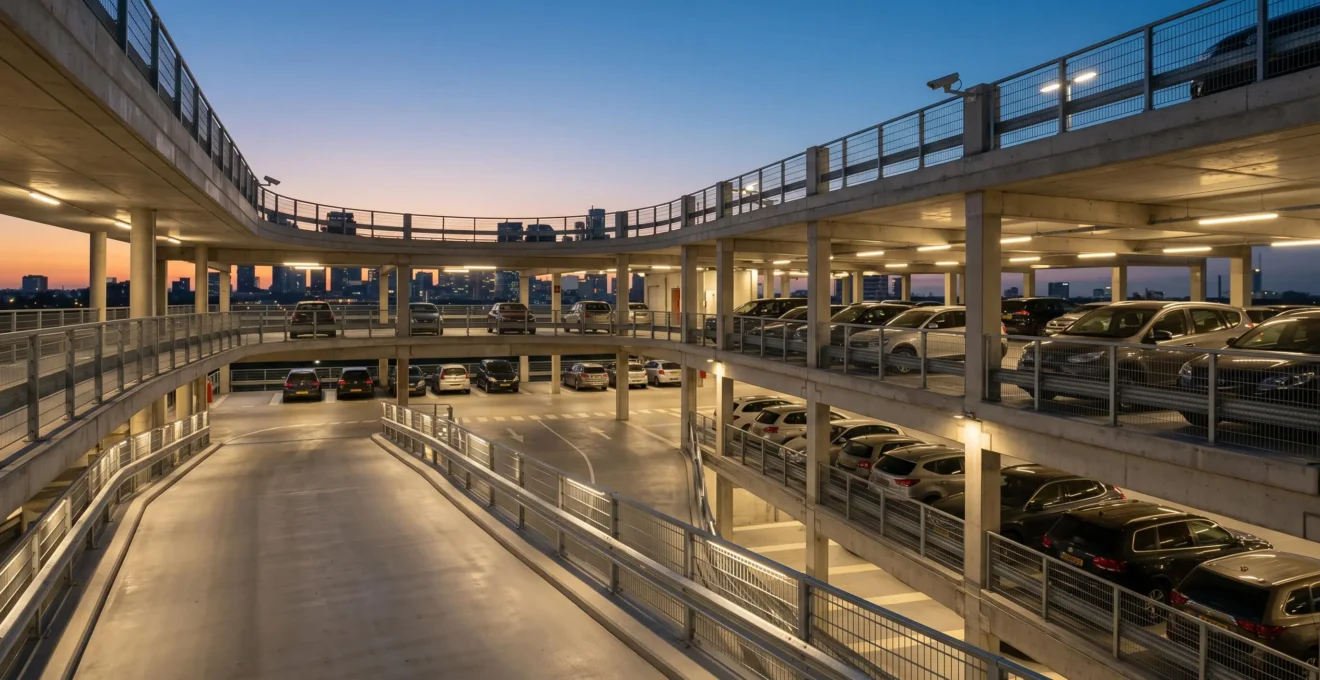
In summary:
- Prioritise car parks with official security certifications like Park Mark, which are proven to have significantly lower crime rates.
- Learn to perform a two-minute visual risk assessment, checking for key indicators like lighting quality, signs of neglect, and clear surveillance sightlines.
- Understand the specific risks of different parking types; multi-storey car parks deter catalytic converter theft, while open surface lots can offer better personal safety.
- Actively increase “criminal friction” by choosing spots that make a thief’s job harder, such as parking on a slope or in a high-traffic, well-observed area.
- For high-value contents or extended stays, the higher cost of a secured compound is a necessary investment against significant financial loss.
The moment you walk away from your parked vehicle, a nagging sense of uncertainty can set in. Is it safe here? This question is more than just abstract anxiety; it’s the beginning of a risk assessment that most people are never taught to perform correctly. The common advice—to find a “well-lit spot” or park near other cars—is dangerously simplistic. It overlooks the sophisticated calculations that opportunistic and professional criminals make in seconds.
True vehicle security is not about luck; it’s about seeing an environment through a security professional’s eyes. It involves understanding the subtle environmental cues that signal risk or safety. This goes beyond the presence of a single camera or a bright light. It’s about evaluating sightlines, access control, signs of social order or neglect, and the “operational privacy” a location might afford a thief. The difference between a vulnerable target and a hardened one often lies in the choice of parking spot.
But what if the key wasn’t just reacting to threats, but proactively choosing environments where risk is structurally minimized? This guide moves beyond the platitudes to provide a strategic framework for parking selection. We will break down the methodology used by security consultants, teaching you how to perform a rapid but effective risk assessment. From decoding certified parking schemes to analyzing the specific threats posed by different car park designs, you will learn to make informed decisions that dramatically reduce your vehicle’s vulnerability to theft and damage.
This article provides a comprehensive look at the critical factors that determine parking security. The following sections will guide you through each element, from certified standards to the psychology of criminal target selection.
Summary: How to Choose Secure Parking and Mitigate Vehicle Theft
- Why Park Mark Certified Car Parks Have 50% Fewer Vehicle Crimes Than Street Parking
- How to Assess Parking Security Using 6 Visual Crime-Risk Indicators in 2 Minutes
- Multi-Storey vs Surface Car Parks: Which Offers Better Vehicle Security at Night?
- The Parking Location Mistake That Triples Catalytic Converter Theft Risk
- When to Use Secured Compounds vs Public Parking: The £5,000 Vehicle Contents Threshold
- The Overnight Parking Mistake That Leads to Campervan Break-Ins in Tourist Areas
- How to Design Dockless Parking Zones That Prevent Pavement Clutter in 5 Steps
- How Urban Micro-Mobility Solutions Reduce City Centre Car Trips by 25%
Why Park Mark Certified Car Parks Have 50% Fewer Vehicle Crimes Than Street Parking
The most effective starting point for securing your vehicle is to choose a facility that has already been professionally vetted. In the UK, the Park Mark Safer Parking Scheme provides this assurance. This police-backed initiative is not a simple rubber stamp; it’s a rigorous assessment of a car park’s design, management, and maintenance practices against strict crime prevention criteria. The result is a network of car parks where crime and the fear of crime are actively reduced. While an estimated 17,000-20,000 car parks operate across the UK, almost 5,000 have achieved this certification, making them a readily available and superior choice.
The scheme’s effectiveness stems from its holistic approach. A Park Mark certified facility must demonstrate high standards in lighting, surveillance, and cleanliness, all of which act as powerful deterrents. For criminals, these environments increase the likelihood of being seen, identified, and apprehended. This added “criminal friction” is why these car parks consistently show dramatically lower crime rates. Opting for a Park Mark car park effectively outsources the most difficult parts of your security assessment to a team of trained professionals, giving you a baseline of safety before you even enter.
Even without a certification, understanding the criteria they use can empower you to make smarter choices. The principles of the Park Mark scheme form a blueprint for what a secure parking environment looks like. By internalizing these standards, you can apply the same logic to any parking area, certified or not, and significantly improve your ability to spot and avoid potential threats. The following checklist details the core areas assessed, providing a practical framework for your own evaluations.
Your Action Plan: Key Park Mark Assessment Criteria
- Lighting levels: Verify upgraded LED lighting systems that eliminate shadow zones and provide uniform illumination across all parking zones.
- Oversight systems: Check for active CCTV coverage with clear sightlines and monitoring capability during all operating hours.
- Maintenance standards: Assess the visible condition of surfaces, signage clarity, and absence of neglect indicators (graffiti, broken fixtures, litter accumulation).
- Entry/Exit control: Evaluate access point security measures including barriers, height restrictors, and traffic flow management systems.
- Social proof validation: Observe the condition and value profile of other parked vehicles as an indicator of peer-validated safety perception.
Ultimately, choosing a certified car park is a strategic decision that stacks the odds in your favour from the outset.
How to Assess Parking Security Using 6 Visual Crime-Risk Indicators in 2 Minutes
When entering a non-certified car park, you must become your own security consultant. A rapid, two-minute visual scan can reveal a wealth of information about the true risk level. This isn’t about looking for criminals; it’s about identifying the environmental cues that criminals look for. These indicators signal whether a location offers them concealment, easy access, and a low risk of being caught. One of the most powerful concepts in this assessment is the “Broken Windows Theory,” which posits that visible signs of neglect—like graffiti, litter, or broken fixtures—signal an absence of oversight and social control, creating an environment where more serious crime can flourish.
This macro-level assessment of a parking facility’s maintenance can reveal its underlying security posture. A well-maintained area suggests active management and surveillance, while a neglected one implies that no one is paying attention.
As this image shows, the contrast between a clean, well-marked surface and a deteriorated one is stark. These details are not just cosmetic; they are a direct reflection of the operator’s commitment to security. Beyond general maintenance, focus on these six indicators: lighting quality, sightlines, access points, hiding spots, escape routes, and evidence of previous crime (like broken glass on the ground). Each one tells a piece of the security story. Poor lighting is a classic red flag, but it’s the specifics that matter. As one expert from Crime Doctor notes, the standard should be clear identification.
You should be able to see and identify someone at 100 feet. If lighting is inadequate, park somewhere else.
– Crime Doctor, Parking Lot Security: Car Park Security Plan for Families
Look for bright, uniform, white light that eliminates deep shadows between cars and in corners. Obstructed sightlines from overgrown vegetation or poor design create blind spots for both you and any surveillance system. Similarly, uncontrolled entry and exit points provide thieves with fast and anonymous escape routes. By training your eye to spot these risk factors, you can make a quick, informed decision to either park in the safest possible spot or move on to a better location.
Mastering this quick scan transforms you from a potential victim into a hard target who understands and avoids unnecessary risks.
Multi-Storey vs Surface Car Parks: Which Offers Better Vehicle Security at Night?
The choice between a multi-storey and a surface car park involves a trade-off between different security risks, especially at night. Neither is universally “safer”; the optimal choice depends on which threats you are trying to mitigate. Surface lots often benefit from natural surveillance from surrounding streets and buildings, meaning more potential witnesses. However, they are also more exposed, with multiple uncontrolled access and egress points that facilitate quick getaways for vehicle thieves. This exposure makes them a higher-risk environment for whole-vehicle theft.
Conversely, multi-storey structures offer superior access control. With limited entry and exit points, often protected by barriers, they create a significant deterrent for car thieves. The time and effort required to steal a car and navigate out of a multi-storey car park increase the criminal’s exposure and risk of being caught. This environment is particularly effective at deterring the theft of catalytic converters, which relies on speed and ease of access. However, the internal layout of these structures creates its own set of problems. Isolated stairwells, poorly lit corners, and empty upper floors can become high-risk zones for personal safety and vehicle break-ins, a fact underscored by the high number of offenses in these environments. An analysis of FBI data shows that parking facilities are the third most common location for violent crimes in the US.
A detailed comparison highlights these differing risk profiles. The key is to choose based on a specific strategy that aligns with the car park’s strengths.
The following table, based on professional lighting and security standards, breaks down the key differences to inform your decision. It draws on data points like those from a detailed guide on lighting standards for multi-storey car parks.
| Security Factor | Multi-Storey Car Parks | Surface Car Parks | Optimal Strategy |
|---|---|---|---|
| Lighting Standards (Night) | 75 lux at entrances/exits; 150 lux main areas with 0.4 uniformity | Variable; often inconsistent coverage | Multi-storey with code compliance |
| Natural Surveillance | Limited on upper floors; stairwells are isolated zones | Higher visibility from surrounding buildings/streets | Surface lots near active areas |
| Access Control | Controllable entry/exit points; floor-by-floor barriers possible | Multiple access points; harder to restrict | Multi-storey for controlled access |
| Personal Safety Risk | Isolated stairwells/lifts; confined spaces | Open sightlines; easier escape routes | Surface for personal safety |
| Vehicle Theft Risk | Lower on upper floors (requires more time/exposure) | Higher due to quick vehicle escape routes | Multi-storey upper floors near lifts |
| Catalytic Converter Theft | Deterred by time constraints and cameras | Easier quick access and escape | Multi-storey with surveillance |
If your primary concern is personal safety, a well-observed surface lot may be preferable. If preventing vehicle or parts theft is the priority, a well-managed multi-storey car park is often the superior tactical choice.
The Parking Location Mistake That Triples Catalytic Converter Theft Risk
Catalytic converter theft remains a significant threat to vehicle owners, despite recent successes in combating it. While a report from the National Insurance Crime Bureau shows a promising 68% drop in thefts from 2023 to 2024, thousands of vehicles are still targeted. The most critical mistake a driver can make is to ignore the single most important factor for these criminals: undercarriage access. Thieves targeting these parts operate on a strict time budget, often needing to complete the theft in under 60 seconds. The easier and faster they can get under your car, the higher your risk.
This is why simply parking in an open, flat, and easily accessible space—especially with a high-clearance vehicle—is a critical error. It provides thieves with the perfect working conditions. They can slide underneath without needing a jack, cut the converter, and be gone before anyone notices. Parking in a corner spot near an exit further reduces their “criminal friction,” giving them operational privacy and a swift escape route. This combination of easy access and a clear getaway path makes a vehicle an almost irresistible target.
The solution is to think like a thief and actively work to disrupt their process. By introducing obstacles that slow them down, you dramatically reduce your vehicle’s appeal. Even a few extra minutes of effort can be enough to make them move on to an easier target.
Case Study: How Vehicle Clearance and Parking Choice Impact Theft Time
An analysis of theft patterns reveals that trucks and SUVs with high ground clearance, such as Ford F-Series models, are prime targets because thieves require no special equipment to get underneath. Hybrid vehicles like the Toyota Prius are also frequently hit due to the higher concentration of precious metals in their converters. In contrast, many European models from Audi, BMW, and Volkswagen have lower theft rates because their converters are positioned closer to the engine block, making them harder to access quickly. The most effective countermeasure is strategic parking. By positioning a vehicle on an uneven surface, against a high curb, or on a noticeable slope, drivers can physically block or reduce undercarriage access. This simple tactic can extend the time required for a theft from less than one minute to several minutes, a delay that often proves to be a powerful deterrent.
Always assess your parking spot from a thief’s perspective: how can you make their job slower, more difficult, and more visible?
When to Use Secured Compounds vs Public Parking: The £5,000 Vehicle Contents Threshold
The decision between using standard public parking and paying a premium for a high-security compound is a simple cost-benefit analysis. The “right” choice is dictated by the value of what you’re protecting. For daily errands with nothing of value inside the vehicle, a well-chosen public car park is usually sufficient. However, when the contents of your vehicle—be it tools, equipment, luggage, or personal electronics—exceed a certain value, the risk equation changes dramatically. A common threshold used by security professionals is £5,000. If the replacement cost of your vehicle’s contents approaches or exceeds this figure, the potential financial loss from a single break-in justifies the expense of a secured compound.
This threshold isn’t arbitrary. It reflects the point at which the cost of enhanced security becomes a sound financial investment rather than a luxury. Even the cost of a single stolen part can be substantial; a State Farm claims analysis found average catalytic converter replacement costs to be between $2,177 and $2,506. When you add high-value tools or equipment, the potential loss escalates quickly. Secured compounds mitigate this risk through a layered security approach that public lots cannot match, including 24/7 on-site personnel, comprehensive and actively monitored CCTV, and stringent access control systems.
This choice is a balance of three factors: security, cost, and convenience. While a public lot is cheaper and more convenient, it offers a lower level of security. A secured compound demands a higher price and may be less conveniently located, but it provides a robust defense against theft.
As this visual metaphor suggests, these three priorities are in constant tension. Your task is to weigh them according to your specific situation. If your vehicle is empty, convenience and cost may win out. But if you are transporting valuable assets, the scale must tip decisively in favor of security. Ignoring this calculation is a gamble where the potential downside far outweighs the savings of cheaper parking.
Treat the cost of secured parking as an insurance policy against a far greater, and increasingly likely, financial loss.
The Overnight Parking Mistake That Leads to Campervan Break-Ins in Tourist Areas
For campervan owners, the freedom of the open road comes with a unique set of security challenges, especially when parking overnight in popular tourist areas. The single most common mistake is misjudging the risk profile of different parking spots. Many assume that isolated, “wild” spots offer peace and safety, when in reality they provide thieves with the perfect combination of a high-value target and complete operational privacy. Analysis of theft incidents across Europe consistently shows that designated campsites are far safer than service areas, public tourist car parks, and remote beauty spots.
Thieves who target campervans are often professionals who can identify an unoccupied vehicle from a distance. External signals like mounted bikes, deployed awnings, or camping chairs left outside act as a clear advertisement that the owners are away for an extended period, such as hiking or visiting an attraction. In an isolated location, this gives criminals an uninterrupted window to work. They can force entry and strip the vehicle of valuables without fear of being seen or heard. The very seclusion that travelers seek is the same advantage that criminals exploit.
The most effective counter-strategy involves a layered approach. First, choose your location wisely. Parking in a designated campervan area or a busy, well-lit campsite creates “safety in numbers.” The constant presence of other people provides natural surveillance and acts as a strong deterrent to organized thieves. Second, use physical security devices, but understand their limitations. A steering lock or wheel clamp is a great visual deterrent in a built-up area where breaking it would create noise. In an isolated spot, however, a thief can use loud tools to defeat it with impunity. Finally, create the illusion of occupancy. Using timed interior lights or other simulators can introduce doubt in a thief’s mind, potentially causing them to move on to an easier target.
The goal is to make your vehicle appear occupied, difficult to access, and parked in a location where a criminal’s actions would be easily observed.
Key Takeaways
- Security is not a single feature, but a layered system. A certified, well-lit, and actively monitored car park is the strongest foundation.
- Your greatest tool is your own assessment. Learning to spot environmental red flags—neglect, poor sightlines, easy escape routes—is a skill that protects you everywhere.
- The “best” parking spot is context-dependent. A multi-storey car park protects against parts theft, while a busy surface lot may be better for personal safety. Match the solution to the most likely threat.
How to Design Dockless Parking Zones That Prevent Pavement Clutter in 5 Steps
While seemingly unrelated to vehicle theft, the design of urban spaces, including parking for micro-mobility solutions like e-scooters and bikes, has a direct impact on public safety and security. Pavement clutter from poorly designed dockless parking zones creates more than just an obstruction; it creates environmental conditions that can increase criminal opportunity. Cluttered pavements can create hiding spots for would-be thieves, obstruct sightlines for CCTV and natural surveillance, and impede access for emergency services. A well-designed public realm is a secure one.
From a security consultant’s perspective, managing these zones is an exercise in Crime Prevention Through Environmental Design (CPTED). The goal is to create spaces that are open, orderly, and clearly defined, which inherently discourages anti-social behavior and criminal activity. By ensuring that parked scooters and bikes do not block pedestrian flow or create visual barriers, urban planners and property managers can maintain the natural surveillance that is crucial for keeping areas safe. An orderly environment signals that the space is managed and monitored, deterring opportunistic crime.
Implementing a clear, five-step design process ensures these zones enhance the urban landscape rather than detract from it, with tangible security co-benefits for everyone, including parked car owners nearby.
Your Action Plan: Designing Secure Micro-Mobility Zones
- Channelisation and Demarcation: Clearly mark designated parking bays on the pavement with high-visibility paint. This channels user behavior and prevents random abandonment of scooters, keeping sightlines clear.
- Strategic Siting: Locate parking zones in areas with high natural surveillance, such as near building entrances, streetlights, and existing CCTV coverage, but without blocking main pedestrian thoroughfares.
- Physical Boundaries: Where appropriate, use low-profile physical guides or racks. This not only enforces neat parking but also prevents the scooters from being easily knocked over to create chaotic clutter.
- Maintain Clear Sightlines: Ensure that the designated zones do not create new blind spots. They should not be placed behind large street furniture, advertising hoardings, or dense vegetation where someone could hide.
- Regular Auditing and Maintenance: Implement a system for regular checks by the operator to clear any mis-parked scooters and maintain the integrity of the parking zone. This demonstrates active management and deters neglect.
Order and clear lines of sight are fundamental deterrents to opportunistic crime, benefiting the entire urban environment.
How Urban Micro-Mobility Solutions Reduce City Centre Car Trips by 25%
The ultimate form of vehicle security is risk elimination. If a car is not present in a high-risk area, it cannot be stolen or broken into. This is the often-overlooked security benefit of well-integrated urban micro-mobility solutions. By providing viable, convenient alternatives to driving, cities can actively reduce the number of vehicles—or “targets”—parked in dense, often vulnerable, city centres. The goal of achieving a 25% reduction in car trips through the adoption of e-scooters, bike-sharing, and other similar services is not just an environmental or traffic-management objective; it is a powerful, strategic crime-reduction tool.
Every car trip that is replaced by a scooter or bike ride is one less vehicle left unattended on a city street or in a public car park for hours at a time. This reduction in “target density” has a compounding effect on vehicle crime statistics. Fewer targets mean fewer opportunities for criminals. For organized theft rings that rely on a high volume of potential vehicles to scout, a lower density makes their operations less efficient and more conspicuous. They are more likely to move their focus to areas with a greater concentration of targets.
This strategic shift requires a holistic view of urban planning. It’s not enough to simply introduce micro-mobility options; they must be part of an integrated system with safe, segregated lanes and the well-designed parking zones discussed previously. When these alternatives are genuinely safe, affordable, and convenient, they can meaningfully displace car usage for short-to-medium urban journeys. This creates a virtuous cycle: fewer cars lead to less congestion, which makes micro-mobility even more attractive, further reducing the number of parked vehicles and, consequently, the opportunities for vehicle crime.
By championing and properly managing urban micro-mobility, city planners and security professionals can fundamentally alter the risk landscape, designing out crime by reducing the number of potential targets in the first place.