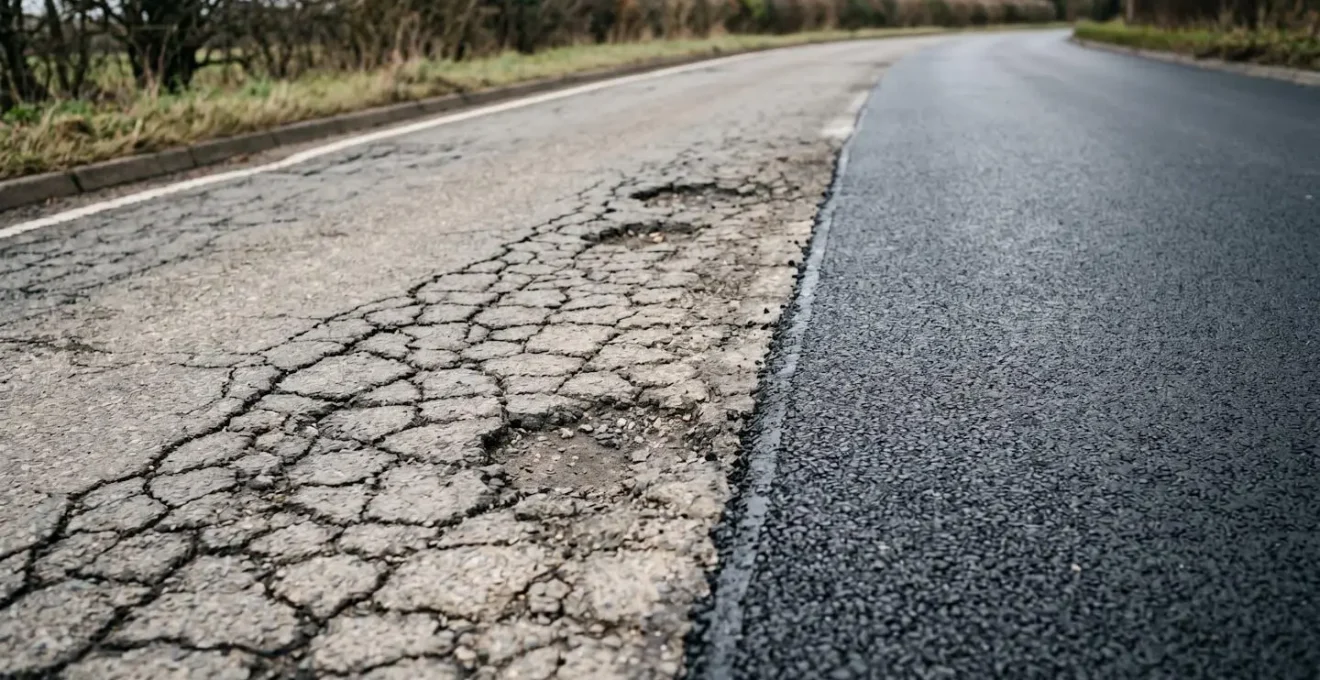
Contrary to popular belief, a road’s longevity isn’t determined by the quality of its visible blacktop, but by the structural integrity of the unseen layers beneath.
- Surface cracks are often just symptoms of a failing foundation (the sub-base), a problem a new layer of asphalt cannot solve.
- The real cause of premature failure is frequently rooted in council procurement decisions that prioritise the lowest bid over long-term engineering specifications.
Recommendation: Next time you see roadworks, pay less attention to the new surface and more to the depth of the excavation and the quality of the foundation being prepared; that’s where the road’s true lifespan is decided.
As a homeowner, observing a freshly resurfaced road begin to crack and crumble within a few years is a common and understandable frustration. The immediate assumption often points to poor workmanship, bad weather, or the sheer volume of heavy traffic. While these factors play a part, they are rarely the root cause. From an engineering perspective, the premature failure of a road is almost never about the final, visible surface course you see being laid. It’s about the complex, multi-layered system hidden beneath it.
Most discussions about road quality get stuck on surface-level issues like potholes. The real story, however, is written in layers of aggregate, bitumen, and compacted earth you never see. It involves physics, material science, and, crucially, the economics of public procurement. The difference between a road that endures for decades and one that fails in a single parliament term is decided long before the first roller appears on site. It’s a difference determined by the quality of the sub-base, the choice between a quick resurfacing and a full reconstruction, and the technical specifications written into a council’s contract.
This article will deconstruct the engineering principles behind road longevity. We will move past the superficial and delve into the structural science. By understanding this hidden world, you will learn to see roads not as simple black surfaces, but as complex engineered structures, and you’ll be able to spot the real reasons one thrives while its neighbour fails.
Summary: The Engineering Behind UK Road Longevity
- Why Winter Freeze-Thaw Cycles Crack Northern England Roads 3× Faster
- How to Spot High-Quality Roadworks vs Substandard Resurfacing in 4 Signs
- Asphalt vs Concrete Surfaces: Which Lasts Longer on UK Motorways?
- The Council Procurement Error That Causes Roads to Fail Within 2 Years
- When Roads Should Be Fully Reconstructed vs Simply Resurfaced: The 3 Structural Indicators
- Why Sub-Base Failure Causes Surface Cracks Despite Fresh Asphalt Above
- Why Adaptive Traffic Lights Reduce Wait Times by 25% Compared to Fixed Timings
- How Modern Roads Are Built in 7 Layers You Never See
Why Winter Freeze-Thaw Cycles Crack Northern England Roads 3× Faster
The most visible adversary of UK roads is the weather, specifically the freeze-thaw cycle. This phenomenon is particularly aggressive in the northern parts of England and Scotland. The mechanism is simple but destructive: water seeps into tiny, often invisible, cracks in the asphalt. When temperatures drop below freezing, this trapped water turns to ice. From a physics standpoint, this is the critical moment. Water expands by approximately 9% in volume as it freezes, exerting immense hydraulic pressure from within the pavement structure.
This internal pressure forces the small crack to widen and deepen. When the temperature rises and the ice thaws, the water drains away, leaving a larger void. The next time it rains, more water fills this bigger crack, and the subsequent freeze cycle expands it even further. This repeated, cyclical stress is a primary driver of pothole formation. A road surface that might have survived years in a milder climate can show significant degradation after just a few harsh winters. The effectiveness of a road’s surface drainage and the impermeability of its top layer are therefore critical defences against this relentless attack.
The cumulative financial impact is staggering. While it’s a localised physical process, the national cost of repairing damage attributable to winter weather and freeze-thaw cycles is a significant drain on maintenance budgets, with some estimates placing the annual repair bill at over £1 billion across the UK. This highlights why designing for climate resilience, not just traffic load, is a fundamental aspect of modern highway engineering.
How to Spot High-Quality Roadworks vs Substandard Resurfacing in 4 Signs
For a non-engineer, judging the quality of roadworks can seem impossible. However, there are several key indicators that offer clues to the standard of work being performed. While a smooth final surface is desirable, the real signs of quality are visible during the construction process itself. These are the things a supervising engineer looks for, and they often revolve around preparation and process, not just the end result.
The most crucial process to observe is compaction. Freshly laid asphalt is a hot, loose mixture. It must be compacted by heavy rollers to achieve the required density and interlock the aggregate particles. Insufficient compaction leaves air voids in the material, which allow water ingress and act as points of weakness, leading to premature cracking and pothole formation. A quality crew works methodically, with rollers following a specific pattern at a controlled temperature to ensure uniform density across the entire mat.
This image demonstrates the critical moment of compaction. The texture and sheen of the asphalt, along with the pressure from the roller’s drum, are all part of a process designed to create a dense, impermeable layer. Beyond this, look for the quality of the joint between the new surface and the old, the cleanliness of the prepared area before the asphalt is laid, and the depth of the initial excavation. A shallow “skim and seal” job that only removes the top few centimetres is a temporary fix; a quality resurfacing will often involve milling off a significant depth to remove all fatigued material.
Action Plan: Your 4-Point Roadworks Quality Check
- Excavation Depth: Observe the initial milling. Is the crew removing a substantial layer (50mm+) of old asphalt, or just skimming the surface? Deep removal indicates they are addressing underlying fatigue, not just cosmetic flaws.
- Base Preparation: Look at the milled surface before new asphalt is laid. Has it been swept clean of all debris and dust? A tack coat (a thin, sticky layer of bitumen) should be applied to ensure the new layer bonds properly.
- Compaction Process: Watch the rollers. Is their work systematic and overlapping? Are they working continuously while the asphalt is hot? Haphazard rolling or compacting a cold mix is a major red flag for future durability.
- Joint Quality: Inspect the longitudinal joints (where two lanes of asphalt meet). A well-constructed joint should be neat, straight, and sealed to prevent it from becoming a channel for water.
Asphalt vs Concrete Surfaces: Which Lasts Longer on UK Motorways?
The choice of surface material is one of the most fundamental decisions in road design, with a direct impact on longevity, cost, and user experience. In the UK, the vast majority of roads are surfaced with flexible asphalt, but you will still find sections of major motorways, like the M1 and M25, constructed from rigid concrete. Each has a distinct engineering profile.
Asphalt, or more accurately, asphalt concrete, is a composite material of aggregate (crushed stone and sand) held together by a bitumen binder. It is known as a “flexible pavement” because it can deflect slightly under load. Its advantages are a smoother and quieter ride, and it is generally easier and faster to repair. A well-constructed asphalt motorway can last 15-20 years before requiring significant resurfacing. However, it is more susceptible to damage from freeze-thaw cycles and the formation of ruts under heavy, channelled traffic.
Concrete roads, on the other hand, are “rigid pavements.” They consist of a slab of Portland cement concrete that distributes loads over a much wider area. Their primary advantage is durability. According to data from highway authorities, a properly constructed concrete road can have a service life of 20 to 40 years with minimal maintenance. The trade-off is a higher initial construction cost, a noisier ride, and repairs that are more complex and time-consuming. The choice between the two is a classic engineering and economic calculation, balancing upfront investment against long-term maintenance costs.
The Council Procurement Error That Causes Roads to Fail Within 2 Years
While technical factors like materials and weather are significant, a primary driver of premature road failure in the UK is rooted in the administrative process of procurement. When a local council decides to repair a road, it issues a tender for the work. The critical error that often occurs here is the selection of a contractor based almost exclusively on the lowest bid, a practice known as “least-cost procurement.”
This approach incentivises contractors to cut corners to protect their margins. This might manifest as using a thinner layer of asphalt than specified, using lower-quality materials, or rushing the compaction process. The road may look good on completion and pass a superficial inspection, but its structural lifespan is severely compromised. The failure is not in the workmanship on the day, but in a procurement system that does not adequately value or enforce long-term quality and performance metrics. A shift towards “best-value” procurement, which considers whole-life cost, durability, and a contractor’s track record, is the engineering-led solution.
The scale of this problem is vast. The 2024 Asphalt Industry Alliance (AIA) ALARM survey revealed that the estimated cost to fix the backlog of local road repairs in England and Wales has reached a record £16 billion. This colossal figure is a direct consequence of decades of underinvestment and a focus on short-term fixes over long-term structural health. As Rick Green, Chair of the Asphalt Industry Alliance, stated when testifying to the Parliament Transport Committee about the state of local road funding:
The current situation is very clearly suboptimal.
– Rick Green, Chair of the Asphalt Industry Alliance, testifying to Parliament Transport Committee
This professional understatement captures the frustration of engineers who know how to build durable roads but are often constrained by flawed procurement models.
When Roads Should Be Fully Reconstructed vs Simply Resurfaced: The 3 Structural Indicators
One of the most critical decisions a highway authority faces is whether to apply a simple resurfacing or to undertake a full-depth reconstruction. A resurfacing, or overlay, is essentially a cosmetic fix. It involves removing the top layer of asphalt and replacing it, restoring the ride quality and sealing the surface. A full reconstruction is a major operation, involving the removal of all pavement layers down to the subgrade soil and rebuilding the entire road structure. The latter is vastly more expensive and disruptive, but is sometimes the only viable long-term solution.
The decision hinges on where the failure is located. An engineer must determine if the problem is confined to the surface layer or if it originates in the deeper foundation layers (the base or sub-base). There are three main structural indicators that point towards the need for reconstruction: 1. Extensive “Alligator” Cracking: A pattern of interconnected cracks resembling an alligator’s skin is a tell-tale sign of deep structural fatigue. It means the foundation can no longer support the traffic loads, and the entire structure is flexing and breaking apart from the bottom up. 2. Significant Rutting/Deformation: Deep ruts in the wheel paths that are not just in the surface asphalt but are reflected in the underlying layers indicate a failure of the sub-base or subgrade. The foundation itself is compressing and shifting. 3. Evidence of Poor Drainage: Water-related damage, such as pumping (water being forced up through cracks as vehicles pass) or persistent damp patches, suggests that the sub-base is saturated and has lost its strength. A new surface on a waterlogged foundation will fail very quickly.
Today, engineers use advanced diagnostic tools to make this decision. Ground Penetrating Radar (GPR) can create a detailed image of the road’s internal structure without destructive coring, revealing layer thickness and identifying hidden defects or moisture. This data-driven approach removes the guesswork, ensuring that the correct, most cost-effective treatment is applied. National infrastructure assessments show the scale of the challenge, indicating that more than half of UK local roads have less than 15 years of structural life remaining.
Case Study: Tay Road Bridge 3D GPR Assessment
WSP conducted a comprehensive pavement assessment of the 2,250-metre Tay Road Bridge using 3D Ground Penetrating Radar. The 55-year-old pavement had never required major maintenance, a testament to its original design. The GPR survey mapped asphalt thickness and rebar positions within the concrete deck, identifying subsurface anomalies without any destructive testing. The case exemplifies how modern GPR technology enables data-driven decisions between resurfacing and full reconstruction by revealing hidden structural conditions that visual inspection cannot detect.
Why Sub-Base Failure Causes Surface Cracks Despite Fresh Asphalt Above
This is perhaps the most crucial and least understood concept in road failure: a new road surface is only as good as the foundation it sits on. The road is a system of layers, each with a specific function. The deep foundation layers—the sub-base and base courses—are responsible for providing the structural strength to distribute traffic loads and protect the natural ground (subgrade) beneath. When this foundation fails, the failure is transmitted upwards through to the new surface, a process known as “reflective cracking.”
Imagine laying a new carpet over a floor with a cracked and moving floorboard. The carpet will look perfect initially, but within a short time, the movement of the broken board beneath will cause a line of wear and eventually a tear to appear in the new carpet directly above it. This is exactly what happens with reflective cracking. If the sub-base has failed and is moving, any cracks in the old layers will propagate directly up through the brand-new surface layer, no matter how thick or well-compacted it is. This is why you sometimes see a perfectly straight crack appear on a new road—it’s simply a reflection of an old, untreated crack in the structure below.
This explains the frustration of seeing a newly resurfaced road fail quickly. The council, constrained by a tight budget, may have opted for a cheaper “overlay” when the engineering diagnosis clearly pointed to a foundational failure that required a more expensive “reconstruction.” As Helen Rowe, Chair of the ADEPT National Bridges Group, articulated, this short-term approach has long-term consequences:
Because we haven’t been able to repair the surface, the structure underneath is being damaged. We’re getting to a critical point.
– Helen Rowe, Chair of ADEPT National Bridges Group
Ultimately, a road’s strength comes from its depth. Ignoring the health of the sub-base is the single biggest cause of what appears to be a surface failure.
Why Adaptive Traffic Lights Reduce Wait Times by 25% Compared to Fixed Timings
It may seem unrelated, but even the sophistication of traffic management systems can have an impact on a road’s physical lifespan. The transition from fixed-timing traffic lights to modern adaptive systems—which use sensors to adjust signal timings in real-time based on traffic flow—does more than just reduce congestion. It helps preserve the road surface at intersections, which are critical high-stress points.
A major source of stress on a road is the cycle of braking and acceleration, particularly from Heavy Goods Vehicles (HGVs). When a 44-tonne lorry brakes, it exerts enormous shear forces on the asphalt surface. When it accelerates from a standstill, its tyres apply immense torque, trying to twist and tear the surface. Intersections with fixed-timing lights force this stop-start cycle repeatedly, even when there is no cross-traffic, concentrating stress in a specific area.
Adaptive systems, by “smoothing” the traffic flow and creating “green waves,” reduce the number of unnecessary stops. This has a direct structural benefit. As one analysis of traffic management’s impact on road longevity notes:
By smoothing traffic flow and reducing the number of stop-start cycles, adaptive lights decrease the immense stress placed on the road surface at intersections by braking and accelerating heavy vehicles.
– Road Engineering Analysis, Transport infrastructure research on traffic management impact on road longevity
While the primary benefit of a 25% reduction in wait times is for the driver, the secondary benefit of reduced pavement stress is for the highway authority’s maintenance budget. It’s a prime example of how a road network should be viewed as an integrated system, where intelligent technology can directly improve the durability of the physical infrastructure.
Key Takeaways
- A road is an engineered system; its strength comes from its deep foundation (sub-base), not the visible surface.
- Premature failure is often caused by procurement choices that prioritise low initial cost over long-term durability and whole-life value.
- Surface treatments like overlays cannot fix foundational problems; they only hide them temporarily before “reflective cracking” appears.
How Modern Roads Are Built in 7 Layers You Never See
The typical UK road, of which over 95% are surfaced with asphalt, is a sophisticated layered structure designed to transfer the immense loads of traffic down to the natural ground without causing it to deform. While specifications vary, a typical heavy-duty road is built from the ground up in a sequence of carefully engineered layers, each with a specific purpose. Understanding this structure is the key to understanding road longevity.
The seven key layers you never see are:
- Subgrade: The natural earth, compacted to create a stable platform. Its strength is the ultimate limiting factor.
- Capping Layer (optional): A layer of lower-cost material used to protect a weak or frost-susceptible subgrade.
- Sub-base: The primary load-spreading layer. Typically made of high-quality unbound aggregate (crushed rock), it provides the main structural foundation and acts as a drainage layer. This is the most critical layer for long-term durability.
- Base Course: The layer that provides the majority of the pavement’s strength. It’s usually a thick layer of asphalt mixed with large, strong aggregate.
- Binder Course: This layer “binds” the strong base course to the smooth surface course. It uses a smaller aggregate than the base course and has a high bitumen content for durability and impermeability.
- Tack Coat: A very thin, sticky layer of bitumen emulsion sprayed on to ensure a strong bond between the binder and surface courses, preventing slippage.
- Surface Course: The top layer we drive on. It’s a high-quality, dense asphalt mix using fine aggregate designed to provide skid resistance, a smooth ride, and resistance to water ingress. This is a sacrificial layer, designed to be milled off and replaced.
.
The modern philosophy of “perpetual pavement” is built on this concept: design and build the sub-base and base courses to be so strong that they never fail, and simply treat the surface course as a renewable layer to be replaced every 15-20 years.
Case Study: A414 Hertfordshire Multi-Layer Innovation Project
The A414 upgrade in Hertfordshire showcased a range of innovative, lower-carbon asphalt solutions from Heidelberg Materials UK. The project demonstrated advanced multi-layer construction using warm mix asphalt (WMA) to cut CO2 emissions, asphalt containing chemically modified waste plastic, and a highly durable binder course. This case exemplifies the modern perpetual pavement philosophy: create a super-strong foundation designed never to need replacement, topped with a sacrificial surface layer that can be periodically milled off and replaced.
Therefore, the next time you drive on a flawlessly smooth road or despair at a crumbling one, look beyond the surface. The real story of its past and its future is written in the seven hidden layers beneath your wheels, a testament to the engineering decisions, good and bad, that were made years before.