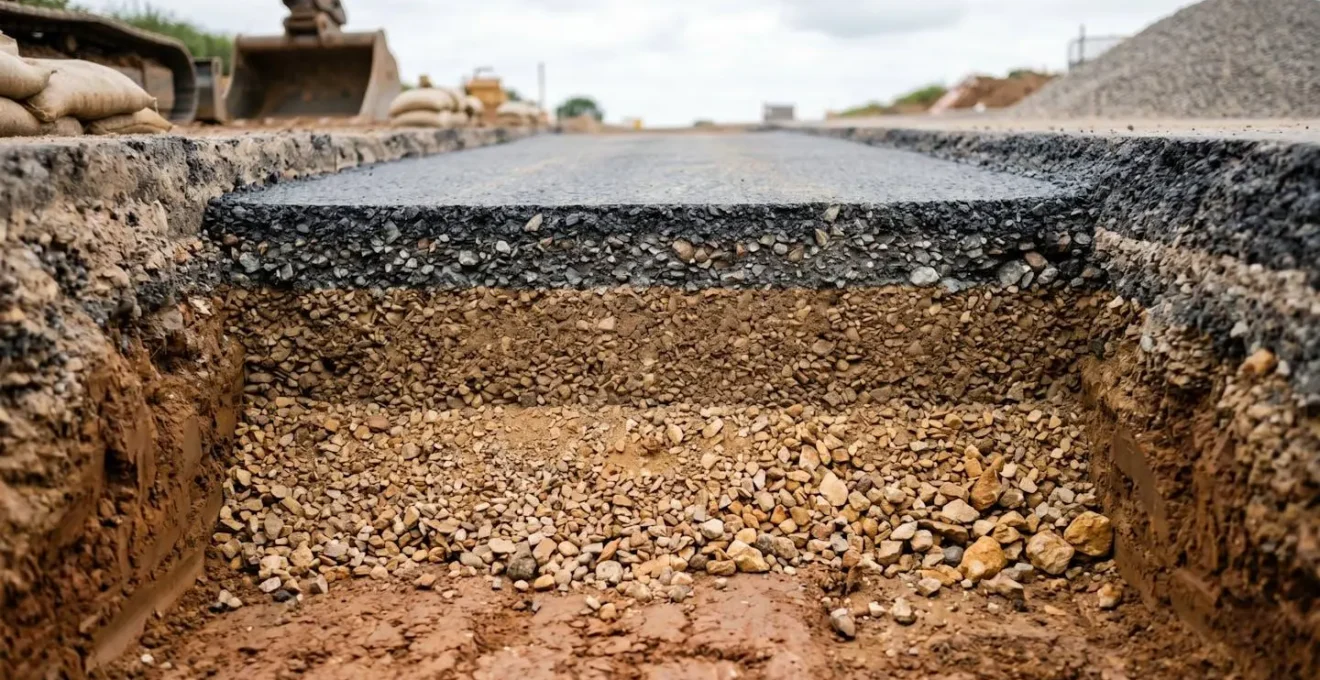
The longevity of a road is not determined by its blacktop surface, but in the complex, engineered system of layers hidden beneath that must manage immense structural forces.
- Pavement failure often begins in the foundation; sub-base weaknesses will ‘reflect’ up to the surface as cracks, regardless of how new the asphalt is.
- Load damage is exponential, not linear. Doubling a truck’s axle weight can cause up to 16 times more damage, a principle that dictates modern pavement thickness calculations.
Recommendation: Shift focus from surface-level repairs to a holistic assessment of the entire pavement structure, starting with the subgrade, to build roads that are truly built to last.
The all-too-familiar jolt of hitting a pothole on a road that looks freshly paved is a frustrating, and common, experience. It raises a fundamental question for any budding or practising engineer: why do some roads last for decades while others crumble within a few years? The conventional answer often points to the visible surface layer—the quality of the asphalt or concrete. This perspective, however, misses the bigger picture.
The true arbiter of a road’s lifespan is not the surface you drive on, but the complex, multi-layered structural system buried beneath it. A modern road is an engineered solution designed to perform a single, critical task: dissipate the colossal forces generated by traffic down into the native soil without failure. Each layer has a specific role in this process of force dissipation, and a weakness in one layer inevitably compromises the entire system.
But what if the key to a 20-year road isn’t just about using better asphalt, but about mastering the integrity of the unseen foundation? This guide moves beyond the surface to decode the structural engineering at the heart of pavement design. We will dissect how sub-base failures telegraph to the surface, how pavement thickness is calculated to counter the exponential damage of heavy vehicles, and why a seemingly minor specification error in compaction can lead to catastrophic premature failure. Understanding this hidden world is the first step toward building more resilient and durable infrastructure.
To navigate the core principles of durable road construction, we will explore the critical functions of each layer, from the foundational subgrade to the final wearing course. This structured journey will reveal why the most important aspects of a road are the ones you never see.
Summary: The Unseen Engineering of a Road’s Hidden Layers
- Why Sub-Base Failure Causes Surface Cracks Despite Fresh Asphalt Above
- How to Calculate Pavement Thickness for Heavy Goods Vehicle Routes in 5 Steps
- Flexible Asphalt vs Rigid Concrete Pavements: Which Performs Better in UK Climate?
- The Specification Error That Costs Councils £2 Million in Premature Repairs
- When to Use Geotextile Reinforcement in Weak Subgrade Conditions: The 3 Soil Signals
- Asphalt vs Concrete Surfaces: Which Lasts Longer on UK Motorways?
- How to Calculate Optimal Load Distribution for Fuel Economy in 5 Steps
- Why Some UK Roads Last 20 Years While Others Crack Within 5
Why Sub-Base Failure Causes Surface Cracks Despite Fresh Asphalt Above
One of the most deceptive types of pavement failure is reflective cracking. This occurs when a new layer of asphalt is laid over an existing, damaged base, and the cracks from the old layer work their way up to the new surface. This phenomenon is a perfect illustration of the road as an interconnected system. The problem isn’t the new asphalt; it’s the unresolved structural weakness in the foundation beneath it.
The mechanism is driven by movement. Daily temperature cycles cause the underlying layers—especially if they are cement-treated or old, brittle asphalt—to expand and contract. If these lower layers have existing cracks, this movement is concentrated at the crack tips. The new, flexible asphalt overlay above is stretched and compressed repeatedly over these moving joints until it, too, fatigues and cracks. This effectively mirrors the crack pattern from below, hence the name “reflective cracking.”
Water is a powerful accelerant in this process. Once a crack reflects to the surface, it creates a direct pathway for moisture to infiltrate the pavement structure. As the Portland Cement Association notes in its analysis of pavement failures:
Wide cracks (> 1/4 in. or 6 mm) can result in poor load transfer and increased stress in the asphalt that will lead to deterioration of the structure. In addition, wider cracks in the surface provide an avenue for water to enter the pavement.
– Portland Cement Association, Reflective Cracking in Cement Stabilized Pavements
This water weakens the sub-base and subgrade materials, reducing their load-bearing capacity and accelerating the rate of deterioration. What began as a foundational issue has now compromised the entire pavement system, leading to potholes and widespread alligator cracking, proving that a road is only as strong as its weakest layer.
How to Calculate Pavement Thickness for Heavy Goods Vehicle Routes in 5 Steps
Designing a road that can withstand heavy traffic is not guesswork; it is a precise calculation of forces. The primary goal of pavement thickness design is to ensure that the load from a vehicle’s axle is spread over a wide enough area of the subgrade (the native soil) so that the soil’s load-bearing capacity is not exceeded. If the pavement is too thin, the stress on the subgrade will be too high, causing it to deform and leading to rutting and structural failure from the bottom up.
The most critical factor in this calculation is not just the volume of traffic, but its weight. The damage inflicted upon a pavement by an axle load is not linear—it is exponential. This relationship is governed by the Generalised Fourth Power Law, a cornerstone of pavement engineering. A detailed engineering analysis shows that if you double the axle weight, you get 16 times the damage. This is why a single, overloaded truck can cause more damage than thousands of cars.
This exponential damage principle is why accurately forecasting traffic loads, particularly for Heavy Goods Vehicles (HGVs), is the most critical part of pavement design. Engineers use a standardized unit called the Equivalent Single Axle Load (ESAL) to convert the damage from various vehicle types into a single, manageable number. State-level studies have quantified this impact, showing that overweight trucks can cause tens of millions of pounds in premature pavement damage annually. The calculation of total design ESALs over a road’s lifespan is the fundamental input for determining the required thickness of each pavement layer.
Action Plan: Calculating Design ESALs for Pavement Thickness
- Vehicle Classification: Classify projected traffic into distinct categories based on axle configuration and weight (e.g., cars, buses, 2-axle trucks, 5-axle semi-trailers).
- Load Equivalency Factoring: Multiply the projected daily number of vehicles in each class by its corresponding ESAL factor, found in standard load equivalency tables. This converts each vehicle type’s impact into a standard unit.
- Summation of Daily Loads: Sum the ESAL results from all vehicle classes to determine the total daily Equivalent Single Axle Loads the pavement will endure.
- Traffic Growth Projection: Apply a projected traffic growth factor, typically derived from regional economic forecasts, to account for increases in traffic volume over the design life of the road.
- Cumulative Design Life Calculation: Multiply the projected daily ESALs by the number of days in the design life (typically 20-40 years) to arrive at the total cumulative design ESALs, which dictates the final pavement thickness.
Flexible Asphalt vs Rigid Concrete Pavements: Which Performs Better in UK Climate?
The choice between flexible (asphalt) and rigid (concrete) pavements is one of the most fundamental decisions in road design, with significant implications for performance, cost, and longevity, especially within the specific climatic challenges of the UK. There is no single “better” option; the optimal choice depends on the application, traffic loading, and expected service life.
Flexible pavements, predominantly made of asphalt (or ‘bitumen’), are the most common type. As the name suggests, they are designed to flex under load. The structure consists of multiple layers (surface, base, sub-base) that distribute traffic stresses down to the subgrade. Their main advantages include lower initial construction costs, a smoother and quieter riding surface, and relative ease of repair. However, they are more susceptible to temperature-related damage like rutting in hot weather and cracking in cold. The UK’s frequent freeze-thaw cycles can be particularly damaging, as water penetrates small cracks, freezes, expands, and widens the fissures.
Rigid pavements, made of Portland Cement Concrete (PCC), behave differently. They use a thick, stiff concrete slab to distribute loads over a very wide area of the subgrade. This slab acts like a beam, relying on its own flexural strength. The primary benefit is their exceptional durability and resistance to wear and tear from heavy traffic, making them suitable for major motorways and airport runways. They have a much longer design life (often 40+ years) and are less affected by temperature-induced rutting. Their downsides are higher initial costs, longer construction times (due to curing), a noisier road surface, and more complex, costly repairs when they eventually fail.
In the context of the UK, the road network is dominated by flexible pavements. Data from National Highways’ Pavement Management System reveals that the strategic road network’s surface is composed of 61% Thin Surface Course Systems (a type of asphalt) and 32% hot rolled asphalt, with only a small fraction being concrete. This preference is driven by a balance of factors including initial cost, traffic management during repairs (asphalt can be opened to traffic much faster), and the development of advanced asphalt mixes designed to resist the UK’s specific climate challenges.
The Specification Error That Costs Councils £2 Million in Premature Repairs
In pavement engineering, success is measured in decades. The standard design life of a flexible pavement is typically 20 years, but achieving this requires meticulous attention to detail during construction. A single, seemingly minor error in the material specification can slash this lifespan by more than half, leading to millions in unplanned repair costs. One of the most critical, yet often overlooked, parameters is the air void content of the asphalt.
Asphalt is not a solid mass; it’s a composite of aggregate (stones), binder (bitumen), and a small, controlled percentage of air. These air voids are essential, but only within a very narrow, engineered tolerance. If the asphalt is not compacted properly on site, the air void content will be too high. Conversely, if the mix design is wrong, it can lead to over-compaction and too few voids. Both scenarios are disastrous for pavement longevity.
The “sweet spot” for air void content in a dense-graded asphalt wearing course is typically between 3% and 8%. According to extensive pavement research, air voids greater than 8% create interconnected pathways within the asphalt. These pathways allow water and air to penetrate deep into the material. Water weakens the bond between the binder and aggregate (a process called stripping), while oxygen hardens the binder, making it brittle. This combination leads to rapid, premature failure through cracking and ravelling.
On the other hand, if air voids fall below 3%, there isn’t enough space for the asphalt binder to expand in hot weather or under the pressure of heavy traffic. This causes the binder to “bleed” to the surface, creating a slick, unsafe driving condition, and leads to permanent deformation in the wheel paths, known as rutting. A local council mis-specifying a mix or failing to enforce compaction quality control can easily find themselves replacing a “new” road within 5 years, turning a standard infrastructure project into a recurring financial liability.
When to Use Geotextile Reinforcement in Weak Subgrade Conditions: The 3 Soil Signals
The entire road structure rests on the native soil, or subgrade. If this foundational layer is weak or unstable, no amount of high-quality asphalt or concrete on top can create a durable road. In these challenging situations, engineers turn to geotextile reinforcement. These polymer-based fabrics and grids are rolled out over the weak subgrade to perform several critical functions: separation, filtration, drainage, and reinforcement. Knowing when to specify them is key to cost-effective and resilient pavement design.
The use of geotextile reinforcement is indicated when site investigation and soil testing reveal three key signals of a problematic subgrade:
- Low California Bearing Ratio (CBR): The CBR test is a standard measure of the subgrade’s strength. A low CBR value (typically less than 3%) indicates that the soil is very weak and will deform significantly under load. A geotextile, particularly a reinforcing geogrid, can interlock with the sub-base aggregate above it, creating a mechanically stabilised layer that more effectively spreads the load and reduces the stress on the weak soil.
- High Moisture Content & Poor Drainage: Subgrades with a high percentage of water are inherently weak, as the water pressure (pore pressure) counteracts the soil’s internal friction. If the soil type also drains poorly, it can become saturated during wet weather, losing almost all of its bearing capacity. A non-woven geotextile fabric can act as a separation and filtration layer, preventing the fine, wet soil particles from migrating up and contaminating the clean aggregate of the sub-base, while allowing water to drain away laterally.
- Presence of Fine-Grained Silts and Clays: Silty and clayey soils are particularly problematic. They are susceptible to changes in volume with moisture content (swelling and shrinking) and are prone to frost heave in cold climates. A geotextile separator is crucial in these conditions to prevent the “pumping” of these fine particles into the sub-base layer under the dynamic loading of traffic, which would quickly clog the drainage paths and compromise the entire pavement foundation.
By using geotextiles, engineers can often improve the performance of a poor subgrade to such an extent that they can build a reliable road without the need for extremely thick and expensive upper layers or the costly process of removing and replacing the weak soil. As noted by experts at Tensar International, this is a primary advantage:
The thickness required by the capping or subbase layer in a flexible pavement may be reduced by the inclusion of soil stabilisation geogrids.
– Tensar International, Flexible Pavement: Layers, Components, and Advantages
Asphalt vs Concrete Surfaces: Which Lasts Longer on UK Motorways?
When considering longevity on the UK’s high-traffic motorways, the historical durability of rigid concrete pavements is well-established. However, the modern conversation has shifted. Advances in polymer-modified bitumen and a growing emphasis on sustainability and whole-life cost are making high-performance asphalt an increasingly competitive and innovative choice for long-term performance.
Traditionally, a well-constructed concrete motorway could be expected to last 40 years with minimal structural maintenance. Its rigidity is its greatest asset under the relentless pounding of heavy goods vehicles. However, when it does require repair, the process is disruptive, time-consuming, and expensive, often requiring full-depth slab replacement and extended lane closures. This has a significant economic impact on heavily trafficked arteries.
Modern asphalt mixes, on the other hand, are being engineered for durability and sustainability in ways that challenge the old paradigms. The use of advanced polymer modifiers improves the asphalt’s resistance to rutting and thermal cracking. Furthermore, the UK is at the forefront of incorporating recycled materials into surface courses, which not only reduces environmental impact but also presents a compelling economic case. Asphalt pavements are 100% recyclable, and the material can be re-used in new mixes, creating a circular economy. This contrasts with concrete, which is more difficult to recycle into new high-spec pavement.
Case Study: M25 Recycled Asphalt Pavement (RAP) Innovation
A landmark trial on the M25 between junctions 25 and 26 showcased the potential of modern asphalt. A surface course containing 50% recycled asphalt pavement (RAP) was installed on one of Europe’s busiest motorways. This was a major step up from the standard UK specification, which typically allows only 10% RAP in surface courses. The project, a collaboration between FM Conway, National Highways, and Connect Plus Services, demonstrated that with advanced mix design and high-quality aggregates (with a high Polished Stone Value for skid resistance), recycled materials can meet the demanding performance standards of strategic routes, paving the way for more sustainable and cost-effective motorway maintenance.
So, which lasts longer? The answer is becoming more nuanced. While a concrete road may still have a longer theoretical *structural* design life, the practicalities of repair, traffic disruption, and the rapid innovation in sustainable asphalt technology mean that high-performance flexible pavements are increasingly delivering comparable service lives in a more cost-effective and environmentally friendly manner.
How to Calculate Optimal Load Distribution for Fuel Economy in 5 Steps
While the title suggests a focus on fuel economy, the most profound engineering impact of load distribution is not on the vehicle, but on the pavement itself. For the pavement engineer, ‘optimal load distribution’ means ensuring vehicle axle loads are managed in a way that minimizes damage to the road infrastructure. Preserving the road’s integrity is, in fact, a long-term strategy for maintaining fuel economy for all users.
The relationship between vehicle load and pavement damage is severe and non-linear. As previously discussed, it follows the fourth power law. This is why road design and regulation focus so heavily on managing axle loads from HGVs. Federal infrastructure analysis consistently shows that heavy trucks comprise about 10% of highway traffic but inflict 80-90% of pavement damage. An overloaded axle or poorly distributed load concentrates stress on a small area of the pavement, initiating microscopic cracks that will eventually grow into structural failures.
How does this connect back to fuel economy? A smooth, well-maintained road has a lower rolling resistance than a road surface that is rutted, cracked, or deformed. When a vehicle travels on a damaged surface, its tyres must constantly deform to conform to the uneven surface, and energy is lost in the suspension system as it absorbs bumps. This extra work requires more energy from the engine, and therefore, more fuel. A study by the National Asphalt Pavement Association (NAPA) in the US found that improving road surface smoothness can lead to fuel savings of up to 5% for vehicles.
Therefore, from a systemic perspective, calculating and enforcing optimal load distribution to protect the pavement is a direct investment in the long-term fuel efficiency of the entire transportation network. By preventing the ruts and cracks that increase rolling resistance, engineers ensure that the energy vehicles expend is used for motion, not for fighting a deteriorating road surface. The calculation for pavement design (ESALs) is implicitly a calculation to preserve the conditions for optimal fuel economy.
Key Takeaways
- A road is an engineered system; failure often starts in the unseen foundation layers and reflects upwards, making subgrade integrity paramount.
- Vehicle load damage is exponential, not linear, governed by the ‘Fourth Power Law’. This principle is the cornerstone of modern pavement thickness design.
- Proper compaction to achieve a specific material density (e.g., 95%) and a controlled air void percentage is a non-negotiable quality factor that directly determines a road’s lifespan.
Why Some UK Roads Last 20 Years While Others Crack Within 5
The vast difference in the lifespan of UK roads often comes down to a single, unglamorous, and largely invisible factor: quality control during construction. While poor design or underestimation of traffic loads can certainly lead to premature failure, the most common culprit for a road failing in 5 years instead of 20 is a failure to meet the specified construction standards on site, with compaction being the most critical of all.
Every layer in the pavement system, from the sub-base to the final asphalt surface, is designed to be placed at a specific density. This is achieved through methodical compaction using heavy vibratory rollers. The goal is not just to “squash it down,” but to achieve a target density that minimizes the air voids within the material to an optimal level. As a fundamental rule, construction quality standards require that each pavement layer must be compacted to 95% of its maximum theoretical density.
Failure to achieve this 95% density means the layer contains too many air voids. Under the repeated stress of traffic, this under-compacted material will continue to densify and settle over time. This settlement is never uniform. It leads to depressions in the road surface—rutting—and creates stresses that cause the pavement to crack. An under-compacted sub-base is a ticking time bomb; even the best asphalt surface placed on top is doomed to fail as its foundation slowly sinks beneath it.
Beyond compaction, other quality control factors that separate a 5-year road from a 20-year road include:
- Material Quality: Ensuring the aggregate used is the correct size, shape, and strength, and is free from contaminants like clay or organic matter.
- Moisture Content: Laying aggregate or asphalt at the correct moisture content is vital for achieving proper compaction.
- Layer Thickness: Rigorously checking that each layer is built to the specified thickness across the entire width of the road.
- Asphalt Temperature: Laying and compacting asphalt while it is within the correct temperature range is essential for creating a durable, well-bonded mat.
Ultimately, a 20-year road is the result of a robust design being executed with military precision on site. A 5-year road is often the result of cutting corners on these fundamental, unseen, but absolutely critical aspects of construction quality.
To design and build roads that stand the test of time, it is imperative that engineers and construction professionals adopt this systemic view, moving beyond surface-level thinking to master the complex interplay of forces and materials hidden from sight. The next step is to apply these principles to your own analysis and projects, always asking what is happening beneath the surface.