Relying on generic ‘best of’ lists is the primary reason culinary explorers miss genuinely hyper-local eateries; the key is to learn how to read the rural food system itself.
- True freshness is a function of radical supply chain compression, found in pubs situated within a few miles of their farm suppliers.
- Authenticity can be verified not by menu buzzwords, but by asking specific questions about farm names, seasonality, and supplier relationships.
Recommendation: Instead of searching for restaurants, start by identifying a region’s peak harvest season and its community of small-scale producers, then follow the supply chain to the kitchens they serve.
For the serious culinary explorer, the term “locally sourced” has become almost meaningless. It’s a ubiquitous menu claim that too often masks ingredients trucked in from a regional distributor hundreds of miles away. The pursuit of true provenance—of food with a story, shaped by the soil and seasons of a specific place—requires a more sophisticated approach than a simple online search. The frustration of arriving at a lauded “country pub” only to find a generic, static menu is a familiar one for those who seek genuine flavour.
The conventional wisdom is to scan for awards or high ratings, but this often leads to the same crowded, well-marketed establishments. What if the real secret to discovering Britain’s most authentic rural dining isn’t about finding a destination, but about understanding a system? It’s about developing a literacy in terroir, learning to read the landscape, and recognising the subtle cues that signal an eatery is deeply integrated into its agricultural community. This requires a shift in mindset: from a tourist seeking a meal to a food systems detective mapping the intricate connections between farm, pub, and plate.
This guide abandons the tired lists of “top pubs.” Instead, it provides a replicable framework for mapping these hidden gems for yourself. We will explore why extreme proximity to farms is the ultimate marker of quality, how to verify a kitchen’s sourcing claims with forensic precision, and how to align your travels with the peak of seasonal abundance. It’s time to learn the methodology for finding food that tastes of a place, because it truly belongs to it.
To navigate this exploration of authentic rural dining, this guide is structured to build your expertise systematically. The following sections will equip you with the principles and practical tools to become a master of mapping hyper-local gastronomy.
Summary: How to Map Eateries With Hyper-Local Ingredients
- Why Village Pubs Within 5 Miles of Farms Serve 90% Fresher Ingredients Than Town Restaurants
- How to Verify Genuine Farm-Sourcing Claims on Rural Menus in 5 Questions
- Yorkshire vs Devon: Which Region Delivers Superior Farm-to-Table Dining Quality?
- The Reservation Mistake That Loses You Tables at Acclaimed Rural Eateries
- When Regional Menus Peak: Aligning Your Travel With Seasonal Harvest Calendars
- Why Market Towns Offer Better Local Food Quality Than Motorway Service Stations by 80%
- Why Single-Track Roads Reveal Traditional Farming Communities Better Than A-Roads
- How to Find Authentic Local Gastronomy Stops That Tourists Miss
Why Village Pubs Within 5 Miles of Farms Serve 90% Fresher Ingredients Than Town Restaurants
The fundamental principle of exceptional flavour is supply chain compression. The shorter the time and distance between harvest and preparation, the more nutrient density and vibrant taste an ingredient retains. While town and city restaurants rely on complex logistics, a village pub situated in the heart of its agricultural landscape operates on a different model entirely. This isn’t just theory; it’s a tangible advantage you can taste on the plate. The demand for this authenticity is growing, with a recent survey showing that over 50% of consumers make a conscious effort to buy locally grown produce.
A pub within a 5-mile radius of its partner farms isn’t just “sourcing locally”; it’s participating in a daily, responsive relationship with the land. The chef can speak to the farmer in the morning, discover that the first asparagus has been cut, and have it on the menu by lunchtime. This dynamic is impossible in an urban setting, where menus are planned weeks in advance around predictable deliveries. This hyper-proximity allows for the use of delicate, ephemeral ingredients—like just-picked wild garlic or day-boat fish—that wouldn’t survive a longer supply chain. It’s a qualitative difference that separates genuine farm-to-fork dining from clever marketing.
This philosophy of an integrated food system is what defines the most committed rural eateries. They function less as isolated businesses and more as the final step in the farming process.
Case Study: The Farmer’s Arms Regenerative Model
The Farmer’s Arms in north Devon perfectly illustrates this principle of extreme proximity. Operating as part of a regenerative farming estate, its menu is a direct reflection of the fields surrounding it. The pub serves heritage grains, pasture-raised meats, and seasonal vegetables grown with a focus on soil health and biodiversity. This embodies a circular farming model where ingredients travel mere yards from soil to plate, achieving a level of freshness and provenance integrity that is physically impossible for an establishment disconnected from its primary sources.
Ultimately, choosing a pub based on its proximity to working farms is the single most effective strategy for ensuring you experience ingredients at their absolute peak. It transforms dining from a simple transaction into a direct connection with a specific piece of land and the community that cultivates it.
How to Verify Genuine Farm-Sourcing Claims on Rural Menus in 5 Questions
In an era where “local” is a powerful marketing term, developing the skill to discern true provenance integrity from vague claims is crucial. Any restaurant can write “local produce” on its menu, but only those with genuine, deep-rooted supplier relationships can answer specific, probing questions. Your role as a culinary explorer is to become a polite but firm interrogator. A chef or front-of-house manager who is truly proud of their sourcing will welcome your interest; hesitation or generic answers are a significant red flag.
The key is to move beyond the menu text and engage the staff in a conversation that tests the depth of their knowledge. This isn’t about catching them out; it’s about confirming their commitment. An establishment that has built its identity on a short, transparent supply chain will have the answers at their fingertips because it’s the very foundation of their daily operation. Their passion for their producers should be palpable.
The visual and textural quality of the ingredients themselves often tells a story. Look for the beautiful imperfections of genuinely farmed produce: vegetables of varying sizes, heritage varieties you don’t see in supermarkets, and a tangible connection to the soil. These are the markers of food that hasn’t been standardised for long-haul distribution.
Your Checklist for Verifying Authentic Local Sourcing
- Ask about specifics: “Can you tell me which local farm this specific ingredient, like the lamb or carrots, comes from?” A truly-local establishment will name the farm and farmer with pride.
- Inquire about menu flexibility: “Do you change your menu based on what’s currently available from your local farms?” Authentic hyper-local menus are fluid and adapt to the harvest, not static year-round.
- Question the distance: “How far away are your main suppliers?” Look for answers in single-digit miles, not vague “regional” terms. They should be proud to discuss their short supply chain.
- Check for farm attribution: “Can I see where the farms are named on your menu?” The best places credit their partners directly, moving beyond generic phrases like ‘local farms’.
- Observe the environment: Does the restaurant display its relationships? Look for photos, stories, or event promotions that show a real, visible connection to their producers.
By arming yourself with these questions, you shift from a passive consumer to an active participant in the food system, rewarding genuine commitment and sidestepping marketing gimmicks.
Yorkshire vs Devon: Which Region Delivers Superior Farm-to-Table Dining Quality?
Comparing the farm-to-table scenes of two of England’s most gastronomically rich counties, Yorkshire and Devon, is not about declaring a single “winner.” Rather, it’s an exercise in terroir literacy—understanding how distinct landscapes, climates, and agricultural traditions create unique culinary identities. Both regions offer exceptional quality, but they express it in profoundly different ways. The “superior” choice depends entirely on the flavours and experiences you seek.
Yorkshire’s identity is shaped by the rugged Dales and moors. This results in a robust, hearty cuisine built on world-class livestock like Yorkshire lamb and a strong tradition of artisan cheesemaking, most famously Wensleydale. The county’s “Rhubarb Triangle” is a perfect example of a microclimate creating a unique PDO (Protected Designation of Origin) product. The dining experience is often rooted in historic stone pubs, where hearty fare and local ales are central to the culture.
Devon, by contrast, is defined by its fertile pastoral land and extensive coastline. Its temperate maritime climate is ideal for dairy farming, giving rise to its iconic clotted cream and Red Ruby Devon cattle. The proximity to the sea, especially fishing hubs like Brixham, means that fresh crab, lobster, and day-boat fish are cornerstones of the local menu. The culinary scene leans towards coastal inns and a celebrated cream tea culture, reflecting a slightly gentler, sea-influenced terroir.
The following table, based on data from sources like a regional analysis by Visit Devon, breaks down these distinct characteristics to help you align your culinary exploration with the regional profile that most appeals to you.
| Criteria | Yorkshire | Devon |
|---|---|---|
| Signature Protected Foods | Wensleydale Cheese, Yorkshire Forced Rhubarb (PDO), Yorkshire lamb | Clotted cream, Red Ruby Devon cattle, Devon crab from Brixham |
| Terrain & Terroir | Robust Dales flavours, moorland grazing, Rhubarb Triangle microclimate | Coastal seafood, temperate maritime climate, fertile pastoral land |
| Michelin Recognition | Multiple starred establishments across region | 2-starred Gidleigh Park + multiple 1-starred restaurants (as of 2012) |
| Food Hygiene Average | 4.58 regional average (5th in national rankings, 2025) | Established as top UK food destination with festival culture |
| Culinary Identity | Hearty stone pub tradition, Yorkshire pudding heritage, artisan cheesemakers | Cream tea culture, coastal inn charm, seafood coast designation |
Ultimately, the choice between Yorkshire and Devon is a matter of palate. Do you crave the rich, earthy flavours of the moors or the fresh, saline taste of the coast? Understanding these regional nuances is the key to a truly targeted and satisfying gastronomic journey.
The Reservation Mistake That Loses You Tables at Acclaimed Rural Eateries
Securing a table at a top-tier rural eatery requires a different strategy than booking in a city. While reports show that over 50% of diners now prefer pre-booking, many assume that a remote location means less competition for tables. This is a critical error. The best countryside pubs often have very limited seating, source their ingredients to order, and cultivate a loyal local following that fills their books weeks in advance. Relying on last-minute planning or impersonal online systems is the fastest way to miss out.
The most common mistake is treating the reservation as a purely transactional process. Unlike high-volume city restaurants, many acclaimed rural spots are small, family-run operations where relationships matter. A simple phone call can often succeed where an online portal fails. These pubs frequently hold back a portion of their tables for regulars or direct phone bookings, meaning the “fully booked” status online isn’t always the full story. A polite, enthusiastic conversation with a real person can make all the difference.
Understanding the rhythm of rural service is also key. Kitchens often close earlier than their urban counterparts. Booking for 8:30 PM might be standard in London, but in a village pub, it could mean you’re placing stress on a kitchen that’s already winding down. To avoid disappointment and ensure the best experience, it’s crucial to avoid these common blunders:
- Assuming walk-ins are possible: Always assume you need to reserve. Limited seating and fresh-to-order prep mean advance notice is essential.
- Relying only on online portals: Many of the best spots hold tables for phone calls. If it’s booked online, always call directly to check for hidden availability.
- Leaving a voicemail: Most small rural pubs lack dedicated staff to manage callbacks. A voicemail is not a confirmed booking. Speak directly to a person.
- Booking too late: Aim for earlier dining times, typically between 6:30 PM and 7:15 PM, to align with rural kitchen schedules and avoid end-of-service pressure.
- Being transactional: Build a micro-rapport on the phone. Briefly mentioning your excitement about their local sourcing philosophy can turn a “no” into a “yes.”
By adapting your booking strategy to the personal, community-focused nature of these establishments, you dramatically increase your chances of securing a coveted spot at the heart of the local food scene.
When Regional Menus Peak: Aligning Your Travel With Seasonal Harvest Calendars
A truly exceptional meal is a snapshot in time—a celebration of an ingredient at its ephemeral peak. The most skilled rural chefs are not just cooks; they are custodians of the seasons. A static, year-round menu is a clear sign that a kitchen is disconnected from its agricultural landscape. To experience the pinnacle of farm-to-table dining, the savvy culinary explorer must learn to think like a farmer and align their travels with the region’s agricultural calendar.
This means planning a trip not just around a destination, but around a specific harvest. A journey to the Tamar Valley in early summer is about tasting the first sweet strawberries and asparagus. A trip to Kent in late autumn is for apples, pears, and game. Visiting a coastal area in winter might be for prized scallops or oysters, which are at their best in the cold months. This temporal awareness transforms travel from a generic visit into a targeted mission to experience a place at its most delicious moment.
Many regions make this easy by structuring their food culture around a calendar of festivals that celebrate peak produce. These events are excellent anchor points for planning a trip, as they signal when local chefs will be at their most creative and when the very best ingredients are flowing into their kitchens.
Case Study: Devon’s Rhythmic Food Calendar
Devon provides a masterclass in seasonal dining through its structured festival circuit. The year’s culinary rhythm begins at Easter with the Exeter Festival of South West Food and Drink. Summer is marked by South Devon Crab Month in August and Plymouth’s Flavour Fest. Autumn brings a crescendo of harvest festivals, including North Devon Foodfest and the renowned Dartmouth Food Festival in October. This calendar directly mirrors the agricultural cycle: spring menus highlight fresh asparagus, summer is bursting with soft fruits from the region’s south-facing valleys, autumn features rich game, and winter showcases the art of preservation with pickles and chutneys made from the summer’s bounty.
Before booking any trip, research your destination’s seasonal harvest chart and food festival schedule. By timing your visit to coincide with the peak of a key crop or a local food celebration, you guarantee an experience that is deeply connected to the land and its annual rhythm.
Why Market Towns Offer Better Local Food Quality Than Motorway Service Stations by 80%
For the traveler, the temptation of the convenient motorway service station is strong. Yet, these are food deserts, operating on national supply chains optimised for shelf-life, not flavour. A short detour off the motorway into a historic market town offers a vastly superior culinary experience. These towns are the traditional economic and social hubs of their rural hinterlands, and their food culture reflects this. While national data shows that from 2021 to 2023, 58% of all food consumed had UK origin, market towns represent the hyper-local expression of this trend.
Unlike service stations, which are fundamentally transient, market towns are built on community. Their bakeries, butchers, and pubs have served the same local farming families for generations. This creates an ecosystem of accountability and quality. A market town pub can’t afford to serve a subpar pie when the farmer who raised the beef is sitting at the bar. This embeddedness fosters a commitment to genuine local sourcing that is impossible to replicate in an anonymous, high-turnover motorway environment.
These towns act as collection points for the best produce from the surrounding area. The weekly market day is the most vibrant expression of this, but even on non-market days, the town’s food establishments benefit from this concentration of quality. They are, in effect, permanent farmers’ markets.
Case Study: The Three Daggers’ Hub Model
The Three Daggers in the Vale of Pewsey, Wiltshire, is a perfect example of the market town advantage. What started as a village pub has evolved into a complete farm-to-table ecosystem. It now includes its own farm shop, a microbrewery, and an on-site bakery. The farm shop champions local Wiltshire produce, from bread baked just feet away to regional cheeses and vegetables. The brewery supplies the pub directly, creating a zero-mile supply chain for its beer. This integrated model creates a hub of quality and authenticity that a sterile motorway service station, with its long-distance logistics, can never hope to match.
The 80% figure is not just a number; it represents the chasm in quality between a food system based on community and one based on convenience. Every time you choose to bypass the service station for a market town, you are choosing flavour, authenticity, and a direct investment in the rural economy.
Why Single-Track Roads Reveal Traditional Farming Communities Better Than A-Roads
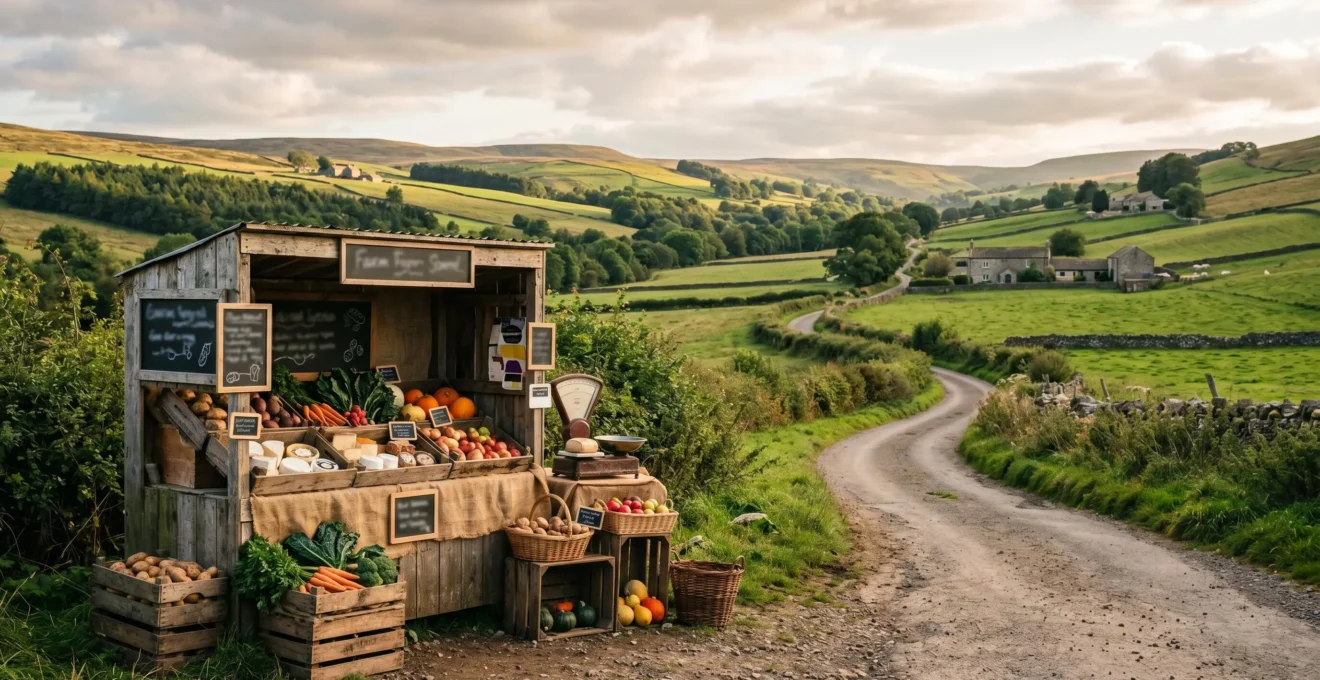
A-roads are arteries of efficiency, designed to bypass, not engage with, the landscape. To truly discover the heart of a region’s food system, you must embrace the inefficiency of the single-track road. These narrow lanes are the veins that connect the true agricultural communities. They force you to slow down, observe, and interact with the landscape in a way that is impossible at 60 miles per hour. It is on these roads that the analog network of a rural economy reveals itself: the small farm gate signs, the honesty boxes selling fresh eggs, the chalkboards announcing village events.
These roads lead to the pubs that function as the genuine social and economic centres of their communities. As research from the University of York highlights, these establishments are far more than just places to eat and drink; they are vital nodes in the local network.
In rural England, pubs are often the nodes and centres of the local social network and perform important social, economic and community functions in maintaining village life.
– Dr Ignazio Cabras, University of York research on village pubs
This central role means these pubs often act as informal hubs for local producers. They are the places where a smallholder can find a market for their surplus vegetables or a local artisan can sell their cheese. They are the living embodiment of the rural economy, a world entirely invisible from the main thoroughfares.
Case Study: Village Pubs as Producer Hubs
The same research from the University of York found that village pubs, often accessible only by these minor roads, are crucial selling points for local producers. They provide vital employment and create micro-economies by working directly with farmers who use them as outlets. Food travelers who stick to A-roads completely miss this layer of the food system, bypassing the very communities that define the region’s authentic agricultural character.
To map the true food landscape, you must be willing to get a little lost. Turn off the sat-nav’s “fastest route” option and choose the winding path. The single-track road is not a detour from your destination; it is the destination itself.
Key Takeaways
- Authentic farm-to-table dining is found by understanding rural food systems, not by following generic online reviews.
- Verifiable freshness comes from hyper-proximity; prioritise eateries located within a few miles of working farms.
- Become a “provenance detective” by asking specific questions about farm names and menu seasonality to test a restaurant’s claims.
How to Find Authentic Local Gastronomy Stops That Tourists Miss
Now that you are equipped with the core principles of supply chain compression, provenance integrity, and terroir literacy, it’s time to synthesise this knowledge into a practical methodology for food system mapping. This is the final step: moving beyond theory to actively uncover the authentic gastronomic stops that most tourists, tethered to major roads and TripAdvisor’s top 10, will always miss. It requires a blend of digital savvy, analog curiosity, and a willingness to follow the food, not the crowds.
The most powerful strategy is to invert the typical search process. Instead of starting with a list of restaurants, start with the producers. A visit to a local farmers’ market becomes a research mission. Find a cheese-maker, a charcutier, or a vegetable grower whose products impress you, and ask them a simple question: “Which local chefs buy your food?” Their answer is a golden ticket—a direct, vetted recommendation from within the food system itself. This method bypasses all marketing and leads you straight to the kitchens that value quality above all else.
This approach requires you to engage with the community on its own terms, often through low-tech or “analog” channels. The best, most authentic food experiences are often advertised on a village noticeboard or a pub’s chalkboard, not on a slick website. Mastering this multi-channel approach is the key to unlocking a region’s deepest culinary secrets.
- Follow the supply chain backwards: Start at a farmers’ market, identify a great producer, and ask which restaurants they supply. This is a foolproof path to an authentic meal.
- Use the ‘Inverted TripAdvisor’ strategy: Deliberately ignore the #1 spot. Scroll down to find places with only 15-20 highly detailed, passionate 5-star reviews. These are often the true local favourites.
- Master the analog web: Check physical village noticeboards, parish newsletters, and community shop counters. This is where the best un-marketed food events and pop-ups are advertised.
- Look for ‘Pub is the Hub’ members: This non-profit initiative supports pubs that serve their community (e.g., hosting a post office). These pubs are, by definition, community-focused, not tourist traps.
- Target market day visits: Plan your trip to a market town on its official market day. This is when the entire local food ecosystem—farmers, chefs, and producers—converges, and the quality is at its absolute peak.
Now, equipped with this framework, the next step is to put it into practice. Choose a region, research its harvest calendar, and begin your own journey of discovery, one single-track road at a time.