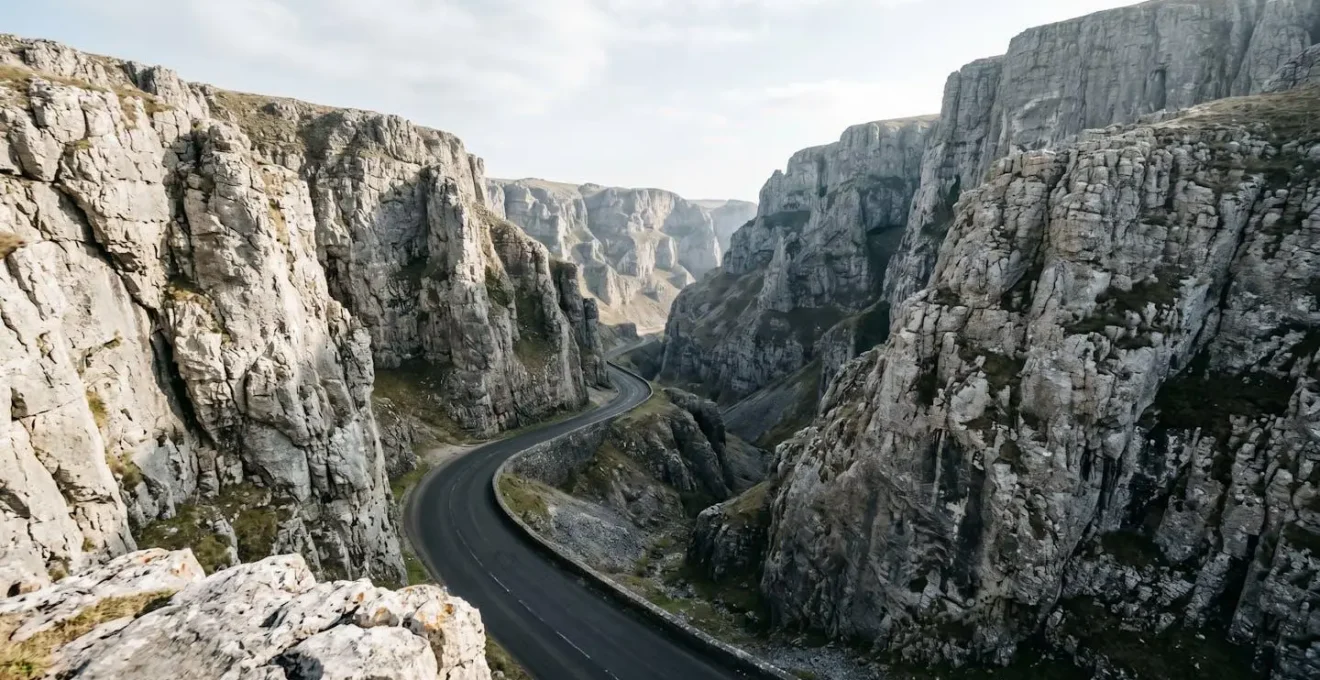
The greatest risk on a gorge road isn’t oncoming traffic; it’s failing to understand the geological story the landscape is telling you.
- The same limestone that creates breathtaking cliffs also becomes deceptively slippery when wet due to its unique karst properties.
- Blind bends aren’t just sharp turns; they are points of “topographical blindness” where the landscape actively hides crucial information.
Recommendation: Drive not just as a motorist, but as a geologist—reading the rock, water, and road surface to anticipate hazards long before they become a danger.
The sight of a road slicing through a colossal limestone gorge is one of the UK’s most exhilarating driving experiences. The sheer, towering cliffs of places like Cheddar Gorge inspire awe, a visceral reminder of the immense geological forces that have shaped our island over millennia. For the adventure traveller and geology enthusiast, these routes are destinations in themselves. Yet, the common advice for navigating them often feels disappointingly generic: “drive slowly,” “watch for tourists.” This reduces a complex environmental challenge to a simple matter of caution.
The truth is more profound. To drive these roads safely is to engage in a dialogue with the landscape itself. The real hazards are not just the other cars or the cyclists; they are etched into the very rock. The slickness of polished limestone, the false horizons of a ridge, the way a valley wall creates absolute blind spots—these are features of a dynamic geological environment. Understanding these elements is the key, transforming your drive from a passive journey into an active reading of the terrain.
This guide moves beyond the platitudes. We will not simply tell you to be careful. Instead, we will equip you with the eyes of a geological tour guide, revealing how the spectacular scenery is intrinsically linked to the unique driving challenges. We’ll explore why these limestone formations are so special, compare the titans of UK gorge driving, and uncover the critical errors that lead to near-misses. Ultimately, you will learn to navigate this rugged topography not just with caution, but with intelligence and a deep appreciation for the forces at play.
This article breaks down the essential knowledge needed to master these dramatic routes. The following sections provide a complete framework, from understanding the geology to advanced driving techniques for staying safe and protecting your vehicle.
Summary: A Driver’s Guide to the UK’s Epic Gorge Roads
- Why Limestone Gorges Create the UK’s Most Dramatic Road Scenery
- How to Drive Narrow Gorge Roads With Oncoming Traffic Safely in 4 Techniques
- Cheddar Gorge vs Winnats Pass: Which Delivers the Most Spectacular Drive?
- The Visibility Error Drivers Make on Blind Canyon Bends That Causes Near-Misses
- When to Visit Gorge Roads: The 3 Time Windows to Avoid Summer Coach Congestion
- Why Ridge-Line Roads Offer Superior Panoramic Views Compared to Valley Routes
- When to Abort a Route: The 3 Surface Deterioration Signals That Mean Turn Back
- How to Navigate Rugged Topography by Road Without Damaging Your Vehicle
Why Limestone Gorges Create the UK’s Most Dramatic Road Scenery
What gives a limestone gorge its soul-stirring drama? The answer lies in its violent and watery past. These landscapes are prime examples of karst topography, a terrain formed by the dissolution of soluble rocks like limestone by water. Over millions of years, mildly acidic rainwater seeps into cracks, slowly dissolving the calcium carbonate and carving out vast underground cave systems. When the roof of such a system collapses or a river carves its way down, a gorge is born. Cheddar Gorge, for example, is a colossal feature; an official survey confirms England’s largest gorge measures almost 400 feet deep and stretches for three miles.
The visual appeal is undeniable: sheer, pale grey cliffs that dwarf your vehicle, hinting at the immense power of nature. But as a driver, you must understand that this beauty comes with inherent geological hazards. The very process that creates the scenery also creates the risk. Limestone’s surface character is the primary culprit.
As the image above shows, the rock surface is a mixture of rough, weathered sections and smoother, polished areas. Years of traffic and water flow can polish the limestone on the road surface to a deceptively smooth finish. Research on limestone properties reveals a critical fact: the smoother the stone, the more slippery it becomes when wet. This creates a surface far more treacherous than granite or sandstone roads, especially with the light film of rain or algae common in these shaded, damp environments. When you drive a limestone gorge, you are driving on a surface that is geologically programmed to be slippery.
This understanding transforms your perspective. The dramatic scenery is no longer just a backdrop; it is a live-information display about the potential grip—or lack thereof—beneath your tyres.
How to Drive Narrow Gorge Roads With Oncoming Traffic Safely in 4 Techniques
The defining feature of a gorge road is its constricted nature. The same cliffs that create the spectacle also create an unforgiving corridor with little room for error. Navigating oncoming traffic, especially on single-track sections, is less about “right of way” and more about a shared, fluid choreography of anticipation and cooperation. Standard defensive driving is not enough; you need to adopt a proactive strategy based on continuous scanning and communication.
The goal is not to force your way through but to create flow. This requires mastering the etiquette of passing places and thinking several hundred metres ahead of your bonnet. The following four techniques are not just rules; they are the fundamental building blocks of safe passage in a constrained environment.
- Harmonise Your Speed: The most efficient and courteous technique is to adjust your speed so that you and the oncoming vehicle meet at a designated passing place. This avoids one driver having to stop completely and wait. It requires looking far ahead and judging closing speeds, turning a potential conflict into a smooth, coordinated manoeuvre.
- Yield to the Easiest Path: Forget who arrived first. The driver with the easiest access to the nearest passing place should be the one to yield. If the passing place is on your side of the road, it’s more efficient for you to pull in. If it’s on their side, it may be better for you to pause on the main carriageway to allow them to pull in. It’s a pragmatic decision, not a contest of will.
- Respect Uphill Priority: This is a long-standing convention for a reason. It is significantly more difficult for a driver to perform a hill start, especially in a manual vehicle or when towing, than it is for a downhill driver to control their stop and start. Therefore, as a general rule, traffic heading downhill should yield to traffic climbing uphill.
- Plan for Passing: Effective gorge driving is a constant process of identifying your “next three” passing places. Scan the road far ahead, noting every wider section, lay-by, or official passing place. Make early decisions to use a wide, safe spot rather than pushing on and creating a pinch point where reversing becomes necessary and dangerous.
Adopting these strategies transforms the challenge of oncoming traffic from a source of stress into a manageable, even graceful, part of the unique driving experience.
Cheddar Gorge vs Winnats Pass: Which Delivers the Most Spectacular Drive?
In the world of UK gorge driving, two names consistently rise to the top: Cheddar Gorge in Somerset and Winnats Pass in the Peak District. Both offer breathtaking drives through limestone valleys, but they provide distinctly different experiences. Choosing between them depends on what you seek: a comprehensive tourist experience or a raw, untamed driving challenge. With the gorge attracting about 500,000 visitors per year, congestion at Cheddar is a real factor, whereas Winnats Pass offers a more isolated feel.
A direct comparison of their characteristics reveals their unique personalities. The B3135 that winds through Cheddar is a longer, more flowing road, while Winnats Pass is a short, brutally steep, and technical climb. The following table, based on data from road analysis sites, breaks down the key differences.
| Characteristic | Cheddar Gorge (B3135) | Winnats Pass |
|---|---|---|
| Maximum Gradient | 16% | 20%+ (estimated) |
| Total Length | 14 miles (23km) | Approximately 1 mile |
| Number of Bends | 22 bends | Numerous tight hairpins |
| Maximum Depth | 400 feet (137m) | Steep limestone gorge |
| Road Classification | B-road (B3135) | Minor road |
| Tourist Infrastructure | Full ecosystem: shops, caves, paid parking | Raw experience: village of Castleton nearby |
Cheddar Gorge delivers a grand, cinematic experience. The scale is immense, and the initial drive through the narrowest section, with its shops and tourist attractions, builds anticipation for the more open, sweeping bends further up. It’s a complete day out, an immersion in a geological wonder that has been tamed for tourism. Winnats Pass, by contrast, is a wilder beast. It’s a pure driving road, a relentless and dramatic ascent (or descent) through a corridor of jagged limestone. The lack of commercial infrastructure means the focus is solely on the road, the gradient, and the raw beauty of the Peak District landscape.
So, which is better? For the scenic driver looking for an awe-inspiring landscape with amenities, Cheddar is unparalleled. For the driving purist seeking a short, sharp, and intensely memorable challenge, Winnats Pass is the undisputed champion.
The Visibility Error Drivers Make on Blind Canyon Bends That Causes Near-Misses
On any road, driver error is a significant factor in collisions. In 2022, driver or rider error or reaction caused 34.7% of road accidents leading to fatality or collision in the UK. In the unique environment of a gorge, this risk is amplified by a specific form of cognitive trap: topographical blindness. This isn’t a failure of eyesight, but a failure to correctly interpret the limited information the landscape provides. As the Department for Transport notes in a report, “Rural roads are often more sinuous and narrow in nature, with blind bends, dips and other distractions.” In a gorge, the bend itself is the primary distraction, and it hides more than just the road ahead.
The critical error is assuming your lane is your own and positioning the car for the perfect “racing line” through a bend. On a two-way public road, this is a recipe for disaster. The mistake is rooted in a misapplication of the vanishing point principle. On a straight road, the point where the road edges appear to converge tells you where you are headed. On a bend, however, the true vanishing point is hidden, and drivers often fixate on the visible edge of the road, pulling them towards the apex and, potentially, into the path of an oncoming vehicle hidden by the cliff face.
The correct technique is counter-intuitive. As you approach a blind left-hand bend, you should position your vehicle to the right of your lane (while remaining safely on your side). This opens up your line of sight, allowing you to see further “through” the corner around the rock face. Conversely, for a blind right-hand bend, you should position yourself to the left of your lane. This “position for vision” strategy maximises the information you have. It feels wrong, as you are not taking the shortest path, but it is the only way to combat the topographical blindness imposed by the gorge walls.
This deliberate, thoughtful positioning is the hallmark of an expert driver in this environment. It replaces assumption with information, turning a gamble into a calculated manoeuvre.
When to Visit Gorge Roads: The 3 Time Windows to Avoid Summer Coach Congestion
The sublime experience of driving a gorge road can be quickly shattered by one thing: congestion. Being stuck behind a slow-moving coach or in a long queue of tourist traffic fundamentally undermines the sense of freedom and discovery that these routes promise. Strategic timing is therefore not just a convenience; it’s essential for a successful trip. The goal is to find the sweet spot between good weather, stable road conditions, and minimal traffic.
Avoiding the peak summer holidays (late July and August) and bank holiday weekends is the most obvious first step. However, a more granular approach reveals specific windows throughout the year that offer a far superior experience. These are the times when you can enjoy the landscape in relative peace, allowing you to focus on the drive and the scenery rather than the car in front.
For the discerning driver, there are three optimal time windows to consider:
- Window 1: Late April to Late May. This period falls neatly between the Easter rush and the summer half-term break. The primary benefit is witnessing the landscape burst into life with spring wildflowers and lush greenery. Temperatures are moderate, and the roads are generally quieter than in the peak season.
- Window 2: Mid-September to Mid-October. Once the school summer holidays are over, visitor numbers drop dramatically. This window offers the magic of autumn colours, with golden light that makes the gorge scenery even more spectacular. The weather is often stable, and road conditions are typically dry before the onset of winter.
- Window 3: The Mid-Week, Mid-Morning Slot. For the ultimate quiet run, timing your visit down to the day and hour is key. A drive between Tuesday and Thursday, from approximately 10:00 AM to 12:00 PM, is often perfect. This avoids the local morning commute, gets you there before the main tourist lunch rush, and provides a clear run before school pick-up times begin to affect traffic in nearby towns.
By treating the timing of your visit with the same care as your driving, you set the stage for an unforgettable journey rather than a frustrating crawl.
Why Ridge-Line Roads Offer Superior Panoramic Views Compared to Valley Routes
Adventure drivers are constantly in search of the perfect view, but not all scenic roads are created equal. There is a fundamental topographical difference between driving through a valley or gorge and driving along a ridge-line, and this difference dramatically impacts the driving experience and the type of visibility you have. A gorge drive is an immersive, enclosed experience, while a ridge-line drive is an expansive, panoramic one.
In a gorge, your world is vertical. Your focus is on the towering cliffs beside you, the ribbon of road ahead, and the sky far above. Your long-range view is often zero, completely blocked by the next bend in the canyon wall. However, your immediate field of vision—the section of road between the bends—can be perfectly clear. You have excellent short-range detail but almost no distant foresight. This creates a sense of intimacy and suspense; you are *in* the landscape.
A ridge-line road is the complete opposite. Driving along the crest of a hill or mountain range, your view is horizontal and seemingly infinite. You can see for miles, taking in vast panoramas of the surrounding countryside. This provides a god-like perspective, a feeling of being *on top of* the landscape. However, this long-range visibility comes at a cost. As one analysis of road topography notes, the trade-off is clear:
On a ridge, you have long-distance panoramic visibility but poor short-range visibility over crests. In a gorge, your long-range view is zero, but your immediate road path between bends can be perfectly clear.
– Advanced Driving Analysis, UK Road Topography Driving Guide
This highlights the critical challenge of ridge-line driving: blind crests. As you approach the top of a rise, the road ahead completely disappears. You have no idea what is on the other side—a sharp bend, a flock of sheep, or a parked vehicle. A gorge’s blindness is lateral (around a bend), while a ridge’s blindness is vertical (over a crest). Both demand a profound respect for the unseen.
Ultimately, neither is “better,” but they offer different rewards. The gorge offers drama and intimacy; the ridge offers scale and majesty. The expert driver appreciates both, adjusting their technique to match the specific type of topographical blindness each route presents.
When to Abort a Route: The 3 Surface Deterioration Signals That Mean Turn Back
Part of the allure of exploring rugged topography is the sense of adventure, but there’s a fine line between adventure and recklessness. The UK’s rural roads, while beautiful, are statistically more dangerous than their urban counterparts; statistics show that rural roads have 70% more deaths than urban areas. The most critical skill for any driver in these environments is not just navigating forward, but knowing when to stop and turn back. This decision should not be based on a vague feeling, but on reading clear, observable signals from the road and other drivers—a practice of developing “surface intelligence.”
Ignoring these signals can lead to vehicle damage, getting stuck, or worse. The road itself will tell you when it is no longer safe to proceed. Your mission is to learn its language. Look for these three undeniable signals that mean it’s time to abort your planned route.
Action Plan: The Route Abandonment Audit
- Observe Oncoming Vehicles: Are cars coming towards you caked in an unusual amount of mud? Are drivers moving exceptionally slowly, or do they look visibly stressed or relieved? This is real-time, human intelligence telling you that conditions worsen significantly just ahead. Trust their experience.
- Check for Road Edge Scalloping: Pay close attention to the edges of the tarmac. If you see repeated, crescent-shaped breakdowns or crumbling at the very edge of the road, this “scalloping” is a red flag. It indicates the road’s foundation is structurally unstable and could potentially collapse under the weight of your vehicle.
- Analyse Water Flow Patterns: After rain, observe how water is moving. Water sheeting *across* the road is normal. But if you see water running in distinct channels *down the length* of the road, this is a serious warning. It signifies that the road’s drainage has failed and water is eroding the sub-base from within, creating a risk of potholes, subsidence, or total surface failure.
These are not minor imperfections; they are clear indicators that the road’s structural integrity is compromised. Pushing forward is no longer an adventure; it’s a gamble against the laws of physics and civil engineering.
The smartest driver isn’t the one who can get through anything; it’s the one who knows when not to try. A safe retreat is always a successful journey.
Key Takeaways
- Read the Geology: The beauty of limestone comes with a hidden danger—it becomes incredibly slippery when wet. Treat it with absolute respect.
- Master Blind Bends: Combat “topographical blindness” by positioning your vehicle for maximum vision, not for the shortest path.
- Develop Surface Intelligence: Learn to read the warning signs of road deterioration—muddy cars, scalloped edges, and water channels—and know when to turn back.
How to Navigate Rugged Topography by Road Without Damaging Your Vehicle
Successfully navigating a dramatic gorge road is a victory in itself, but doing so without inflicting damage on your vehicle is the true mark of a skilled driver. Rugged topography presents a unique set of mechanical challenges, from steep gradients that strain your engine and brakes, to uneven surfaces that threaten your tyres, suspension, and ground clearance. As a final piece of the puzzle, you must integrate vehicle sympathy into your driving strategy, treating your car not as an invincible tool, but as a partner in the journey.
The forces at play are significant. For instance, the B3135 through Cheddar Gorge features a 16% maximum gradient. This requires careful gear selection—using a low gear for both ascent (to maintain power) and descent (to use engine braking and save your brake discs from overheating). Rushing a descent and relying solely on the brake pedal is a classic way to cause brake fade, a situation where your brakes become dangerously ineffective.
Beyond gradients, the road surface itself is the biggest threat. Potholes, loose gravel, and broken edges are common. The key is to drive slowly enough that your eyes can scan the immediate road surface for these hazards, allowing you time to steer around them. This isn’t about swerving erratically, but making small, deliberate adjustments. Remember that the most damaging impacts often happen when a wheel drops into a hole, putting immense stress on the tyre wall and suspension components. A slower speed reduces these impact forces exponentially.
English drivers are very much used to the winding, narrow roads that are the norm in the UK. Rural driving poses unique difficulties since many back roads are narrow, perhaps only single lanes, and tend to be fairly winding. The best bet is to pay attention and never assume that it will be clear around the corner.
– Steve Drice, Travel Blogger
This advice encapsulates the mindset. Assume nothing. Pay attention to the micro-details of the road. Your vehicle’s health depends on your ability to read these small but crucial signals and react with smooth, measured inputs.
Your next gorge drive should be a memorable adventure for you, not a costly trip to the mechanic. By applying this geological and topographical mindset, you transform the drive into a rewarding display of skill, awareness, and respect for both the landscape and your machine. Go forth and explore these magnificent roads with the confidence of a true expert.